

One of the better known of Brahms' many Hungarian Dances originally composed for piano duet. This highly effective arrangement by Carlo Martelli successfully conveys the excitement and verve of the original.

Brahms wrote 21 Hungarian Dances of which this is one of the most well known. Originally written for piano duet, and here arranged for string quartet by Carlo Martelli, it is in an extravert style with good spanking tunes and simple rhythms.

This is an arrangement for wind quintet of a late piano work by Brahms. There is not enough music, that communicates the deepest of human emotions, available for wind quintet at present, either as original compositions or in arrangements. By making this arrangement David has contributed to remedying this shortage, as well as bringing a powerful piece to the attention of musicians and audiences who might not otherwise come across it. The arrangement seeks to preserve the textural clarity and sensuous melodic lines of the original. Much of the richness and late romantic warmth of the arrangement comes from Brahms' flexibility of rhythm and tonality. This piece can be played by an ensemble where nobody is beyond the standard of Grade 8 Associated Board, which would include most adult amateur wind quintets. For secondary schools, community performing groups, teaching studios, colleges, conservatories, amateurs, libraries and professionals.

Arranged by Stephen Wick, this is a show piece for two solo piccolo trumpets and is a sumptuous alternative to the Purcell. For advanced students and professionals.

Clarinet Quartet
Borodin arr. Morland – Nocturne from String Quartet No. 2 (Clarinet Quartet) – Digital Download
Another delightful arrangement by Stephen Morland for clarinet quartet.

Borodin, Alexander Porfiryevich
Borodin arr. Martelli – Symphony No. 2 Movement 4 (String Quartet) – Digital Download
Borodin's 2nd is the most well know of his three Symphonies and uses several musical ideas originally intended for his opera Prince Igor. The festive character of this final movement is skillfully recaptured in Martelli's masterful arrangement for the four stringed instruments.

Borodin, Alexander Porfiryevich
Borodin arr. Martelli – Polovtsian Dances from Prince Igor (String Quartet) – Digital Download
These dances, inseparably associated with Diaghilev's 'Russian Ballet', form the climax of the 2nd act of the opera 'Prince Igor', where the Khan entertains his royal captive. The melody of the maidens dance was used in the musical 'Kismet' to the words 'Hold my Hand, I'm a Stranger in Paradise'. Little of the brilliance and excitement of the original is lost in this masterly condensation for string quartet by Carlo Martelli. For conservatories and professionals.
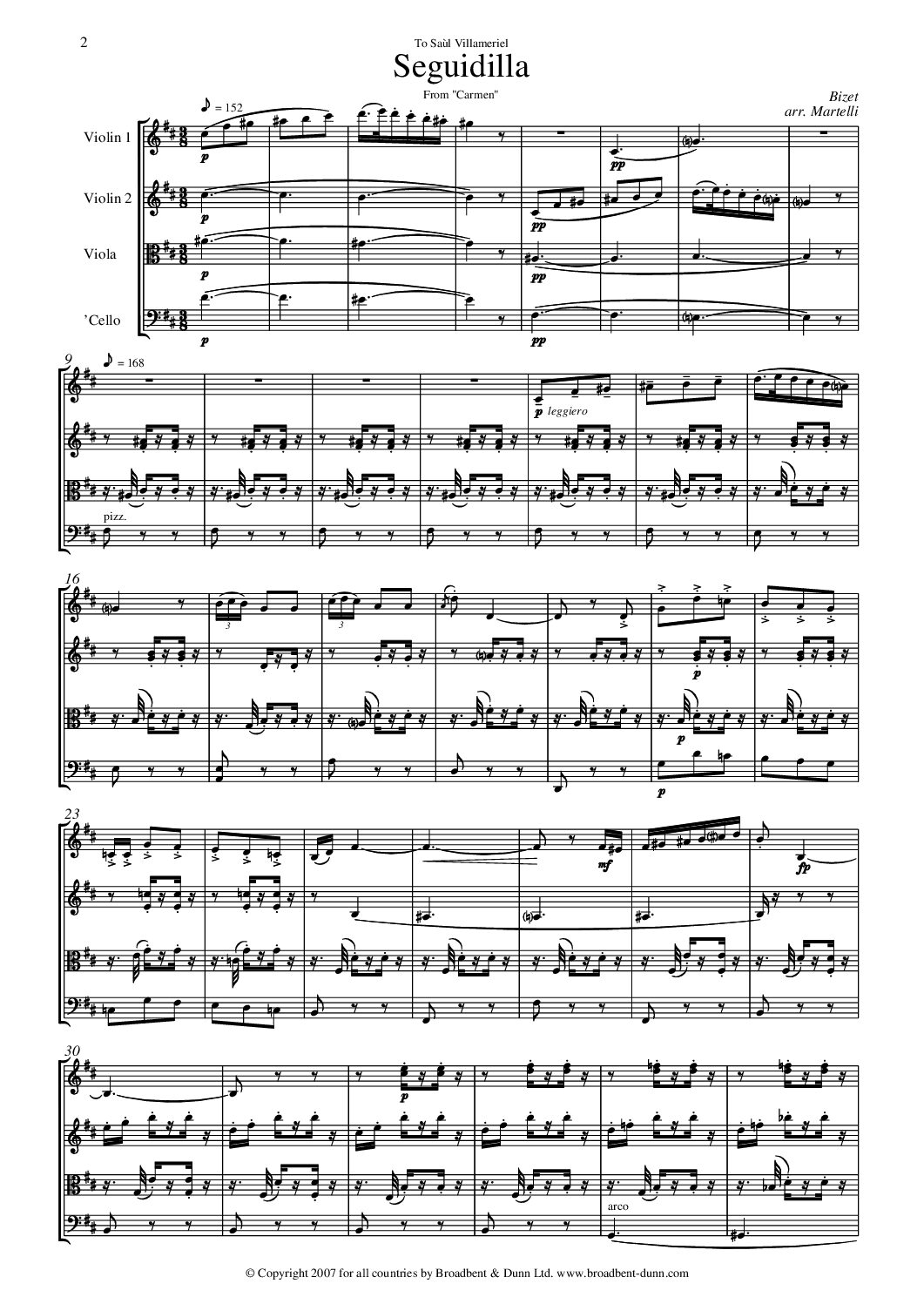
Carmen's beguiling aria from the first act of Bizet's masterpiece, in which she successfully seduces her guard Don José, is here expertly transcribed to the medium of string quartet by Carlo Martelli. For colleges, conservatories and professionals.

Bizet, Georges
Bizet arr. Martelli – Minuet from L’Arlésienne Suite No. 2 (String Quartet) – Digital Download
This minuet (or menuet), arranged by Carlo Martelli, is from the second of two concert suites in which Bizet made out the beautiful and highly picturesque L'Arlésienne music which he wrote to accompany Daudet's play.

Bizet, Georges
These are two of the eight pieces that comprise the two suites made from the incidental music that Bizet wrote to Daudet's play. Arranged by Carlo Martelli.

Bizet, Georges
Bizet arr. Martelli – Farandole from L’Arlésienne Suite No. 2 (String Quartet) – Digital Download
Two concert suites were made out of the beautiful and highly picturesque L'Arlésienne music. The Farandole, which concludes the second suite and is here arranged by Carlo Martelli, is a spirited circle dance of Provençal derivation.

Bizet, Georges
Bizet arr. Martelli – Duet from The Pearl Fishers (String Quartet) – Digital Download
Perhaps the most popular operatic duet ever penned, this arrangement by Carlo Martelli captures the nobility and rapture of the original to perfection.

Bizet, Georges
Bizet arr. Martelli – Danse Bohème from Carmen, Gypsy Dance (String Quartet) – Digital Download
This gypsy dance, which opens the second act of Bizet's famous opera Carmen, starts quietly and works up to a breathtakingly exciting climax. Arranged by Carlo Martelli.

Bizet, Georges
Bizet arr. Martelli – Carillon from L’Arlésienne Suite No. 1 (String Quartet) – Digital Download
This delightful piece concludes the first suite that Bizet made from his incidental music to Daudet's play. This music, arranged by Carlo Martelli, has a freshness, vivacity and clarity of outline, which arrives like a cool breeze in a stuffy room.

The introduction to the fourth act of Bizet's famous opera Carmen sets the scene for the public rejoicing at the bullfight in Seville, during which the fate of the two protagonists Don José and the eponymous heroine is sealed. Arranged by Carlo Martelli.

Berlioz, Hector
Berlioz arr. Martelli – Symphonie Fantastique, Movement 2 (String Quartet) – Digital Download
Berlioz's depiction of a brilliant ball scene, in which a jealous lover spots his beloved amidst the dancing throngs, is finely adapted here for the much smaller medium of the string quartet. The skill of the arranger Carlo Martelli has ensured that the piece loses none of its sparkle and glamour. For colleges, conservatories and professionals.

Beethoven, Ludwig Van
Beethoven arr. Martelli – Symphony No. 8 Movement 4 (String Quartet) – Digital Download
This final movement of Beethoven's penultimate symphony has many unique features, not the least of which is the immensely protracted coda which is longer than the whole of the movement that precedes it. Arranged by Carlo Martelli for colleges, conservatories and professionals.

Beethoven, Ludwig Van
Beethoven arr. Martelli – Symphony No. 8 Movement 3 (String Quartet) – Digital Download
This movement from the composers Little Symphony, as he called it, abandons the rumbustious style of the scherzo movements of his immediately preceding five symphonies, and is instead a graceful minuet. Arranged by Carlo Martelli. For colleges, conservatories and professionals.

Beethoven, Ludwig Van
Beethoven arr. Martelli – Symphony No. 8 Movement 2 (String Quartet) – Digital Download
This movement of Beethoven's Little Symphony, as he called it, was inspired by the ticking of the metronome which had recently been invented by a friend of the composer. Arranged by Carlo Martelli. For conservatories and professionals.

Beethoven, Ludwig Van
Beethoven arr. Martelli – Symphony No. 8 Movement 1 (String Quartet) – Digital Download
This symphony, dubbed the Little Symphony by its composer, is much more compact in its construction than almost all of Beethoven's other mature works. In spite of this the first movement of the Eighth Symphony lacks none of the vigour and dynamism of the more complexly constructed symphonies. Arranged by Carlo Martelli.

Beethoven, Ludwig Van
Beethoven arr. Martelli – Symphony No. 7 Movement 3 (String Quartet) – Digital Download
The publication of this movement, arranged by Carlo Martelli, of Beethoven's masterpiece completes the printing of the four movements of a work that Wagner described as The apotheoses of the dance. For colleges, conservatories and professionals.

Beethoven, Ludwig Van
Beethoven arr. Martelli – Symphony No. 7 Movement 2 (String Quartet) – Digital Download
Of all Beethoven's symphonic movements this can claim to be his most popular. Indeed, for many years after its first performance it was sometimes used as a substitute slow movement for the second symphony. Arranged by Carlo Martelli.

Beethoven, Ludwig Van
Beethoven arr. Martelli – Symphony No. 7 Movement 1 (String Quartet) – Digital Download
This first movement contains the longest introduction of any of Beethoven's symphonies, and like the succeeding Allegro is almost dance-like in character. Arranged by Carlo Martelli.

Beethoven, Ludwig Van
Beethoven arr. Martelli – Symphony No. 7 Finale (String Quartet) – Digital Download
Arranged by Carlo Martelli, the final movement of Beethoven's seventh symphony, once described by Wagner as the apotheosis of the dance, is one of the most rumbustious and exciting ever composed by any symphonist.

Beethoven, Ludwig Van
Beethoven arr. Martelli – Symphony No. 6 Movement 1 (String Quartet) – Digital Download
This opening movement, of perhaps Beethoven's most lyrical and contemplative symphony, lends itself particularly well to transference to the string quartet. Beethoven meant this movement to evoke the awakening of cheerful feelings on arrival in the country. This skilful arrangement by Carlo Martelli captures the mood intended just as well as the original.

Beethoven, Ludwig Van
Beethoven arr. Martelli – Symphony No. 5 Movement 1 (String Quartet) – Digital Download
As to be or not to be is the one Shakespeare quote that is universally recognised, so too is the opening of this Symphony vis a vis Beethoven. Despite the impression of overwhelming intensity given by this movement, it is one of the most perfectly balanced the composer ever wrote.

Beethoven, Ludwig Van
Beethoven arr. Martelli – Symphony No. 3 Eroica Movement 1 (String Quartet) – Digital Download
The Eroica is the first significant work of Beethoven's second period in which he enlarged the whole scale and vocabulary of music. This, the opening movement of that towering masterpiece is a triumphant paean to heroism and liberty. Arranged by Carlo Martelli.

Beethoven, Ludwig Van
Beethoven arr. Martelli – Symphony No. 2 Movement 2 (String Quartet) – Digital Download
Perhaps the most exquisitely beautiful of all Beethoven's symphonic slow movements, this is in essence a love song of the profoundest depth and purity. Arranged by Carlo Martelli.

Beethoven, Ludwig Van
Beethoven arr. Martelli – Symphony No. 1 Movement 2 (String Quartet) – Digital Download
Beethoven's nine symphonies have for nearly two hundred years formed the backbone of the orchestral repertory. This movement from the first of these symphonies, though already strongly marked with the composers personality, retains some traces of the 18th century, especially of Haydn. Arranged by Carlo Martelli.

Beethoven, Ludwig Van
Beethoven arr. Martelli – Symphony No. 1 Finale (String Quartet) – Digital Download
This gay and skittish movement from Beethoven's earliest symphony recalls Haydn in the character of its themes and their development. The arranger Carlo Martelli has omitted the opening hesitant violin passage.