

£10.95
This movement of Beethoven’s Little Symphony, as he called it, was inspired by the ticking of the metronome which had recently been invented by a friend of the composer. Arranged by Carlo Martelli. For conservatories and professionals.
Piece Description
This movement of Beethoven’s Little Symphony, as he called it, was inspired by the ticking of the metronome which had recently been invented by a friend of the composer. Arranged by Carlo Martelli. For conservatories and professionals.
Additional information
| Media | |
|---|---|
| Composer | |
| Arranger | |
| Instrumentation | |
| Difficulty | |
| Series |
Biography
Biography
Martelli, Carlo
Carlo Martelli was born on the 12th December 1935 in London to an Italian father and an English mother. By the age of eleven Carlo had developed a passion for the symphony orchestra. Just before his twelfth birthday he started taking regular violin lessons and very soon began writing elaborate orchestral scores achieving a mastery in this field by the age of sixteen, by which time he had obtained a County Scholarship to attend the Royal College of Music in London, studying composition and viola. By the time he was 21 he had written a string quartet and had already had a great deal of success with several large scale serious symphonic compositions, notably his Second Symphony, which had many performances and broadcasts by several major orchestras in the few years after its completion. In the 1960's he turned to film music to make a living, and also worked steadily as a freelance viola player. His arrangements for string quartet, trio and other combinations number well over 250 and are played by hundreds of groups all over the world.

Related products

Beethoven, Ludwig Van
Beethoven arr. Martelli – Symphony No. 8 Movement 3 (String Quartet)
This movement from the composers Little Symphony, as he called it, abandons the rumbustious style of the scherzo movements of his immediately preceding five symphonies, and is instead a graceful minuet. Arranged by Carlo Martelli. For colleges, conservatories and professionals.

Beethoven, Ludwig Van
Beethoven arr. Martelli – Moonlight Sonata, Movements 1 and 2 (String Quartet)
The first movement of this sonata is one of Beethoven's most loved pieces, with the nocturnal romantic mood it encapsulates being perfectly captured in this arrangement. The third movement has been published separately. The Pavão Quartet recorded the first movement on the CD Dreaming, released in 2008 on Discrete Recordings DISC0801 and re-released in 2010 on Discadia Records DISCA001. Included on the same CD are four more of Martelli’s Grieg, Elgar, Debussy and Dvořák arrangements also published by Broadbent & Dunn.

Beethoven, Ludwig Van
Beethoven arr. Martelli – Symphony No. 1 Movement 2 (String Quartet) – Digital Download
Beethoven's nine symphonies have for nearly two hundred years formed the backbone of the orchestral repertory. This movement from the first of these symphonies, though already strongly marked with the composers personality, retains some traces of the 18th century, especially of Haydn. Arranged by Carlo Martelli.
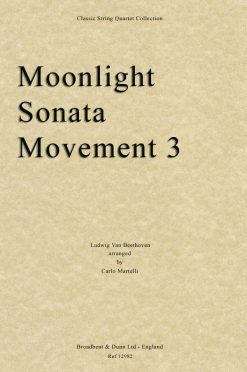
Beethoven, Ludwig Van
Beethoven arr. Martelli – Moonlight Sonata, Movement 3 (String Quartet)
Arranging symphonically orientated works for string quartet is always a daunting challenge, especially when there is a pronounced virtuosic element or a high degree of complexity in the original. In this publication Carlo Martelli has risen magnificently to the challenge as always.

Beethoven, Ludwig Van
Beethoven arr. Martelli – Pathétique Piano Sonata No. 8 Movement 1 (String Quartet)
One of the most well known movements of Beethoven's 32 piano sonatas, this splendid arrangement by Carlo Martelli is a welcome addition to Broadbent and Dunn's Classic String Quartet Collection.

Beethoven, Ludwig Van
Beethoven arr. Martelli – Symphony No. 2 Movement 2 (String Quartet)
Perhaps the most exquisitely beautiful of all Beethoven's symphonic slow movements, this is in essence a love song of the profoundest depth and purity. Arranged by Carlo Martelli.