

This evergreen suite, redolent of childhood and full of Gallic charm, has six contrasting movements arranged by Bill Thorp, ranging from the beautiful Berceuse (of Listen with Mother fame, for those old enough to remember), the feline Mi-a-ou and Kitty-Valse, the tender Le Jardin de Dolly and Tendresse, to the lively finale Le Pas Espagnol.

In a lovely arrangement by Bill Thorp, this ever popular piece forms part of a group of Edward Elgar's much-loved salon pieces, that are as fresh and exquisite as when first conceived over a century ago. The wistful Salut d'Amour nostalgically evokes the (appropriately) Edwardian golden age, and will be ever-popular because it is so beautifully written.

This piece, arranged by Bill Thorp, forms part of a group of Edward Elgar's much-loved salon pieces, that are as fresh and exquisite as when first conceived over a century ago. The elegiac Idylle (a particularly lovely arrangement) evokes the (appropriately) Edwardian golden age, and will be ever-popular because it is so beautifully written.

This piece, arranged by Bill Thorp, forms part of a group of Edward Elgar's much-loved salon pieces, that are as fresh and exquisite as when first conceived over a century ago. Chanson de Nuit evokes the (appropriately) Edwardian golden age, and will be ever-popular because it is so beautifully written.

Elgar, Edward
Elgar arr. Thorp – Chanson De Matin, Opus 15 No. 2 (String Quartet) – Digital Download
This piece, arranged by Bill Thorp, forms part of a group of Edward Elgar's much-loved salon pieces, that are as fresh and exquisite as when first conceived over a century ago. Chanson de Matin evokes the (appropriately) Edwardian golden age, and will be ever-popular because it is so beautifully written.

This piece, arranged by Bill Thorp, forms part of a group of Edward Elgar's much-loved salon pieces, that are as fresh and exquisite as when first conceived over a century ago. The more sprightly Beau Brummel nostalgically evokes the (appropriately) Edwardian golden age, and will be ever-popular because it is so beautifully written.

Elgar, Edward
The Wild Bears, here arranged by Carlo Martelli for String Quartet, is the last movement from Elgar's second Wand of Youth Suite and has become a favourite concert encore.

Elgar, Edward
At the height of his maturity as a composer, Elgar made two suites for orchestra by expanding and developing some incidental music he had composed at the age of twelve for some private theatricals. This arrangement by Carlo Martelli is the penultimate number from the second suite and is ideal for colleges.

Elgar, Edward
Elgar arr. Martelli – The Marksmen from Three Bavarian Dances (String Quartet) – Digital Download
Arranged for string quartet by Carlo Martelli, this lively piece, better known in its orchestral arrangement, is the final movement of a suite of choral songs Elgar composed while on holiday in Bavaria. For conservatories and professionals.

Elgar, Edward
The Little Bells is the second movement of Elgar's Wand of Youth Suite No. 2 - it was first performed in Worcester on the 9th September 1908 as part of the Three Choirs Festival, and was conducted by the composer. Now arranged for String Quartet by Carlo Martelli.

Elgar, Edward
Elgar arr. Martelli – Sun Dance from Wand of Youth Suite No. 1 (String Quartet) – Digital Download
Sun Dance is the fourth movement of Elgar's Wand of Youth Suite No. 1, first performed at the Queen's Hall in London in December 1907 and conducted by Henry Wood - arranged here for String Quartet by Carlo Martelli.

Elgar, Edward
Elgar arr. Martelli – Serenade from Wand of Youth Suite No. 1 (String Quartet) – Digital Download
At the height of his maturity as a composer Elgar composed two suites for orchestra by expanding and developing some incidental music he had composed at the age of twelve for some private theatricals. This arrangement by Carlo Martelli is from the first suite.

Elgar, Edward
Elgar arr. Martelli – Nimrod from Enigma Variations (String Quartet) – Digital Download
The central movement Nimrod of Elgar's most popular symphonic orchestral work, has in this arrangement by Carlo Martelli had its original key (E flat) transposed to C for the sake of the greater sonority thus attained.

Elgar, Edward
At the height of his maturity as a composer Elgar composed two suites for orchestra by expanding and developing some incidental music he had composed at the age of twelve for some private theatricals. This arrangement by Carlo Martelli is from the second suite and is ideal for colleges.

Elgar, Edward
Elgar arr. Martelli – March from Wand of Youth Suite No. 2 (String Quartet) – Digital Download
At the height of his maturity as a composer, Elgar composed two suites for orchestra by expanding and developing some incidental music he had composed at the age of twelve for some private theatricals. Suite Two was first performed in Worcester on the 9th September 1908 as part of the Three Choirs Festival, and was conducted by the composer.

Elgar, Edward
Elgar arr. Martelli – Lullaby from Three Bavarian Dances (String Quartet) – Digital Download
In the early 1890s, whilst on holiday in Bavaria, Elgar composed several pieces for chorus and keyboard for a group of musicians he met at the inn in which he was staying. He later orchestrated three of the pieces that were published as Three Bavarian Dances - this arrangement is the second movement of that suite. The Pavão Quartet recorded this arrangement on the CD Dreaming, released in 2008 on Discrete Recordings DISC0801 and re-released in 2010 on Discadia Records DISCA001. Included on the same CD are four more of Martelli’s Grieg, Beethoven, Debussy and Dvořák arrangements also published by Broadbent & Dunn.

Elgar, Edward
Elgar arr. Martelli – Bavarian Dance from Three Bavarian Dances (String Quartet) – Digital Download
This is an adaptation by Carlo Martelli for string quartet of one of six choral songs the composer wrote while holidaying in Southern Germany. The original version was for harmonium and 4 part chorus. Elgar later orchestrated three of the songs under the title Three Bavarian Dances. For colleges, conservatories and professionals.
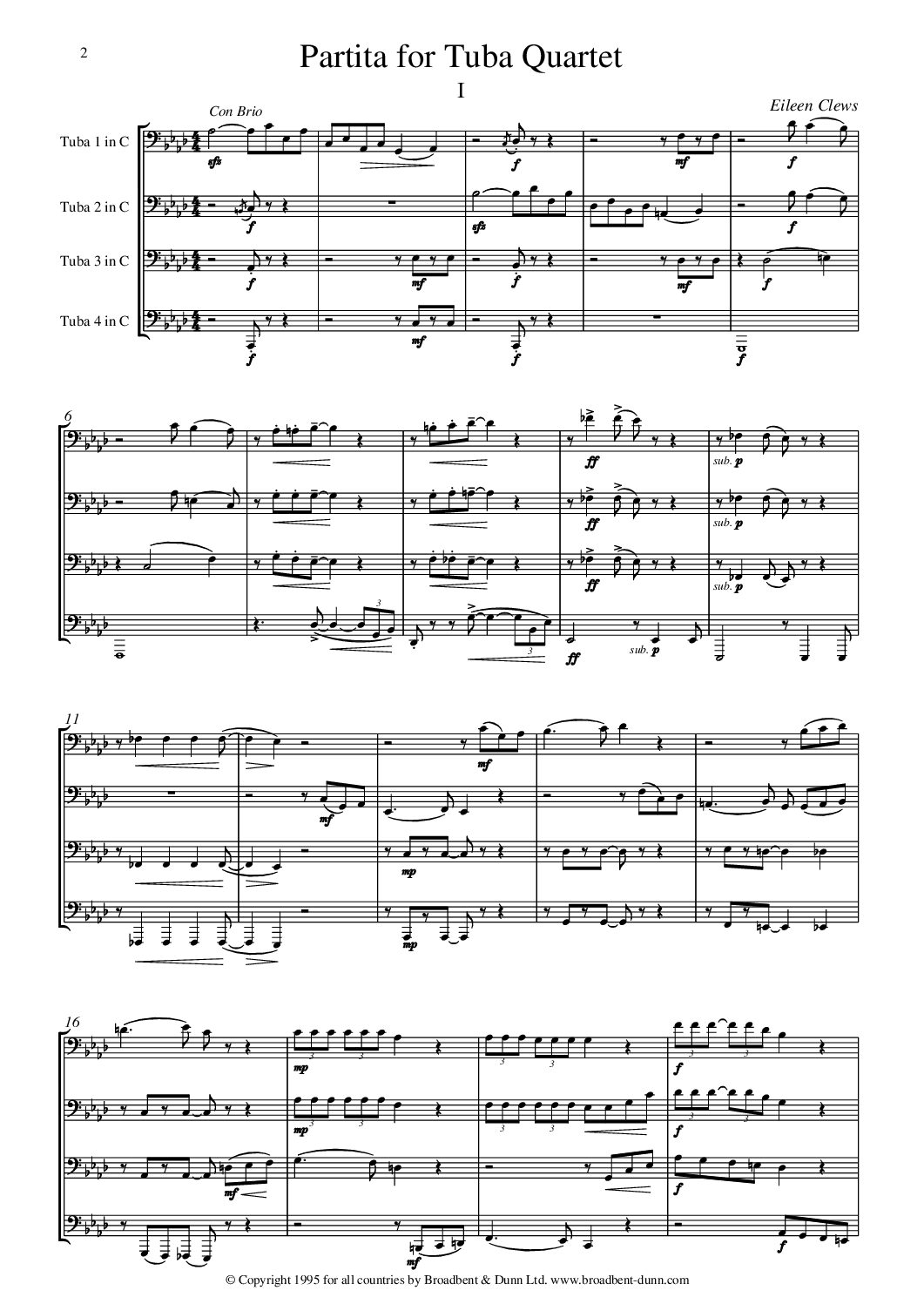
This'Partita consists of three short movements - a showy Con Brio, a more reflective Andante and a sparkling Giocoso with a strong rhythmic interest. With attractive melodic lines passed between the parts and varied syncopated rhythms it makes a good show piece for instruments that are usually only given bass lines to play. All parts are of equal difficulty, so making it an ideal piece for study and performance at a brass workshop. For more advanced players it provides good ensemble practice with varied dynamics and tempos, and is useful as a light-hearted encore.

In his Three by series Stephen Morland has compiled and edited favourite themes in an interesting and challenging way. These flute quartets, in this case Dvořák’s Humoreske Opus 101 No. 7, themes from the New World Symphony and Slavonic Dance, have been delightfully arranged in such a manner that students of varying ability can have a rewarding and enjoyable musical experience. For studios, schools, colleges, conservatories and professionals.

Dvořák, Antonín
Dvořák arr. Martelli – Slavonic Dance, Opus 46 No. 8 (String Quartet) – Digital Download
Dvořák wrote two sets of Slavonic Dances in which he expresses his great love of his homeland, a passion derived in its musical manifestation from Smetana. This very well known dance has now been arranged for string quartet by Carlo Martelli.

Dvořák, Antonín
Dvořák arr. Martelli – Slavonic Dance, Opus 46 No. 7 (String Quartet) – Digital Download
This dance, arranged by Carlo Martelli for string quartet, is one of the lesser known of the series but contains all the usual attributes of this much loved composer - clean, logical harmony and a rich homophonic melodiousness with fresh and homely emotions.

Dvořák, Antonín
Dvořák arr. Martelli – Slavonic Dance, Opus 46 No. 3 (String Quartet) – Digital Download
This is the third of Dvořák's eight Slavonic Dances originally composed for piano duet. In their orchestral versions the dances took London by storm in the late 1870's, establishing Dvořák's reputation both in England and in the rest of Europe. Now arranged for string quartet by Carlo Martelli.

Dvořák, Antonín
Dvořák arr. Martelli – Slavonic Dance, Opus 46 No. 1 (String Quartet) – Digital Download
This jaunty and melodious piece is the first of sixteen written originally for piano duet but better known in their orchestral version, and now arranged for string quartet by Carlo Martelli.

Dvořák, Antonín
Dvořák arr. Martelli – Largo from the New World Symphony (String Quartet) – Digital Download
The Pavão Quartet recorded this fine arrangement of the famous slow movement from Dvořák's final symphony on the CD Dreaming, released in 2008 on Discrete Recordings DISC0801 and re-released in 2010 on Discadia Records DISCA001. Included on the same CD are four more of Carlo Martelli’s Grieg, Elgar, Beethoven and Debussy arrangements also published by Broadbent & Dunn.

Dvořák, Antonín
Dvořák arr. Martelli – Humoresque, Opus 101 No. 7 (String Quartet) – Digital Download
This charming piece, originally composed for pianoforte but much better known in its violin and piano version, is here expertly transcribed for the medium of the string quartet by Carlo Martelli.
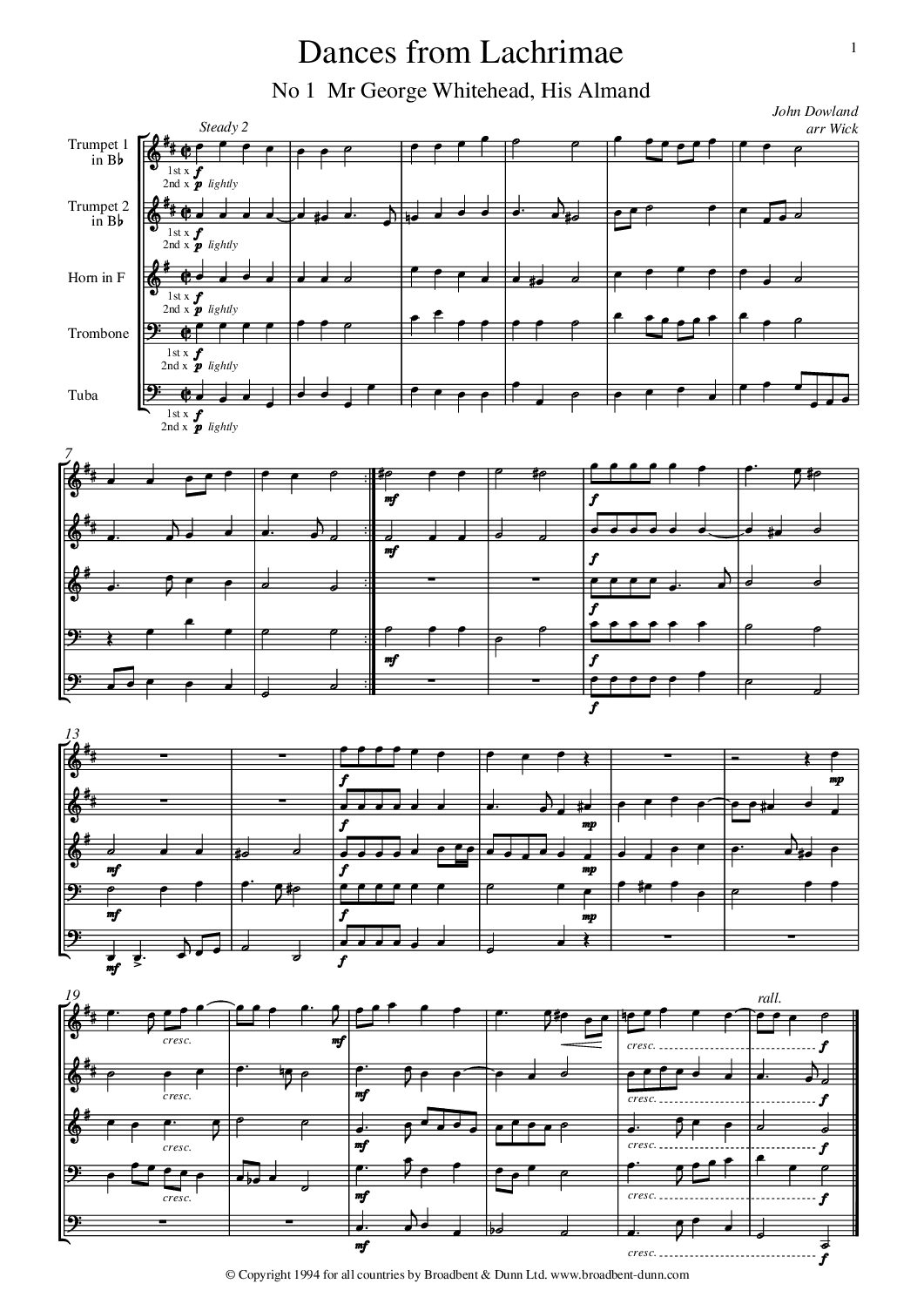
Dowland was the most famous composer of his day - he had an international reputation and was famous for the beauty of his songs. The dance numbers here show a complexity way beyond the normal brass consort music of his time. The gentle Semper Dowland, Semper Dolens is one of the most beautiful pieces of the 16th (or indeed any) Century. Arranged by Stephen Wick and suitable for students and professionals.

This viola solo in five movements was commissioned by Christel Baillie for a recital in Hamburg in 2004. Although difficult, it has been particularly taken on as an audition piece or for final recitals at Conservatoires in the UK. It has become customary to select movements as each can function as a piece in its own right. The style is tonal with a harmonic twist and in total is about 12 minutes long.

This piece by Dominic Sewell was written for a memorial service and hence has a rather wistful quality to it. It has been performed many times at Junior Department Conservatoires, other memorial services and in concerts and recitals throughout the UK. It is tonal and melodious and so has a wide appeal.

A solid, serious work for aspiring string quartets or established groups, this piece was the subject of a master class from the Wihan Quartet from the Czech Republic. The quartet, inspired by Janáček's Intimate Letters quartet, was similarly inspired by letters from a woman to her lover. It is scored in three contrasting movements consisting of a gestural first movement, a slow arch form second movement and a fiery syncopated 5/4 finale.