
Flute & Piano
A delightful recital piece by English composer Martin Yates, whose eclectic style is fast earning him popularity. For studios, colleges, conservatories and professionals.

An lovely original work, perfect for recitals.
Flute & Piano
An lovely original work, perfect for recitals.

A substantial challenging work set in three movements. The first movement with its energetic opening is a rhapsody, a fantasy representing everyones Fire Island. The Adagio is there to remind us of the people who are no longer on the island - those who died and those who just don't return. The second subject is like the whispering of the kind of questions that permeate every close knit community. The excesses of life explode throughout the exuberant final, and Fire Island ends in optimism and triumph.
Flute & Piano
A substantial challenging work set in three movements. The first movement with its energetic opening is a rhapsody, a fantasy representing everyones Fire Island. The Adagio is there to remind us of the people who are no longer on the island - those who died and those who just don't return. The second subject is like the whispering of the kind of questions that permeate every close knit community. The excesses of life explode throughout the exuberant final, and Fire Island ends in optimism and triumph.

Flute, 'Cello & Piano
Martin Yates – Café Music (Flute, ‘Cello & Piano) – Digital Download
The first movement First Waltz is a delicate waltz, very English in spirit. The Lopsided Polka is just that (imagine three old ladies playing in the Pump Room in Bath, with none of them able to agree on the time signatures or the rhythms in this polka. Valse d'Amour is a beautiful melody played on the 'cello, whose intention it is to remind the listener of the love theme from a turn of the century operetta, and Midsummer Waltz is a happy forward looking dance, simple and straightforward with a charm all of its own. For colleges, conservatories and professionals.

Thinking of nostalgic memories of bygone days Memories pictures someone sitting on a public bench looking out to sea. Concert Waltz represents returning from a music concert to go on to happy partying and dancing, while Haunted Dreams pictures a sleeping adult haunted by memories of the past.
Flute & Piano
Thinking of nostalgic memories of bygone days Memories pictures someone sitting on a public bench looking out to sea. Concert Waltz represents returning from a music concert to go on to happy partying and dancing, while Haunted Dreams pictures a sleeping adult haunted by memories of the past.

The suggestion in Awakening Day is that with all the buds of May shooting up we must also wake up and go forward like nature. Intensity represents strong feelings in life and the need for will power to accomplish what you really want to. Paris Walk starts with an early morning walk, stark and slightly eerie, going towards the Seine with the Notre Dame glaring out in the early morning mist, before walking back past the Opera House - the walk continues, eventually coming to Montmartre, and then in the animato section climbs the steps to Sacre Coeur to see the expanse of Paris and the Eiffel Tower in the distance.
Flute & Piano
The suggestion in Awakening Day is that with all the buds of May shooting up we must also wake up and go forward like nature. Intensity represents strong feelings in life and the need for will power to accomplish what you really want to. Paris Walk starts with an early morning walk, stark and slightly eerie, going towards the Seine with the Notre Dame glaring out in the early morning mist, before walking back past the Opera House - the walk continues, eventually coming to Montmartre, and then in the animato section climbs the steps to Sacre Coeur to see the expanse of Paris and the Eiffel Tower in the distance.

Starting with deep thoughts of life itself, Reflections is followed by a lighter middle section of getting on with life. Song of Spring begins with rays of sunshine and the grass turning from brown to green - by the main theme we are into spring and enjoying it. Neapolitan Thoughts represents thinking of Italy and a visit to Naples and the famous Bay.
Flute & Piano
Starting with deep thoughts of life itself, Reflections is followed by a lighter middle section of getting on with life. Song of Spring begins with rays of sunshine and the grass turning from brown to green - by the main theme we are into spring and enjoying it. Neapolitan Thoughts represents thinking of Italy and a visit to Naples and the famous Bay.

Starting with a lively opening theme the Bagatelle leads into an appassionato type melody before going back to a faster pace - a reminder perhaps of a short happy holiday? Dawn awakens in Dawn Chorus leading to the main melody as the day progresses, with a second theme representing the sun arriving in the early hours of morning. Ganger is a walking type dance of a German nature reminiscent of pre war Berlin.
Flute & Piano
Starting with a lively opening theme the Bagatelle leads into an appassionato type melody before going back to a faster pace - a reminder perhaps of a short happy holiday? Dawn awakens in Dawn Chorus leading to the main melody as the day progresses, with a second theme representing the sun arriving in the early hours of morning. Ganger is a walking type dance of a German nature reminiscent of pre war Berlin.

Describing a person's feelings towards his or her partner Melody of Love shows continuing affection in a couple of variations. Impressions reflects moods, sadness and nostalgic thoughts, leading to a short melody of joy before returning to impressions of life, and Air is a serene hymn like melody with a feeling of peace.
Flute & Piano
Describing a person's feelings towards his or her partner Melody of Love shows continuing affection in a couple of variations. Impressions reflects moods, sadness and nostalgic thoughts, leading to a short melody of joy before returning to impressions of life, and Air is a serene hymn like melody with a feeling of peace.

Starting peacefully and calmly Valse Semplice is followed by a variation of mood swings and melodies before returning to the valse. The Gipsy Rondo represents an atmospheric Hungarian scene, and When Autumn Comes starts with a nostalgic main melody describing autumn having arrived, before chasing through the falling leaves.
Flute & Piano
Starting peacefully and calmly Valse Semplice is followed by a variation of mood swings and melodies before returning to the valse. The Gipsy Rondo represents an atmospheric Hungarian scene, and When Autumn Comes starts with a nostalgic main melody describing autumn having arrived, before chasing through the falling leaves.

These lyrical pieces are essentially nostalgic, although never sad. They appeal to all audiences.

As a change from show-off bravura items this piece simply asks to be loved, and will return that feeling. Written in a very approachable style, it is well mannered enough to be taken anywhere. For colleges, conservatories and professionals.
Flute & Piano
As a change from show-off bravura items this piece simply asks to be loved, and will return that feeling. Written in a very approachable style, it is well mannered enough to be taken anywhere. For colleges, conservatories and professionals.

Sonata for Flute and Piano, Opus 17 is written in a late Romantic style. The first movement is constructed essentially in traditional sonata-allegro form, with an extensive coda augmenting the new material heard in the development. The passionate second movement opens with a lyrical theme that culminates into a free cadenza at the end. The third movement is written in theme and variation form. Of importance, the fifth variation is written as a four-part fugue and the final variation culminates by joining the theme of the third movement with that of the first. This work not only adds to the existing repertoire of intermediate-advanced flute music, but also teaches young people about traditional classical forms such as the rondo, theme and variations and the fugue. For the history of the composition please see Jim Kelsey's biography. Suitable for teaching studios, secondary schools, colleges and conservatories.
Flute & Piano
Sonata for Flute and Piano, Opus 17 is written in a late Romantic style. The first movement is constructed essentially in traditional sonata-allegro form, with an extensive coda augmenting the new material heard in the development. The passionate second movement opens with a lyrical theme that culminates into a free cadenza at the end. The third movement is written in theme and variation form. Of importance, the fifth variation is written as a four-part fugue and the final variation culminates by joining the theme of the third movement with that of the first. This work not only adds to the existing repertoire of intermediate-advanced flute music, but also teaches young people about traditional classical forms such as the rondo, theme and variations and the fugue. For the history of the composition please see Jim Kelsey's biography. Suitable for teaching studios, secondary schools, colleges and conservatories.
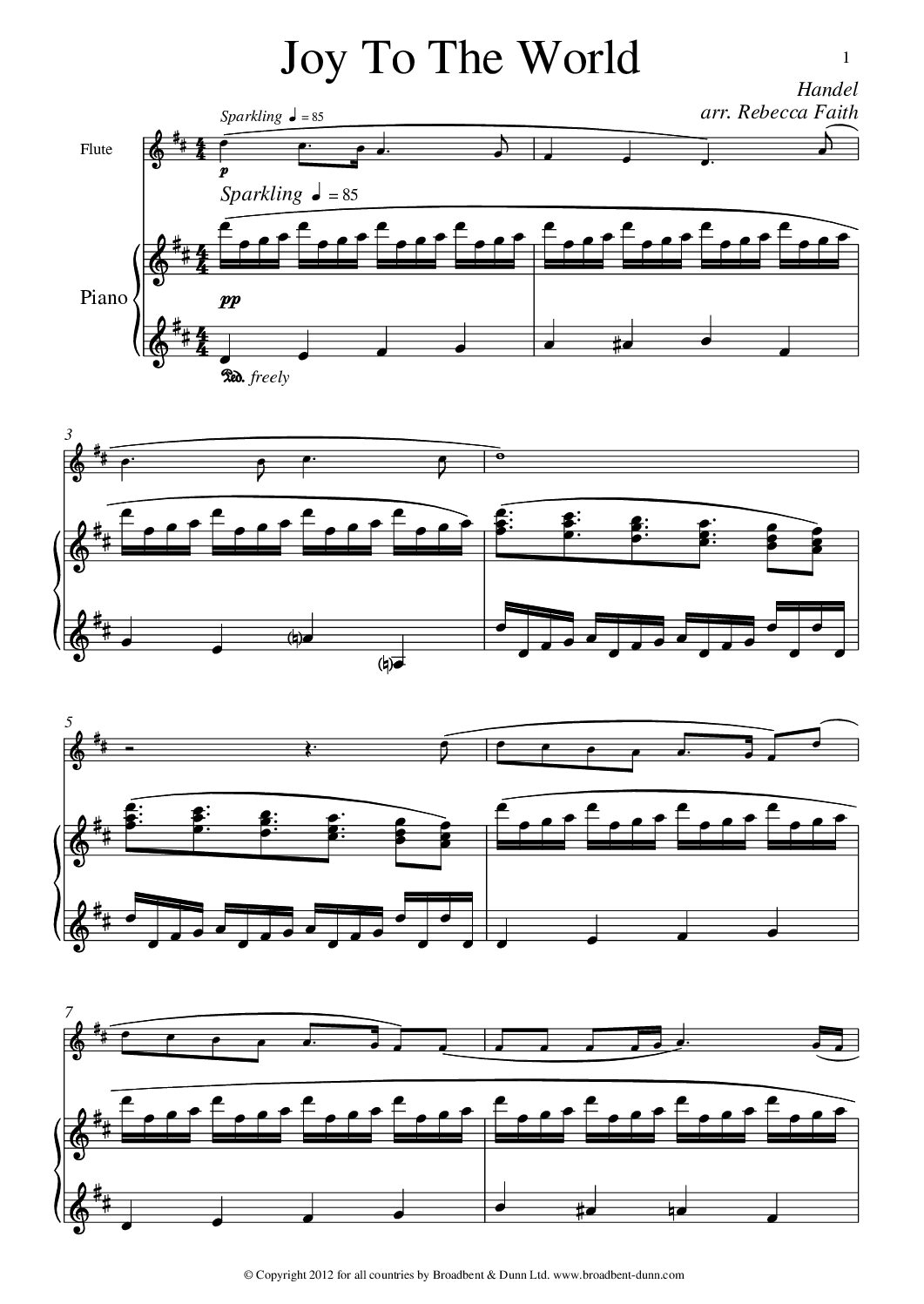
A lively interpretation by Rebecca Faith, the Joy to the World melody is heard layered with original melodies and motifs. An interesting rhythmic idea binds the piece together making it sparkle and dance, with the underlying semiquaver movement creating an exciting shimmer effect. The constant shifting of key, texture and melodic ideas makes this an arrangement that will keep both the performer and listener on their toes.
Flute & Piano
A lively interpretation by Rebecca Faith, the Joy to the World melody is heard layered with original melodies and motifs. An interesting rhythmic idea binds the piece together making it sparkle and dance, with the underlying semiquaver movement creating an exciting shimmer effect. The constant shifting of key, texture and melodic ideas makes this an arrangement that will keep both the performer and listener on their toes.
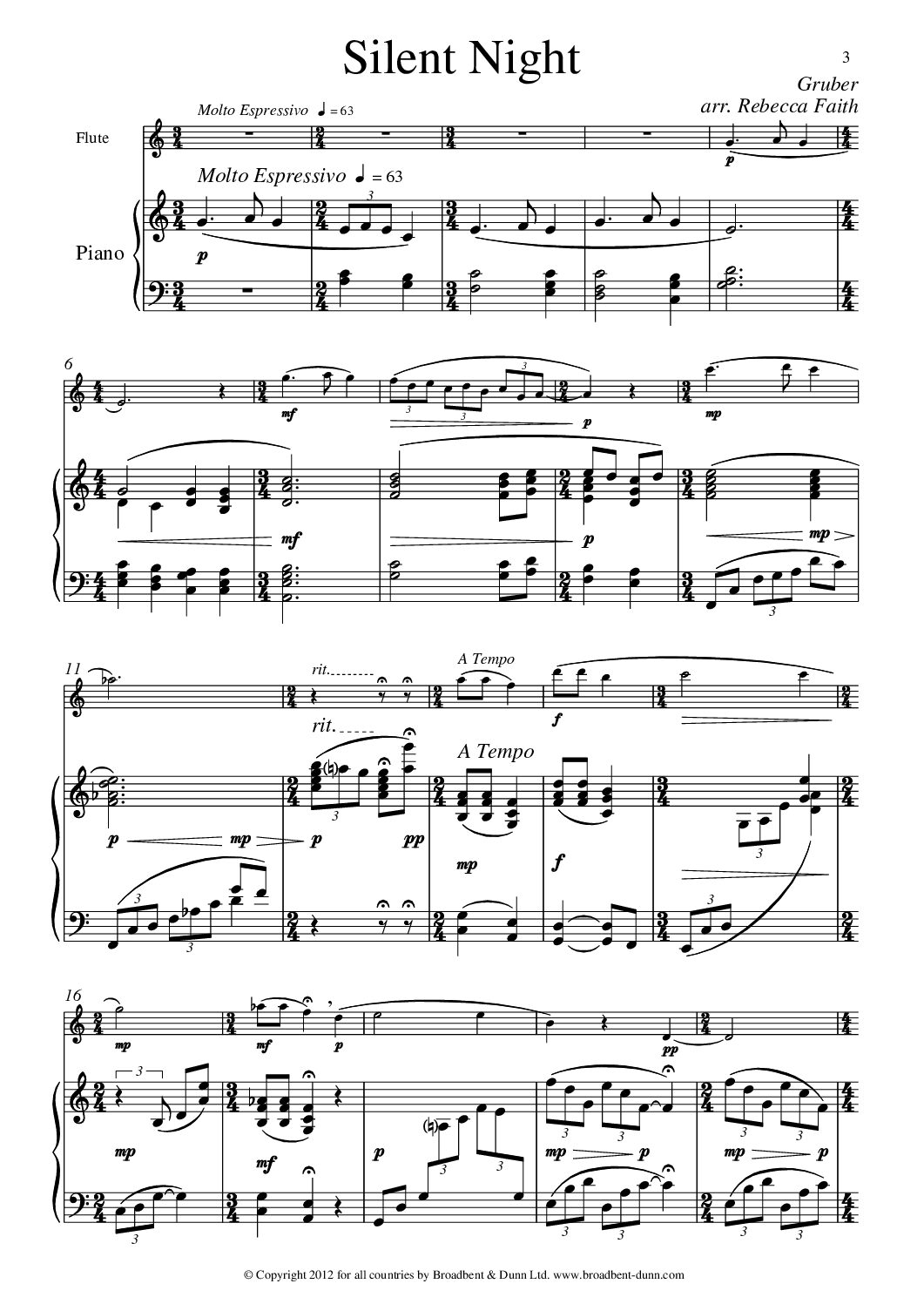
This arrangement by Rebecca Faith is not what is usually expected when labelled with the familiar title Silent Night. This piece of music is more of a variation of themes, the familiar melodies remaining recognisable but treated as small pockets of atmospheric motifs rather than one long lyrical melody. The style and harmonies have a more experimental magical feel whilst remaining easy on the ear, and are created to capture the attention and imagination of the listener.
Flute & Piano
This arrangement by Rebecca Faith is not what is usually expected when labelled with the familiar title Silent Night. This piece of music is more of a variation of themes, the familiar melodies remaining recognisable but treated as small pockets of atmospheric motifs rather than one long lyrical melody. The style and harmonies have a more experimental magical feel whilst remaining easy on the ear, and are created to capture the attention and imagination of the listener.
Flute & Piano
Albéniz arr. Parry – Granada from Suite Española No. 1, Opus 47 (Flute & Piano) – Digital Download
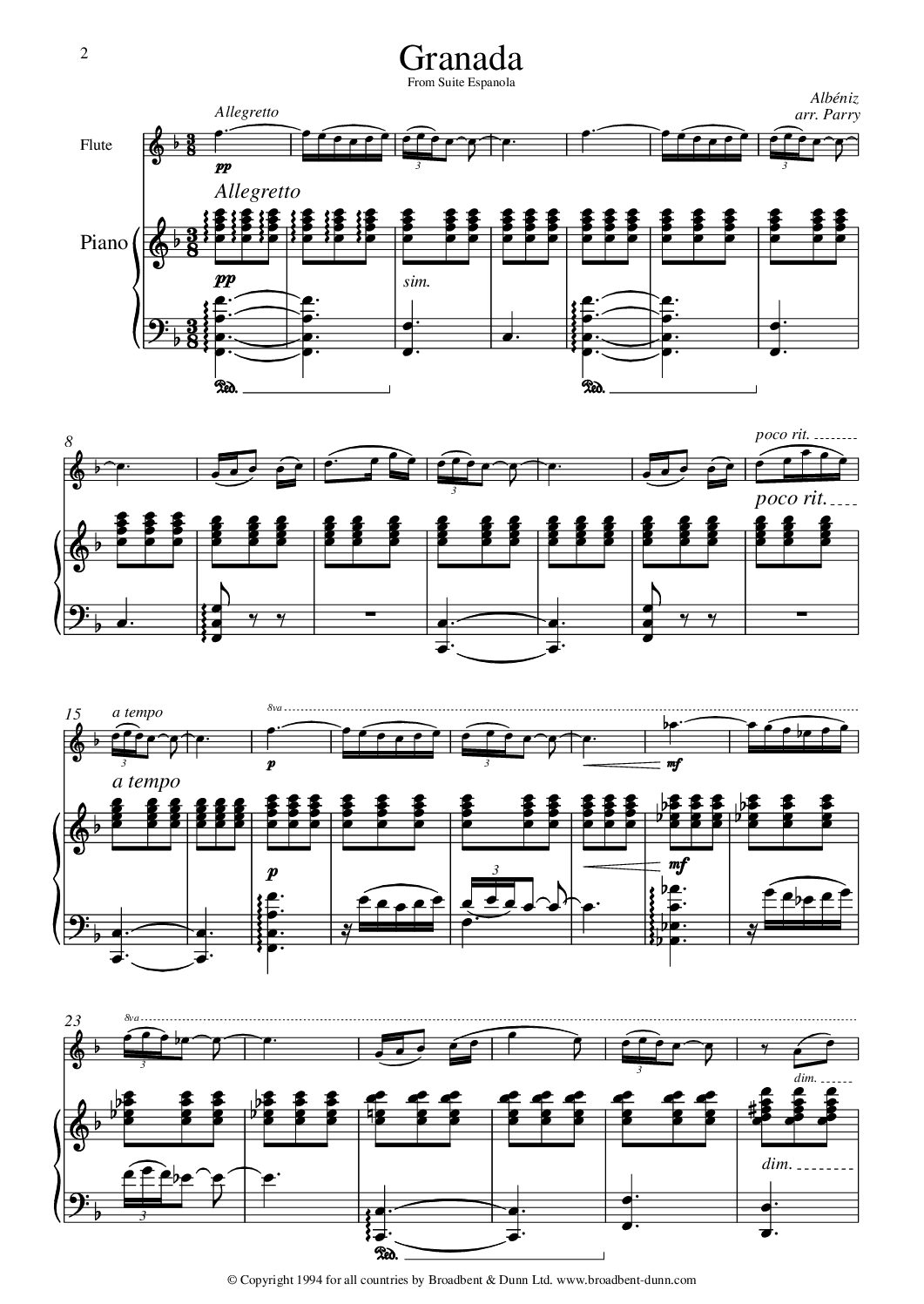
An arrangement by Martin Parry of one of Albéniz's most haunting and evocative pieces.
An arrangement by Martin Parry of one of Albéniz's most haunting and evocative pieces.
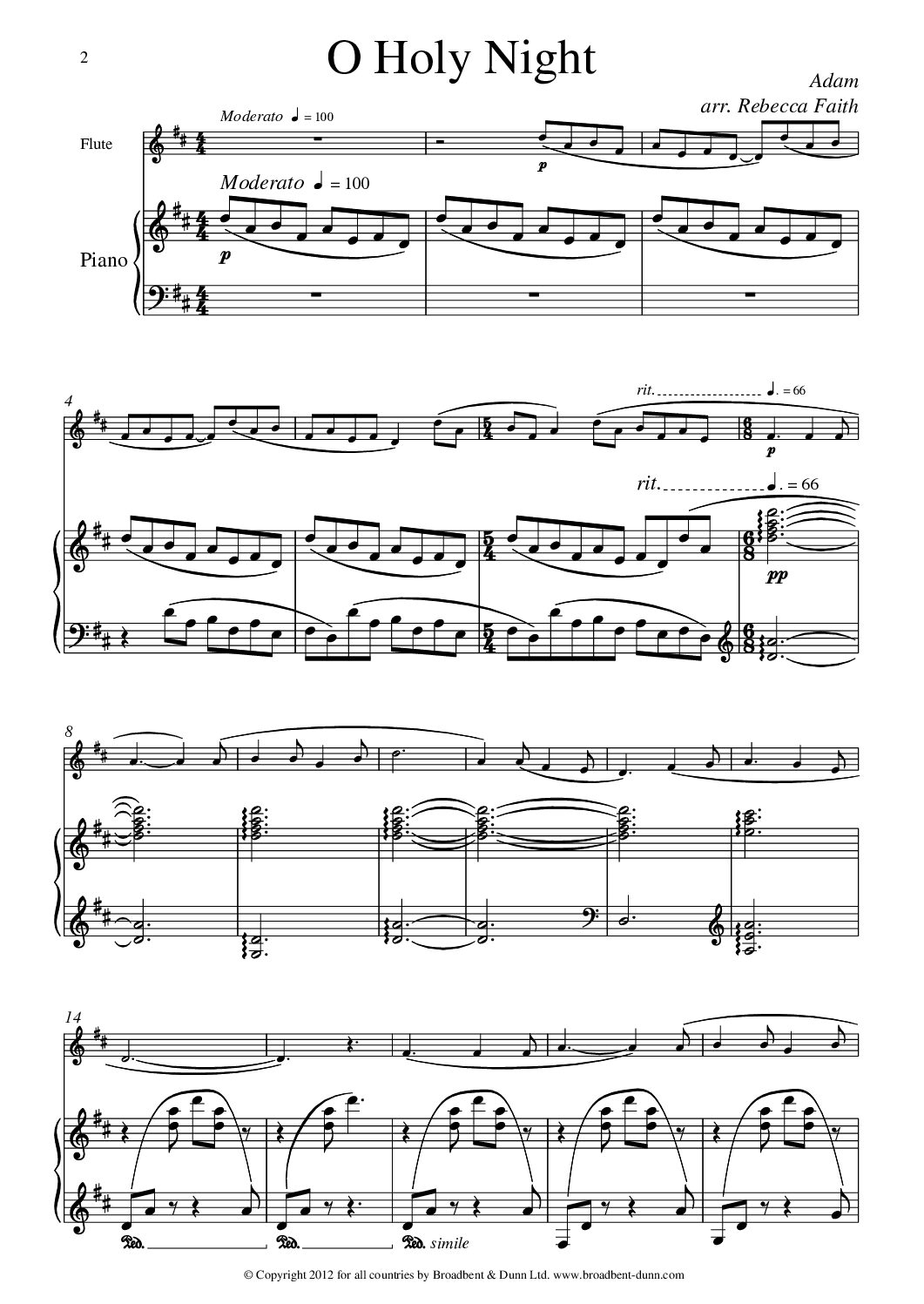
Following a bell-like introduction, the O Holy Night melody is heard in different colours, first on the flutes mid register, then in the piano bass, back to the flute and its higher register and then in a more chordal manner from the piano's treble. This arrangement by Rebecca Faith has a definite gradual growth in richness and emotion, climaxing at the key change where the flute is heard playing a very passion filled counter melody.