


£8.95
Most string quartets are long, but this short little piece in one movement was intended as an encore item, but could also fit comfortably into any portfolio for weddings or other functions. For schools, colleges, conservatories and professionals.
Piece Description
Most string quartets are long, but this short little piece in one movement was intended as an encore item, but could also fit comfortably into any portfolio for weddings or other functions. For schools, colleges, conservatories and professionals.
Additional information
| Media | |
|---|---|
| Composer | |
| Instrumentation | |
| Difficulty | |
| Series |
Biography
Biography
Marson, John
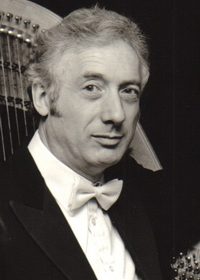
John Marson was born in 1932 and died in 2007. He studied the harp with Marie Goossens at the Royal College of Music in London, and in 1958, while still a student, began his professional career with the Carl Rosa Opera Company. A week after leaving college he joined the London Symphony Orchestra for two years before embarking on two decades of freelance work, during which he played solos, chamber music and concerti, worked with all the London orchestras and spent much time in recording studios. He played in many outstanding feature films including the original 'Star Wars'. In 1982 he was appointed principal harp of the BBC Symphony Orchestra, and subsequently resumed his freelance career while increasingly engaging in composition, both for the harp and for other instruments and voice. He played for many West End and National Theatre productions including over three years as harpist in Lloyd Webber's 'Aspects of Love'.
The roll call of artists with whom John has worked include the Beatles, Richard Rodney Bennett, Leonard Bernstein, Pierre Boulez, Benjamin Britten, Charlie Chaplin, Bing Crosby, John Dankworth, Duke Ellington, Benny Goodman, Liberace, Martha Graham, Hans Werner Henze, Herbert von Karajan, Otto Klemperer, Zoltan Kodaly, Lorin Maazel, Neville Marriner, Pierre Monteux, Jessye Norman, Laurence Olivier, Luciano Pavarotti, Gennadi Rozhdestvenski, Frank Sinatra, George Solti, Leopold Stokowski, Igor Stravinsky, George Szell, William Walton, John Williams, Stevie Wonder and countless others.
In 1964 John was one of the two founders of the United Kingdom Harp Association, edited its magazines for many years and became President of the Association in January 2005. His book 'The Complete Guide to Harp Glissandi', is published by Lyra Music of New York, while his other major work 'The Book of the Harp - techniques, history and lore of a unique musical instrument', was published by Kevin Mayhew Ltd. in 2005.
Related products
String Quartet
Written above all to be enjoyed by the players, audiences have shown that they too share that same delight. Both of Mason's string quartets are in four movements which exploit the instruments on equal terms, and both are in a musical language that enables the strings to sing as they should. These two quartets will happily share any programme with music from Haydn to Debussy and beyond.
String Quartet
This is the composer's first acknowledged work and was written when he was only 17 years of age and a first year student at the Royal College of Music. The Pavão Quartet recorded this work in August 2012 on the CD Carlo Martelli, released in October 2013 by Discadia Records, DISCA 002. Included on the same CD, and also published by Broadbent & Dunn, are Martelli's String Quartet No. 2, Prelude and Fugue for String Sextet and Terzetto for Two Violins and Viola.
String Quartet
Three Snippets for String Quartet is a short entertaining work and concert stocking-filler - lasting only 6½ minutes. Originally written for saxophone quartet, the three movements are: Flourish, a march-like fanfare with a suggestion of toy soldiers, a deeply-felt Love Song as an unexpectedly emotional core, and Dislocated Rag to finish with a smile - ragtime with recurring 7/8 bars thrown in to trip up the dancers! Dislocated Rag is based on the composer's music for the 1984 mystery film The Case of Marcel Duchamp about the famous French Dadaist artist.

'Frisco by those in the know is a jewel of a city. The titles of the four movements tell it all - Keeping Ahead of yourself is what you have to do in a city with a glorious past but an uncertain and uneasy present. Light Reflecting from the Bridge seems to warm the whole city, bathing it in a gently reddish hue. Alongside the pathway in one of the city parks is a sand track for horses, and every now and then you see Footprints in the Sand, some are in couples, others alone. The thoughts of those people who are alone touches you, but it is the Time to Be Certain and you regain your beliefs and confidence.
String Quartet
A contemporary work in one movement that was begun in 1939 when the composer was in his fourth and last year at the Royal College of Music. It was completed in New York, receiving its first performance on the 21st April 1940 by the Galimir Quartet in a series of concerts promoted by the New York Public Library.

This quartet evokes the sounds and attitudes of The Big Apple