

The result of a commission by the Rugby Sinfonia in 1984, Allegro Risotto is an ambitious one movement work that contrasts lively, energetic sections (containing exciting rhythms and occasional unequal bar lengths) with calmer, more lyrical passages.

String Orchestra
Richard Peirson – Allegro Risotto for String Orchestra – Full Score Digital Download
The result of a commission by the Rugby Sinfonia in 1984, Allegro Risotto is an ambitious one movement work that contrasts lively, energetic sections (containing exciting rhythms and occasional unequal bar lengths) with calmer, more lyrical passages.

String Orchestra
Richard Peirson – Allegro Risotto for String Orchestra – Double Bass Digital Download
The result of a commission by the Rugby Sinfonia in 1984, Allegro Risotto is an ambitious one movement work that contrasts lively, energetic sections (containing exciting rhythms and occasional unequal bar lengths) with calmer, more lyrical passages.

The result of a commission by the Rugby Sinfonia in 1984, Allegro Risotto is an ambitious one movement work that contrasts lively, energetic sections (containing exciting rhythms and occasional unequal bar lengths) with calmer, more lyrical passages.

String Orchestra
Richard Peirson – Allegro Risotto for String Orchestra – 2nd Violins Digital Download
The result of a commission by the Rugby Sinfonia in 1984, Allegro Risotto is an ambitious one movement work that contrasts lively, energetic sections (containing exciting rhythms and occasional unequal bar lengths) with calmer, more lyrical passages.
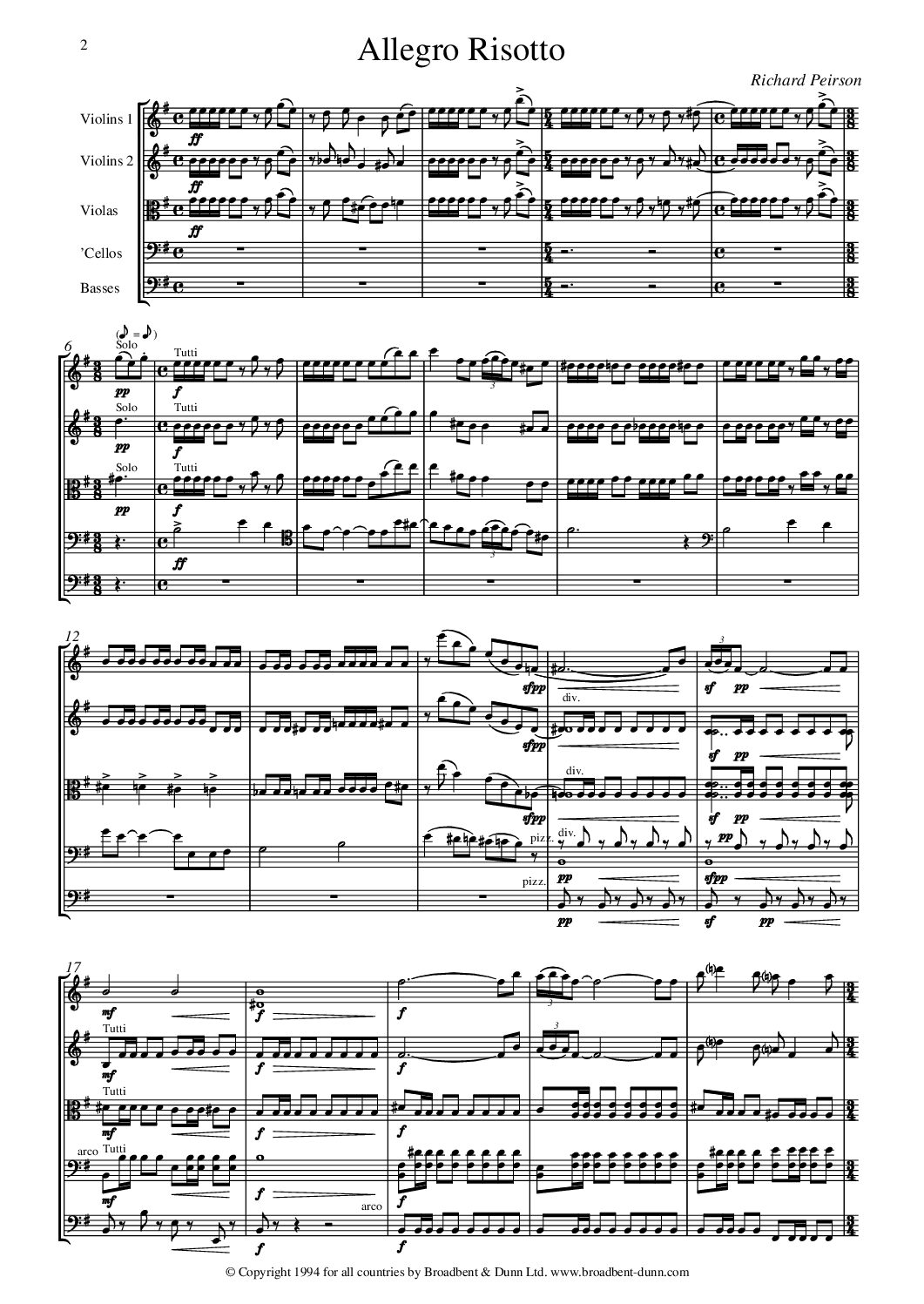
String Orchestra
Richard Peirson – Allegro Risotto for String Orchestra – 1st Violins Digital Download
The result of a commission by the Rugby Sinfonia in 1984, Allegro Risotto is an ambitious one movement work that contrasts lively, energetic sections (containing exciting rhythms and occasional unequal bar lengths) with calmer, more lyrical passages.

The result of a commission by the Rugby Sinfonia in 1984, this string quartet version of Allegro Risotto is an ambitious one movement work that contrasts lively, energetic sections (containing exciting rhythms and occasional unequal bar lengths) with calmer, more lyrical passages.
String Quartet
The result of a commission by the Rugby Sinfonia in 1984, this string quartet version of Allegro Risotto is an ambitious one movement work that contrasts lively, energetic sections (containing exciting rhythms and occasional unequal bar lengths) with calmer, more lyrical passages.

As the title suggests 'Jazz Sonata' combines features of both classical and jazz music. The first movement is 'Swing', the second movement bluesy and the third movement Latin - but all are set in more conventional classical forms, respectively Sonata form, Ternary and Rondo.
Trumpet & Piano
As the title suggests 'Jazz Sonata' combines features of both classical and jazz music. The first movement is 'Swing', the second movement bluesy and the third movement Latin - but all are set in more conventional classical forms, respectively Sonata form, Ternary and Rondo.

A contemporary work in one movement that was begun in 1939 when the composer was in his fourth and last year at the Royal College of Music. It was completed in New York, receiving its first performance on the 21st April 1940 by the Galimir Quartet in a series of concerts promoted by the New York Public Library.
String Quartet
A contemporary work in one movement that was begun in 1939 when the composer was in his fourth and last year at the Royal College of Music. It was completed in New York, receiving its first performance on the 21st April 1940 by the Galimir Quartet in a series of concerts promoted by the New York Public Library.
Ravel, Maurice
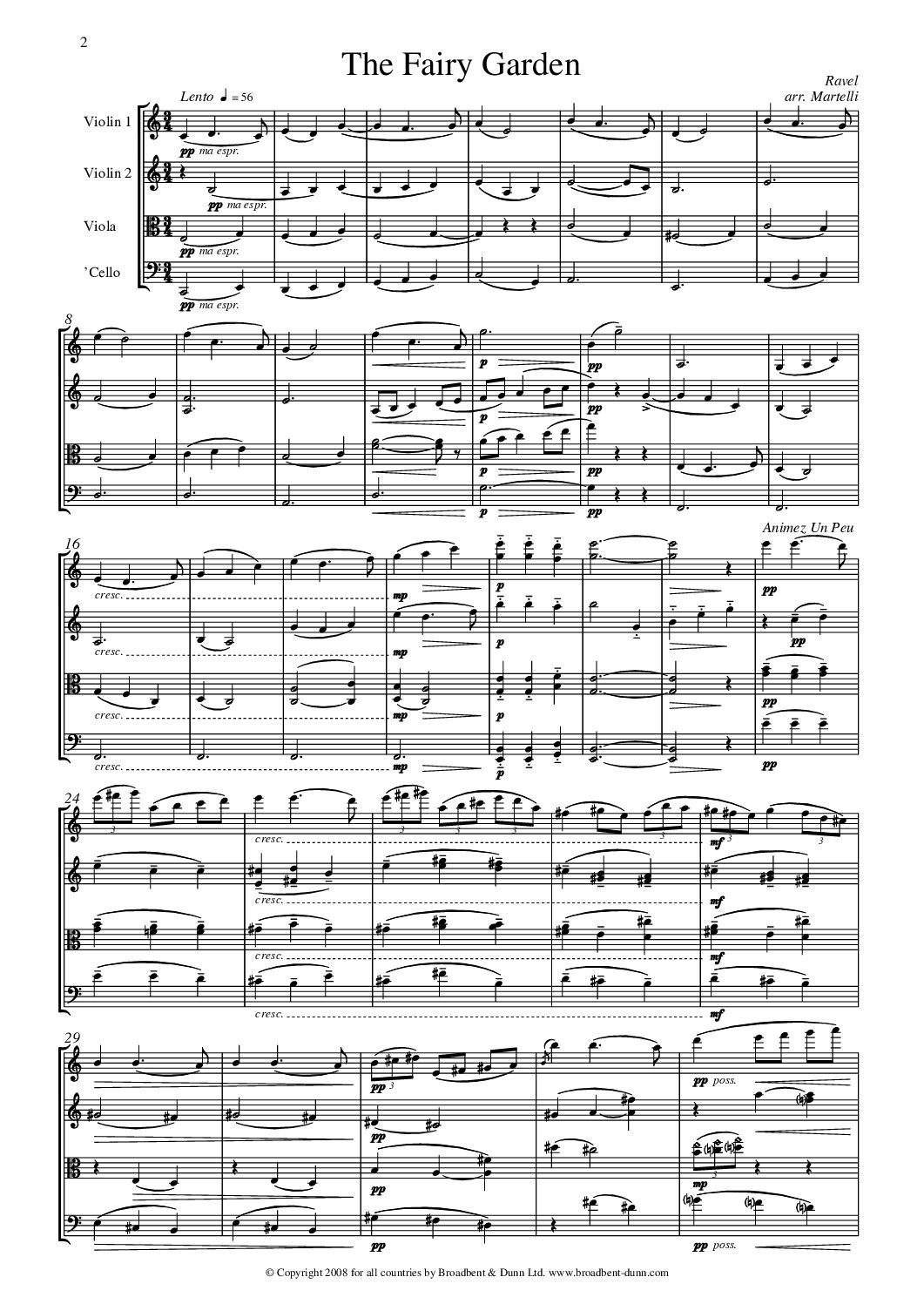
Ravel arr. Martelli – The Fairy Garden from Mother Goose (String Quartet) – Digital Download
The Fairy Garden (also known as The Enchanted Garden) is the concluding movement of a suite originally published as a piano duet, but which became better known in the composer's orchestral version. Arranged here for string quartet by Carlo Martelli and ideal for colleges, conservatories and professionals.
The Fairy Garden (also known as The Enchanted Garden) is the concluding movement of a suite originally published as a piano duet, but which became better known in the composer's orchestral version. Arranged here for string quartet by Carlo Martelli and ideal for colleges, conservatories and professionals.

Ravel, Maurice
Ravel arr. Martelli – Rigaudon from Le Tombeau de Couperin (String Quartet) – Digital Download
The Rigaudon is a lively jumping quickstep for couples that was fashionable in 18th century France. This arrangement by Carlo Martelli is one of six movements of a suite composed for piano by Ravel in free imitation of the style of Couperin. Ideal for colleges, conservatories and professionals.
The Rigaudon is a lively jumping quickstep for couples that was fashionable in 18th century France. This arrangement by Carlo Martelli is one of six movements of a suite composed for piano by Ravel in free imitation of the style of Couperin. Ideal for colleges, conservatories and professionals.

Ravel, Maurice
Ravel arr. Martelli – Pavane pour une Infante Défunte (String Quartet) – Digital Download
This gravely beautiful piece is one of the composers most popular works, although Ravel himself was said to be not too enamoured of it. This fine arrangement by Carlo Martelli perhaps would have convinced him it is a better composition than he would admit to. For colleges, conservatories and professionals.
This gravely beautiful piece is one of the composers most popular works, although Ravel himself was said to be not too enamoured of it. This fine arrangement by Carlo Martelli perhaps would have convinced him it is a better composition than he would admit to. For colleges, conservatories and professionals.

Rachmaninoff, Sergei
The lovely tune of this variation, the most well known of the 24, is achieved by inverting and doubling in time the original Paganini idea, and is here skilfully arranged for String Quartet by Carlo Martelli.
Rachmaninoff, Sergei
Rachmaninoff arr. Martelli – Variation 18 from Rhapsody on a Theme of Paganini (String Quartet)
The lovely tune of this variation, the most well known of the 24, is achieved by inverting and doubling in time the original Paganini idea, and is here skilfully arranged for String Quartet by Carlo Martelli.

Traditional Etudes with a melodic flavour to suit performance. The Etudes practice speed, agility, expression and solo work, and are bright, rhythmic and full of expression. Etude No. 1 is a solo for grade 8 and above that practices fingering, note jumps, dynamics, breathing control, concentration and stamina - it is a wonderfully melodic exercise that when played well, and at the correct speed, will go down a treat in any concert. Etude No. 2 is an exercise practicing triplets whilst changing from staccato to slurred notation - this exercise as written will be useful to most students from around grade 3, and can be played in the higher octave from around grade 6. Etude No. 3 is a fast solo practicing note jumps, speed and playing in the highest octave - the exercise uses top C on several occasions and is suitable for grade 8 and above. As the piece is also melodic, it makes an excellent concert piece when played well at the correct speed with dynamics and expression. Etude No. 4 gives practice in playing in 6/8 with note jumps and triple tonguing, and would suit players around grade 6 standard. Etude No. 5 is a solo practicing longer passages and arpeggios, reaching top C and suitable for grade 8 and above. The higher passages can be easily played in the lower octave to give lower grade students fingering practice.
Traditional Etudes with a melodic flavour to suit performance. The Etudes practice speed, agility, expression and solo work, and are bright, rhythmic and full of expression. Etude No. 1 is a solo for grade 8 and above that practices fingering, note jumps, dynamics, breathing control, concentration and stamina - it is a wonderfully melodic exercise that when played well, and at the correct speed, will go down a treat in any concert. Etude No. 2 is an exercise practicing triplets whilst changing from staccato to slurred notation - this exercise as written will be useful to most students from around grade 3, and can be played in the higher octave from around grade 6. Etude No. 3 is a fast solo practicing note jumps, speed and playing in the highest octave - the exercise uses top C on several occasions and is suitable for grade 8 and above. As the piece is also melodic, it makes an excellent concert piece when played well at the correct speed with dynamics and expression. Etude No. 4 gives practice in playing in 6/8 with note jumps and triple tonguing, and would suit players around grade 6 standard. Etude No. 5 is a solo practicing longer passages and arpeggios, reaching top C and suitable for grade 8 and above. The higher passages can be easily played in the lower octave to give lower grade students fingering practice.

Puccini, Giacomo
This sentimental song from Puccini's only comic opera has achieved enormous popularity, which this imaginative arrangement by Carlo Martelli should boost considerably.
This sentimental song from Puccini's only comic opera has achieved enormous popularity, which this imaginative arrangement by Carlo Martelli should boost considerably.

Puccini, Giacomo
Puccini arr. Martelli – Musetta’s Waltz from La Bohème (String Quartet) – Digital Download
This well loved aria, arranged by Carlo Martelli, occurs towards the climax of the second act of La Bohème, when Musetta and her ex-lover Marcello are reunited.
This well loved aria, arranged by Carlo Martelli, occurs towards the climax of the second act of La Bohème, when Musetta and her ex-lover Marcello are reunited.

Two liltingly romantic waltzes, the second marked Gently Swinging. The first is based on a short ballet sequence on Oscar Wilde's The Nightingale and the Rose, composed for The Rose of Puddle Fratrum, an episode of the ITV childrens series Dramarama in the late 1970s. The work is an example of late twentieth century French-influenced romanticism, with a gentle jazz feeling in the second waltz and no reference whatsoever to modernist musical trends. It is extremely grateful to play and always pleases audiences. For secondary schools, colleges, conservatories and professionals.
Flute & Harp
Two liltingly romantic waltzes, the second marked Gently Swinging. The first is based on a short ballet sequence on Oscar Wilde's The Nightingale and the Rose, composed for The Rose of Puddle Fratrum, an episode of the ITV childrens series Dramarama in the late 1970s. The work is an example of late twentieth century French-influenced romanticism, with a gentle jazz feeling in the second waltz and no reference whatsoever to modernist musical trends. It is extremely grateful to play and always pleases audiences. For secondary schools, colleges, conservatories and professionals.

Violin, 'Cello & Harp
Paul Lewis – Trio Romantico (Violin, ‘Cello & Harp) – Digital Download
Though the composer had yet to pay his first visit to Italy, romanticized thoughts of the country pervaded his mind as he wrote Trio Romantico. Images of the Tuscan countryside shimmering in a haze of midsummer sun are conjured in the first movement Invocazione, a love of courtly Renaissance art inspired the antique dance-like nature of the Intermezzo, and the yearning feelings of the final Romanza are those of a composer never truly at home when not surrounded by ancient art and architecture. The premiere of Trio Romantico was given by Willemijn Steenbakkers (violin), Gemma Kost (‘cello) and Alexander Rider (harp) at the Sounds New 2010 Contemporary Music Festival held in Canterbury in May 2010.
Violin, 'Cello & Harp
Though the composer had yet to pay his first visit to Italy, romanticized thoughts of the country pervaded his mind as he wrote Trio Romantico. Images of the Tuscan countryside shimmering in a haze of midsummer sun are conjured in the first movement Invocazione, a love of courtly Renaissance art inspired the antique dance-like nature of the Intermezzo, and the yearning feelings of the final Romanza are those of a composer never truly at home when not surrounded by ancient art and architecture. The premiere of Trio Romantico was given by Willemijn Steenbakkers (violin), Gemma Kost (‘cello) and Alexander Rider (harp) at the Sounds New 2010 Contemporary Music Festival held in Canterbury in May 2010.