
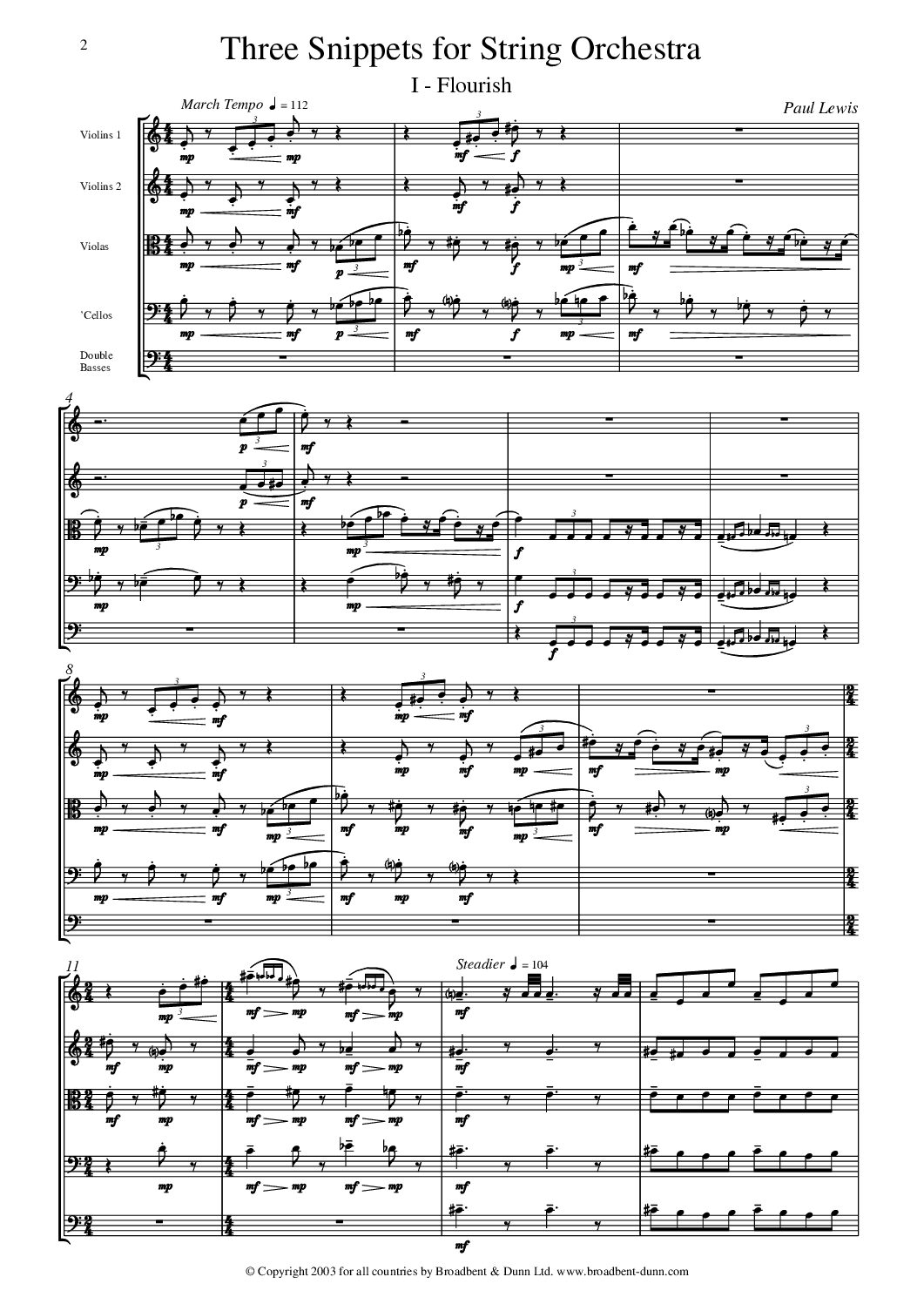
Three Snippets for String Orchestra is a short entertaining work and concert stocking-filler - lasting only 6½ minutes. Originally written for saxophone quartet, the three movements are: Flourish, a march-like fanfare with a suggestion of toy soldiers, a deeply-felt Love Song as an unexpectedly emotional core, and Dislocated Rag to finish with a smile - ragtime with recurring 7/8 bars thrown in to trip up the dancers! Dislocated Rag is based on the composer's music for the 1984 mystery film The Case of Marcel Duchamp about the famous French Dadaist artist.
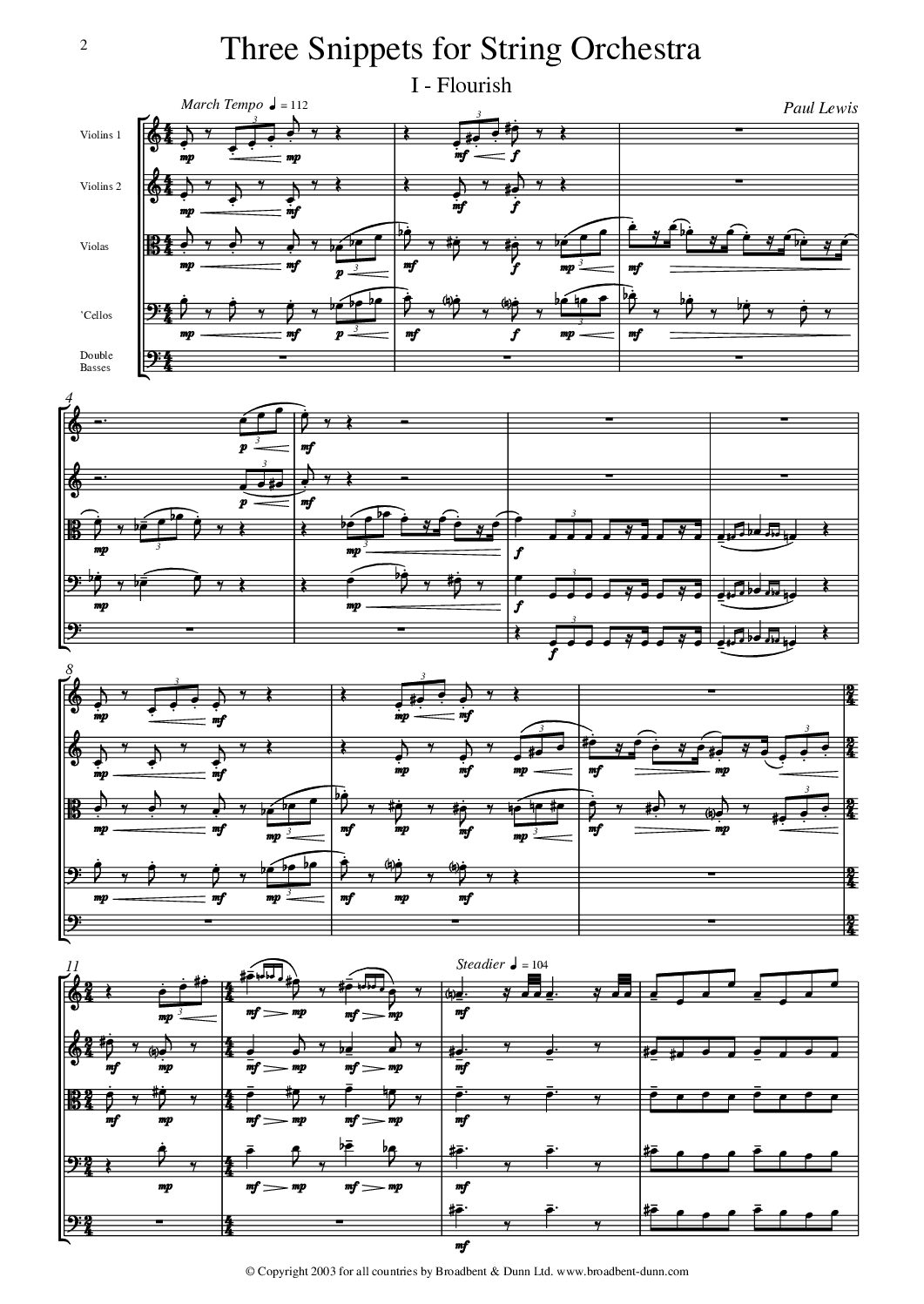
Three Snippets for String Orchestra is a short entertaining work and concert stocking-filler - lasting only 6½ minutes. Originally written for saxophone quartet, the three movements are: Flourish, a march-like fanfare with a suggestion of toy soldiers, a deeply-felt Love Song as an unexpectedly emotional core, and Dislocated Rag to finish with a smile - ragtime with recurring 7/8 bars thrown in to trip up the dancers! Dislocated Rag is based on the composer's music for the 1984 mystery film The Case of Marcel Duchamp about the famous French Dadaist artist.
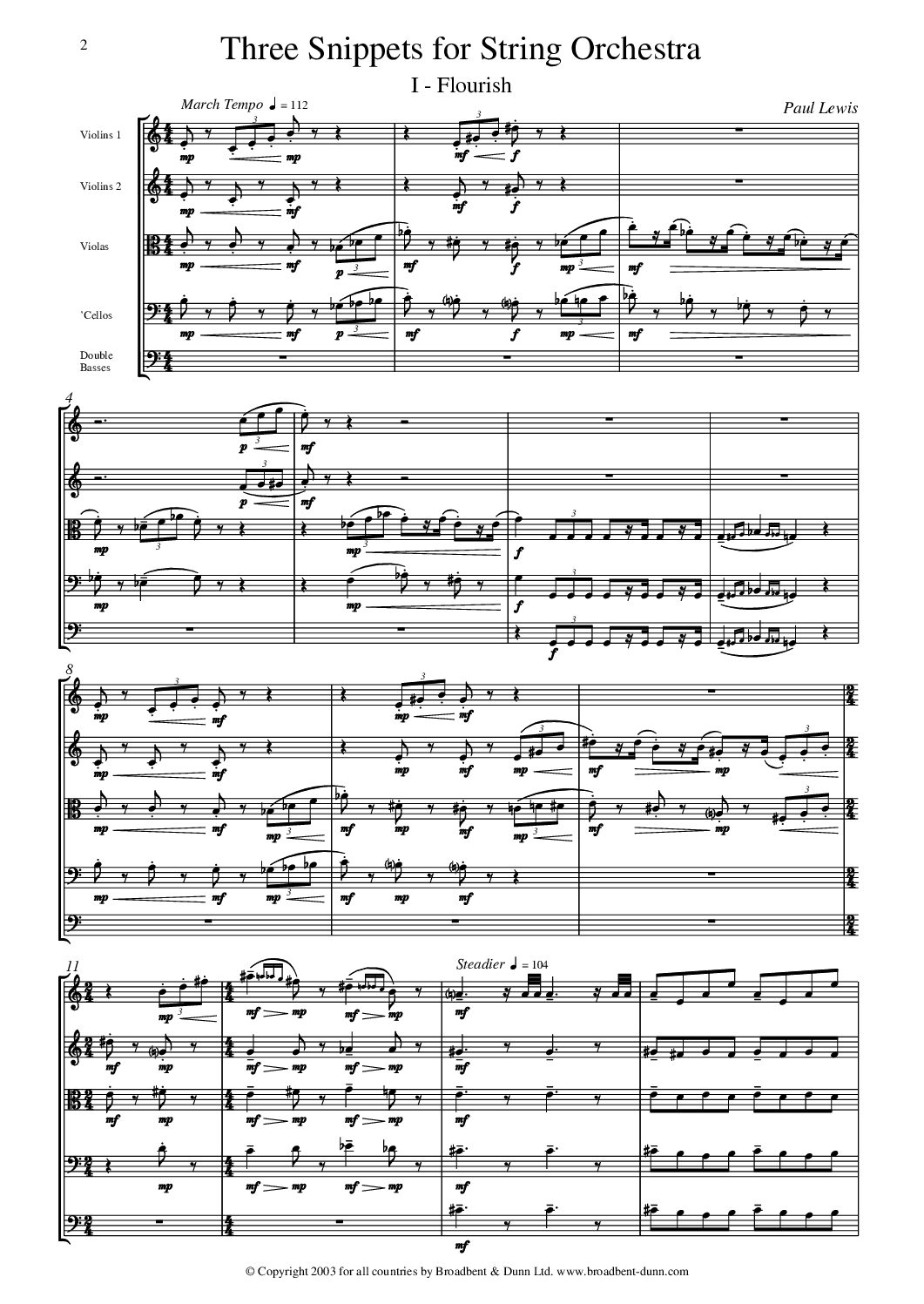
Three Snippets for String Orchestra is a short entertaining work and concert stocking-filler - lasting only 6½ minutes. Originally written for saxophone quartet, the three movements are: Flourish, a march-like fanfare with a suggestion of toy soldiers, a deeply-felt Love Song as an unexpectedly emotional core, and Dislocated Rag to finish with a smile - ragtime with recurring 7/8 bars thrown in to trip up the dancers! Dislocated Rag is based on the composer's music for the 1984 mystery film The Case of Marcel Duchamp about the famous French Dadaist artist.
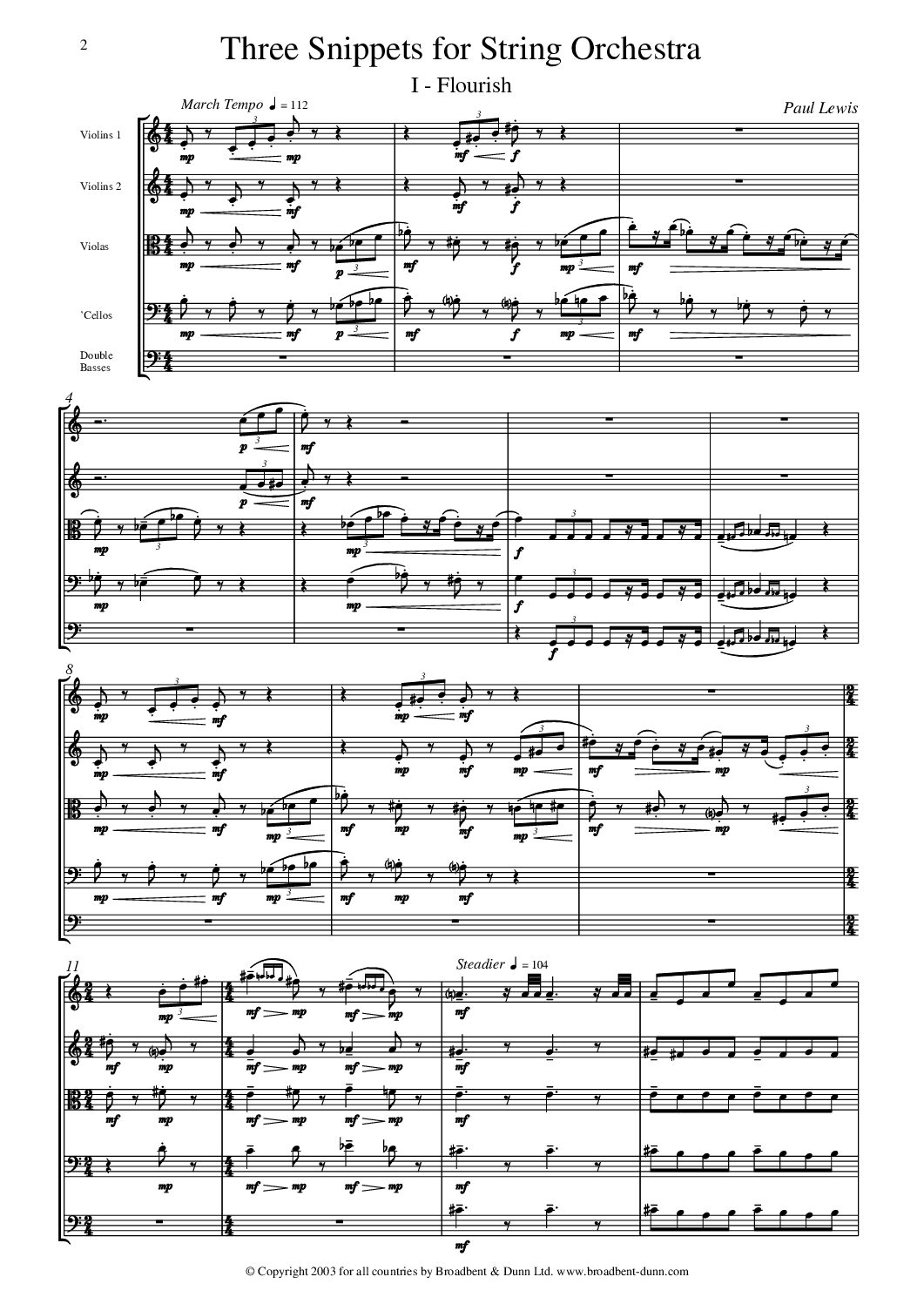
Three Snippets for String Orchestra is a short entertaining work and concert stocking-filler - lasting only 6½ minutes. Originally written for saxophone quartet, the three movements are: Flourish, a march-like fanfare with a suggestion of toy soldiers, a deeply-felt Love Song as an unexpectedly emotional core, and Dislocated Rag to finish with a smile - ragtime with recurring 7/8 bars thrown in to trip up the dancers! Dislocated Rag is based on the composer's music for the 1984 mystery film The Case of Marcel Duchamp about the famous French Dadaist artist.
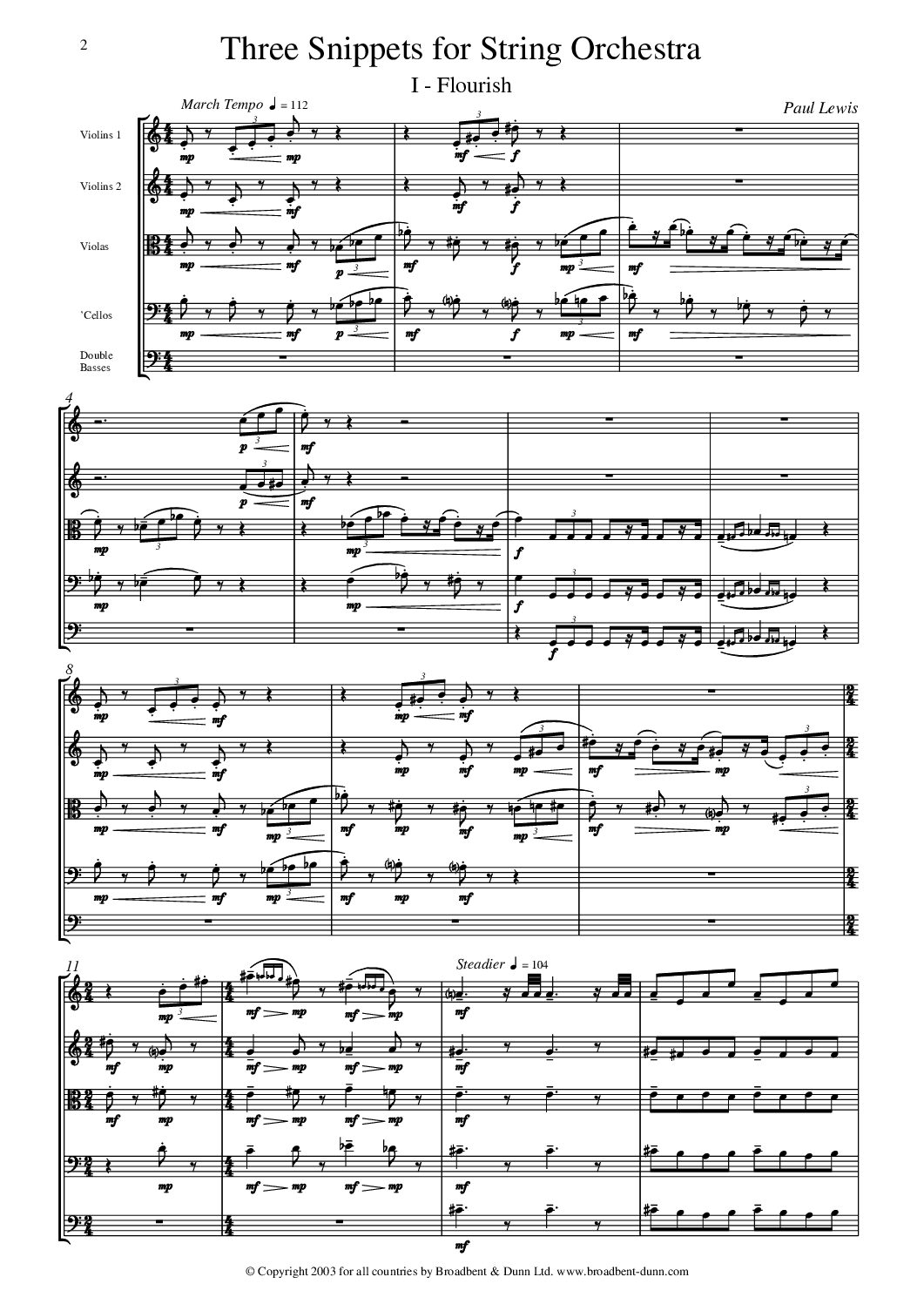
Three Snippets for String Orchestra is a short entertaining work and concert stocking-filler - lasting only 6½ minutes. Originally written for saxophone quartet, the three movements are: Flourish, a march-like fanfare with a suggestion of toy soldiers, a deeply-felt Love Song as an unexpectedly emotional core, and Dislocated Rag to finish with a smile - ragtime with recurring 7/8 bars thrown in to trip up the dancers! Dislocated Rag is based on the composer's music for the 1984 mystery film The Case of Marcel Duchamp about the famous French Dadaist artist.
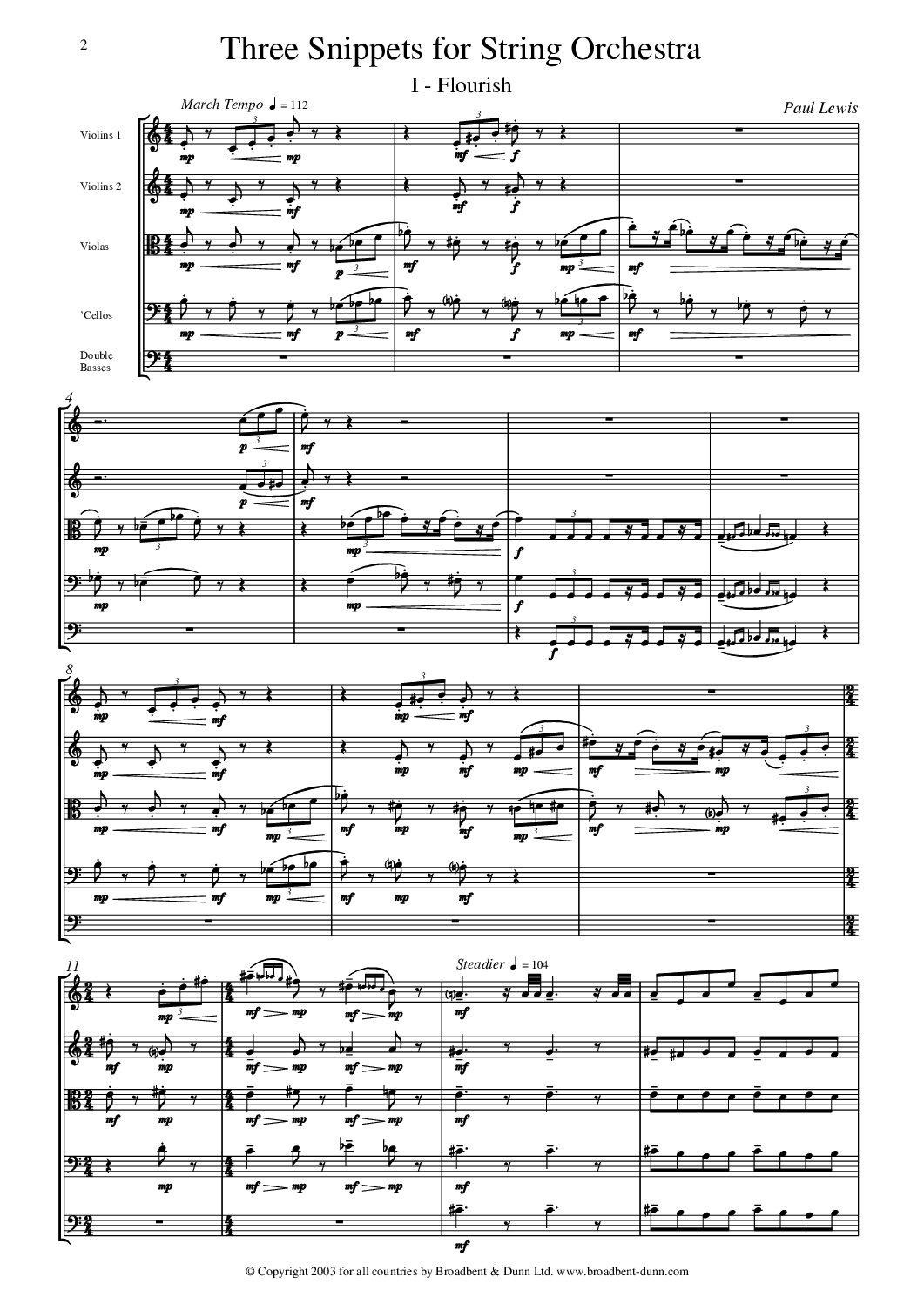
Three Snippets for String Orchestra is a short entertaining work and concert stocking-filler - lasting only 6½ minutes. Originally written for saxophone quartet, the three movements are: Flourish, a march-like fanfare with a suggestion of toy soldiers, a deeply-felt Love Song as an unexpectedly emotional core, and Dislocated Rag to finish with a smile - ragtime with recurring 7/8 bars thrown in to trip up the dancers! Dislocated Rag is based on the composer's music for the 1984 mystery film The Case of Marcel Duchamp about the famous French Dadaist artist.

Norman expanded the woefully small viola repertoire by composing two Sonatinas for Viola and Piano to play in recitals with his brother - they are both tuneful works that are easy to listen to, while at the same time providing some technical problems for the player, which may commend them to proficient students and also for use in recitals. The first movement of Sonatina No. 2 is less demanding technically than that of the first sonatina, being more about phrasing and tone production. The player needs to be very aware of what is coming later, so as to grade the dynamics adequately. The second movement gives the opportunity to concentrate on making a beautiful sound and grading the dynamics with care. The viola starts the third movement on its own with the fugue subject, and so needs to be played with confidence as the way the music skips from string to string can be daunting. It is quite a difficult movement to bring off, but very satisfying nonetheless. For secondary schools, colleges, conservatories and professionals.
Viola & Piano
Norman expanded the woefully small viola repertoire by composing two Sonatinas for Viola and Piano to play in recitals with his brother - they are both tuneful works that are easy to listen to, while at the same time providing some technical problems for the player, which may commend them to proficient students and also for use in recitals. The first movement of Sonatina No. 2 is less demanding technically than that of the first sonatina, being more about phrasing and tone production. The player needs to be very aware of what is coming later, so as to grade the dynamics adequately. The second movement gives the opportunity to concentrate on making a beautiful sound and grading the dynamics with care. The viola starts the third movement on its own with the fugue subject, and so needs to be played with confidence as the way the music skips from string to string can be daunting. It is quite a difficult movement to bring off, but very satisfying nonetheless. For secondary schools, colleges, conservatories and professionals.

Norman expanded the woefully small viola repertoire by composing two Sonatinas for Viola and Piano to play in recitals with his brother - they are both tuneful works that are easy to listen to, while at the same time providing some technical problems for the player, which may commend them to proficient students and also for use in recitals. The first movement of Sonatina No. 1 makes use of the full range of the instrument, giving scope for both tone production and dexterity. The second movement provides a break between the more difficult first and third movements. The third movement is the most difficult technically and is more rhythmic in character than the other movements and calls for some bravura, although it ends quietly and gently. For secondary schools, colleges, conservatories and professionals.
Viola & Piano
Norman expanded the woefully small viola repertoire by composing two Sonatinas for Viola and Piano to play in recitals with his brother - they are both tuneful works that are easy to listen to, while at the same time providing some technical problems for the player, which may commend them to proficient students and also for use in recitals. The first movement of Sonatina No. 1 makes use of the full range of the instrument, giving scope for both tone production and dexterity. The second movement provides a break between the more difficult first and third movements. The third movement is the most difficult technically and is more rhythmic in character than the other movements and calls for some bravura, although it ends quietly and gently. For secondary schools, colleges, conservatories and professionals.

This quartet evokes the sounds and attitudes of The Big Apple
String Quartet
This quartet evokes the sounds and attitudes of The Big Apple

This piece is all about the fun side of country music. Don't Ask is the simple answer to the question asking what happens next. Freedom is a spiritual from the rural state of Tennessee, starting with a lone plaintive cry that becomes a statement of optimism as more people join in. In Pam! Bam! Zonk! the drinking gets a little too much for some, so this movement is a glorious fight.
String Quartet
This piece is all about the fun side of country music. Don't Ask is the simple answer to the question asking what happens next. Freedom is a spiritual from the rural state of Tennessee, starting with a lone plaintive cry that becomes a statement of optimism as more people join in. In Pam! Bam! Zonk! the drinking gets a little too much for some, so this movement is a glorious fight.
String Orchestra
Martin Yates – L.A. Beach Music for String Orchestra (Set of Parts)
Your purchase will consist of the following set of Parts:
5 x First Violin 4 x Second Violin 3 x Viola 2 x 'Cello 1 x Double Bass Extra parts available on request A musical representation of the city or area of the titles as experienced by the composer. The music is drawn from pop, rock, jazz and jazz funk.
String Orchestra
Martin Yates – L.A. Beach Music for String Orchestra (Full Score)
A musical representation of the city or area of the titles as experienced by the composer. The music is drawn from pop, rock, jazz and jazz funk.

A musical representation of the city or area of the titles as experienced by the composer Martin Yates. The music is drawn from pop, rock, jazz and jazz funk.

A musical representation of the city or area of the titles as experienced by the composer Martin Yates. The music is drawn from pop, rock, jazz and jazz funk.

String Orchestra
Martin Yates – L.A. Beach Music for String Orchestra – Double Bass Digital Download
A musical representation of the city or area of the titles as experienced by the composer Martin Yates. The music is drawn from pop, rock, jazz and jazz funk.

A musical representation of the city or area of the titles as experienced by the composer Martin Yates. The music is drawn from pop, rock, jazz and jazz funk.

String Orchestra
Martin Yates – L.A. Beach Music for String Orchestra – 2nd Violins Digital Download
A musical representation of the city or area of the titles as experienced by the composer Martin Yates. The music is drawn from pop, rock, jazz and jazz funk.

String Orchestra
Martin Yates – L.A. Beach Music for String Orchestra – 1st Violins Digital Download
A musical representation of the city or area of the titles as experienced by the composer Martin Yates. The music is drawn from pop, rock, jazz and jazz funk.

A musical representation of the city or area of the titles as experienced by the composer. The music is drawn from pop, rock, jazz and jazz funk.
String Quartet
A musical representation of the city or area of the titles as experienced by the composer. The music is drawn from pop, rock, jazz and jazz funk.

'Frisco by those in the know is a jewel of a city. The titles of the four movements tell it all - Keeping Ahead of yourself is what you have to do in a city with a glorious past but an uncertain and uneasy present. Light Reflecting from the Bridge seems to warm the whole city, bathing it in a gently reddish hue. Alongside the pathway in one of the city parks is a sand track for horses, and every now and then you see Footprints in the Sand, some are in couples, others alone. The thoughts of those people who are alone touches you, but it is the Time to Be Certain and you regain your beliefs and confidence.
String Quartet
'Frisco by those in the know is a jewel of a city. The titles of the four movements tell it all - Keeping Ahead of yourself is what you have to do in a city with a glorious past but an uncertain and uneasy present. Light Reflecting from the Bridge seems to warm the whole city, bathing it in a gently reddish hue. Alongside the pathway in one of the city parks is a sand track for horses, and every now and then you see Footprints in the Sand, some are in couples, others alone. The thoughts of those people who are alone touches you, but it is the Time to Be Certain and you regain your beliefs and confidence.

Violin & Piano
Lenny Cavallaro – ‘Raindrops’ Fantasia for Violin and Piano, Opus 5 – Digital Download
"Raindrops" Fantasia, Opus 5, is essentially a set of free variations in early Romantic style. The work develops a simple three-note motif (E-D#-E) in both the minor and major modes. Each variation is quite different, with one taking the form of the Classical minuet and trio. This composition was hailed by a critic as "a throwback to Schubert", which is certainly somewhat unusual for a 21st Century publication, although Cavallaro audaciously adheres to 18th and 19th century forms, harmonic language, and structure. In this sense Lenny is a 'cultural missionary' who hopes that his compositions will encourage other composers to return to our common heritage. "Raindrops Fantasia" can be heard on YouTube with Bobby Portney on violin and Lenny Cavallaro on piano at https://www.youtube.com/watch?v=QQ8PRH9n2AM
"Raindrops" Fantasia, Opus 5, is essentially a set of free variations in early Romantic style. The work develops a simple three-note motif (E-D#-E) in both the minor and major modes. Each variation is quite different, with one taking the form of the Classical minuet and trio. This composition was hailed by a critic as "a throwback to Schubert", which is certainly somewhat unusual for a 21st Century publication, although Cavallaro audaciously adheres to 18th and 19th century forms, harmonic language, and structure. In this sense Lenny is a 'cultural missionary' who hopes that his compositions will encourage other composers to return to our common heritage. "Raindrops Fantasia" can be heard on YouTube with Bobby Portney on violin and Lenny Cavallaro on piano at https://www.youtube.com/watch?v=QQ8PRH9n2AM

This Sonata for Violin and Piano reflects the essence of John Simpson's music. It belongs to one of the most fulfilled periods of the composers life when he was experiencing both the excitement of travelling the world as a music examiner as well as the intense happiness of being a grandparent. As such this is possibly the composers most radiant work, with a slow movement that he would most like to be remember by.
The opening movement of this work, the most extended of the four, contrasts a wistful almost elegiac section with one that is fast and dance-like. There is an extended slow passage at the end that seems to be searching for resolutions not provided until later. The second movement, a scherzo, is passionate rather than playful: it is the most joyous of the four, indicative perhaps of the elation that it is possible to feel when finding the means of being able to express ideas in a way that the composer hardly thought possible. The slow third movement, a lyrical cantilena with the violin always to the fore, is the emotional core of the work, and leads without a break into the quick dance-like finale. After modulating through a variety of keys this reaches a climax in an ecstatic waltz-time transformation of the opening of the work in the home key of D major. However, rather than ending loudly, the music drifts ever more quietly into the distance without ever slowing down, like a procession fading into memory.
Violin & Piano
This Sonata for Violin and Piano reflects the essence of John Simpson's music. It belongs to one of the most fulfilled periods of the composers life when he was experiencing both the excitement of travelling the world as a music examiner as well as the intense happiness of being a grandparent. As such this is possibly the composers most radiant work, with a slow movement that he would most like to be remember by.
The opening movement of this work, the most extended of the four, contrasts a wistful almost elegiac section with one that is fast and dance-like. There is an extended slow passage at the end that seems to be searching for resolutions not provided until later. The second movement, a scherzo, is passionate rather than playful: it is the most joyous of the four, indicative perhaps of the elation that it is possible to feel when finding the means of being able to express ideas in a way that the composer hardly thought possible. The slow third movement, a lyrical cantilena with the violin always to the fore, is the emotional core of the work, and leads without a break into the quick dance-like finale. After modulating through a variety of keys this reaches a climax in an ecstatic waltz-time transformation of the opening of the work in the home key of D major. However, rather than ending loudly, the music drifts ever more quietly into the distance without ever slowing down, like a procession fading into memory.