

£24.95
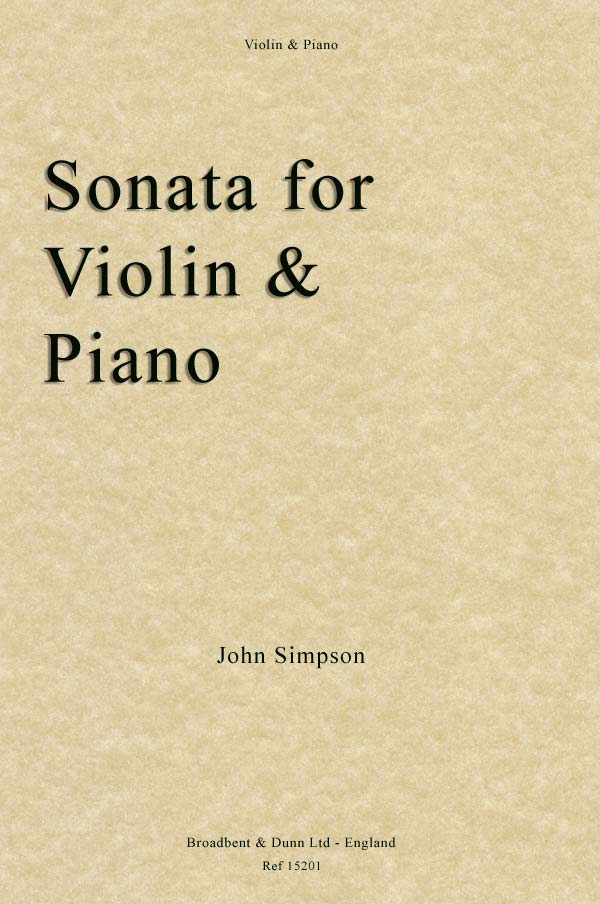
This Sonata for Violin and Piano reflects the essence of John Simpson’s music. It belongs to one of the most fulfilled periods of the composers life when he was experiencing both the excitement of travelling the world as a music examiner as well as the intense happiness of being a grandparent. As such this is possibly the composers most radiant work, with a slow movement that he would most like to be remember by.
The opening movement of this work, the most extended of the four, contrasts a wistful almost elegiac section with one that is fast and dance-like. There is an extended slow passage at the end that seems to be searching for resolutions not provided until later. The second movement, a scherzo, is passionate rather than playful: it is the most joyous of the four, indicative perhaps of the elation that it is possible to feel when finding the means of being able to express ideas in a way that the composer hardly thought possible. The slow third movement, a lyrical cantilena with the violin always to the fore, is the emotional core of the work, and leads without a break into the quick dance-like finale. After modulating through a variety of keys this reaches a climax in an ecstatic waltz-time transformation of the opening of the work in the home key of D major. However, rather than ending loudly, the music drifts ever more quietly into the distance without ever slowing down, like a procession fading into memory.
Piece Description
This Sonata for Violin and Piano reflects the essence of John Simpson’s music. It belongs to one of the most fulfilled periods of the composers life when he was experiencing both the excitement of travelling the world as a music examiner as well as the intense happiness of being a grandparent. As such this is possibly the composers most radiant work, with a slow movement that he would most like to be remember by.
The opening movement of this work, the most extended of the four, contrasts a wistful almost elegiac section with one that is fast and dance-like. There is an extended slow passage at the end that seems to be searching for resolutions not provided until later. The second movement, a scherzo, is passionate rather than playful: it is the most joyous of the four, indicative perhaps of the elation that it is possible to feel when finding the means of being able to express ideas in a way that the composer hardly thought possible. The slow third movement, a lyrical cantilena with the violin always to the fore, is the emotional core of the work, and leads without a break into the quick dance-like finale. After modulating through a variety of keys this reaches a climax in an ecstatic waltz-time transformation of the opening of the work in the home key of D major. However, rather than ending loudly, the music drifts ever more quietly into the distance without ever slowing down, like a procession fading into memory.
Review: “Mr Simpson is influenced by the concept of yin and yang – two opposing but symbiotic principles deriving from Chinese philosophy. Yin is the dark element, corresponding to the night. Yang is the bright element, corresponding to the day. The two elements co-exist, never far from each other. It is tempting to relate the yin and yang principle to the vicissitudes of composing. The Sonata for Violin and Piano reflects this struggle – passionate, reflective, insistent with an edgy and uncertain calm and a hauntingly beautiful Andante. Mr Simpson’s music needs players of real qualify to give it birth.” – The Guide to Entertainment in the Hastings Observer following on from a July 8th 2007 performance.
Additional information
| Media | |
|---|---|
| Composer | |
| Instrumentation | |
| Difficulty | |
| Series |
Biography
Biography
Simpson, John
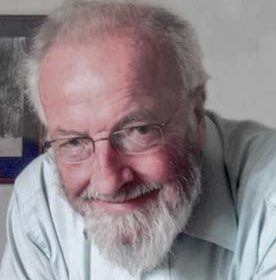
Born in London in 1933, John Simpson studied at the Trinity College of Music. His entire career was dedicated to music education, and in 1969 he settled with his family in Hastings when he was appointed Music Adviser to the local education authority, a position which he held until his retirement in 1992. Since then he has devoted his energies to examing worldwide for Trinity College and to composition. His large output includes four symphonies composed for the Hastings Area Youth Symphony Orchestra and an opera for children based on the Oscar Wilde story The Selfish Giant. His most recent works have been mainly for chamber combinations and include a Trio for Flute, Violin and Piano, a Piano Trio and a series of thirteen String Quartets.
Related products

Violin & Piano
John Marson – Two Idylls (Violin & Piano) – Digital Download
Short modern violin and piano pieces are rare, but these can take their place amongst examples from Elgar and the like. Unpretentious and good at making friends Two Idylls attempts to capture the sense of delight in the contemplation of pastoral landscapes, and the perceived serenity of the countryside. For the city dweller passing through such vistas speak of more relaxed times and freedom from constant pressures. There is, however, an underlying sense of not belonging, and in these pieces the tranquil settings are shot through with tensions that will not go away. No specific times or places are depicted, but the composers own recall of a period spent living in the country and his feeling of loss as he looks back to those years, perhaps account for the mixed moods of these pieces.
A melodic and reflective miniature by Paul Lewis, giving the chance to display legato technique and the expressive possibilities of the instruments. Requires sensitivity of performance and use of rubato.
Violin & Piano
Another piece in the Blue series for solo instruments and piano, this time for violin and piano. Slow, dreamy and written in the high register of the violin, it has a soft fluid middle section suggestive of bird song. It was first performed by Alisdair Savage at the Little Venice Music Festival in London in 2004 and since then at the BBC in Glasgow and the Elgar Society's concerts in Edinburgh. A difficult piece that needs a secure high register.

Violin & Piano
Lenny Cavallaro – ‘Raindrops’ Fantasia for Violin and Piano, Opus 5 – Digital Download
"Raindrops" Fantasia, Opus 5, is essentially a set of free variations in early Romantic style. The work develops a simple three-note motif (E-D#-E) in both the minor and major modes. Each variation is quite different, with one taking the form of the Classical minuet and trio. This composition was hailed by a critic as "a throwback to Schubert", which is certainly somewhat unusual for a 21st Century publication, although Cavallaro audaciously adheres to 18th and 19th century forms, harmonic language, and structure. In this sense Lenny is a 'cultural missionary' who hopes that his compositions will encourage other composers to return to our common heritage. "Raindrops Fantasia" can be heard on YouTube with Bobby Portney on violin and Lenny Cavallaro on piano at https://www.youtube.com/watch?v=QQ8PRH9n2AM
Alfonso Cavallaro's Tango, like its sister composition Serenade (also published by Broadbent & Dunn), is essentially a very tonal concert piece, loosely modelled after those of Fritz Kreisler. The composition assumes the familiar 'three-part song form' and is usually performed with Serenade.

A melodic and reflective miniature by Paul Lewis, giving the chance to display legato technique and the expressive possibilities of the instruments. Requires sensitivity of performance and use of rubato.