

£10.95
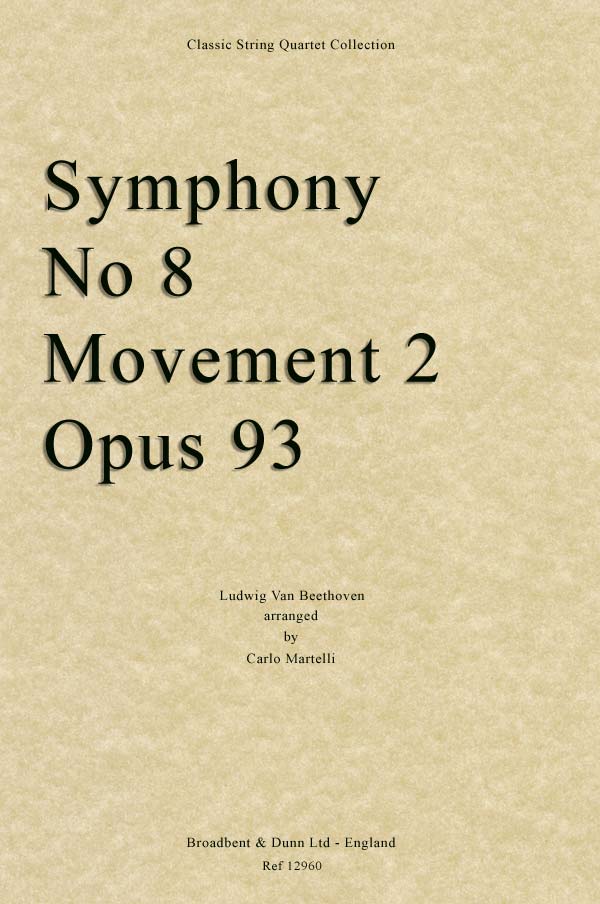
This movement of Beethoven’s Little Symphony, as he called it, was inspired by the ticking of the metronome which had recently been invented by a friend of the composer. Arranged by Carlo Martelli. For conservatories and professionals.
Piece Description
This movement of Beethoven’s Little Symphony, as he called it, was inspired by the ticking of the metronome which had recently been invented by a friend of the composer. Arranged by Carlo Martelli. For conservatories and professionals.
Additional information
| Media | |
|---|---|
| Composer | |
| Arranger | |
| Instrumentation | |
| Difficulty | |
| Series |
Biography
Biography
Martelli, Carlo
Carlo Martelli was born on the 12th December 1935 in London to an Italian father and an English mother. By the age of eleven Carlo had developed a passion for the symphony orchestra. Just before his twelfth birthday he started taking regular violin lessons and very soon began writing elaborate orchestral scores achieving a mastery in this field by the age of sixteen, by which time he had obtained a County Scholarship to attend the Royal College of Music in London, studying composition and viola. By the time he was 21 he had written a string quartet and had already had a great deal of success with several large scale serious symphonic compositions, notably his Second Symphony, which had many performances and broadcasts by several major orchestras in the few years after its completion. In the 1960's he turned to film music to make a living, and also worked steadily as a freelance viola player. His arrangements for string quartet, trio and other combinations number well over 250 and are played by hundreds of groups all over the world.

Related products

Beethoven, Ludwig Van
Beethoven arr. Martelli – Latin American Ludwig (String Quartet) – Digital Download
The similarity between the Mexican Hat Dance and the opening of the last movement of Beethoven's String Quartet No. 3 Opus 18 was the starting point for the inspiration of this arrangement by Carlo Martelli, which skilfully combines the two pieces.
Beethoven, Ludwig Van
Beethoven arr. Martelli – Moonlight Sonata, Movement 3 (String Quartet)
Arranging symphonically orientated works for string quartet is always a daunting challenge, especially when there is a pronounced virtuosic element or a high degree of complexity in the original. In this publication Carlo Martelli has risen magnificently to the challenge as always.
Beethoven, Ludwig Van
Beethoven arr. Martelli – Symphony No. 5 Movement 1 (String Quartet)
As to be or not to be is the one Shakespeare quote that is universally recognised, so too is the opening of this Symphony vis a vis Beethoven. Despite the impression of overwhelming intensity given by this movement, it is one of the most perfectly balanced the composer ever wrote.
Beethoven, Ludwig Van
Beethoven arr. Martelli – Symphony No. 1 Finale (String Quartet)
This gay and skittish movement from Beethoven's earliest symphony recalls Haydn in the character of its themes and their development. The arranger Carlo Martelli has omitted the opening hesitant violin passage.
Beethoven, Ludwig Van
Beethoven arr. Martelli – Symphony No. 7 Movement 1 (String Quartet)
This first movement contains the longest introduction of any of Beethoven's symphonies, and like the succeeding Allegro is almost dance-like in character. Arranged by Carlo Martelli.
Beethoven, Ludwig Van
Beethoven arr. Martelli – Symphony No. 7 Movement 3 (String Quartet)
The publication of this movement, arranged by Carlo Martelli, of Beethoven's masterpiece completes the printing of the four movements of a work that Wagner described as The apotheoses of the dance. For colleges, conservatories and professionals.