

£8.95
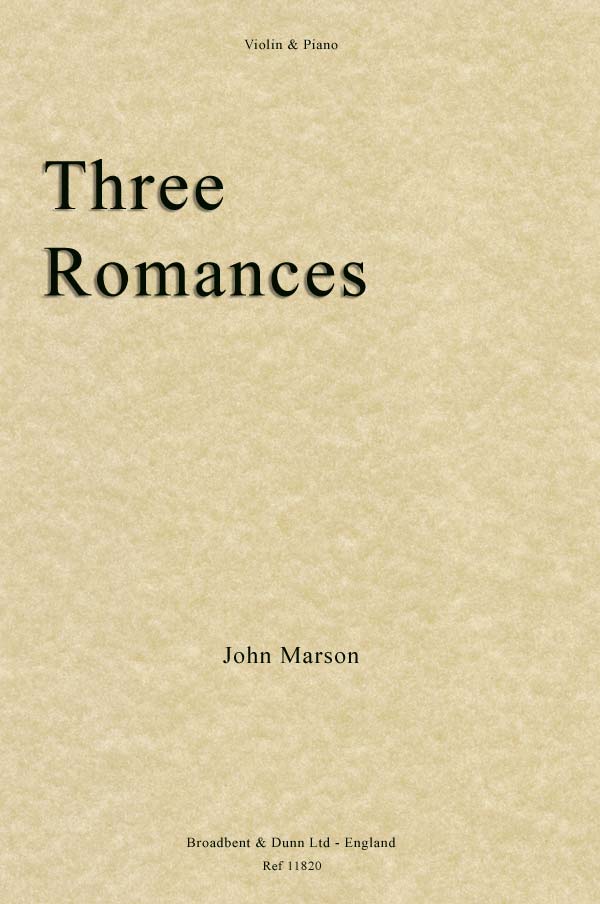
These lyrical pieces are essentially nostalgic, although never sad. They appeal to all audiences.
Piece Description
These lyrical pieces are essentially nostalgic, although never sad. They appeal to all audiences.
Review: “Lovely, melodic works suitable for recitals or special occasions.” – American Music Teacher, August/September 1997
Additional information
| Media | |
|---|---|
| Composer | |
| Instrumentation | |
| Difficulty | |
| Series | |
| Movement Titles | Once In a Dream, A Place That I Knew and The Sweetest Memories |
Biography
Biography
Marson, John
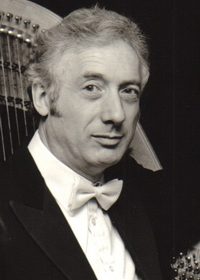
John Marson was born in 1932 and died in 2007. He studied the harp with Marie Goossens at the Royal College of Music in London, and in 1958, while still a student, began his professional career with the Carl Rosa Opera Company. A week after leaving college he joined the London Symphony Orchestra for two years before embarking on two decades of freelance work, during which he played solos, chamber music and concerti, worked with all the London orchestras and spent much time in recording studios. He played in many outstanding feature films including the original 'Star Wars'. In 1982 he was appointed principal harp of the BBC Symphony Orchestra, and subsequently resumed his freelance career while increasingly engaging in composition, both for the harp and for other instruments and voice. He played for many West End and National Theatre productions including over three years as harpist in Lloyd Webber's 'Aspects of Love'.
The roll call of artists with whom John has worked include the Beatles, Richard Rodney Bennett, Leonard Bernstein, Pierre Boulez, Benjamin Britten, Charlie Chaplin, Bing Crosby, John Dankworth, Duke Ellington, Benny Goodman, Liberace, Martha Graham, Hans Werner Henze, Herbert von Karajan, Otto Klemperer, Zoltan Kodaly, Lorin Maazel, Neville Marriner, Pierre Monteux, Jessye Norman, Laurence Olivier, Luciano Pavarotti, Gennadi Rozhdestvenski, Frank Sinatra, George Solti, Leopold Stokowski, Igor Stravinsky, George Szell, William Walton, John Williams, Stevie Wonder and countless others.
In 1964 John was one of the two founders of the United Kingdom Harp Association, edited its magazines for many years and became President of the Association in January 2005. His book 'The Complete Guide to Harp Glissandi', is published by Lyra Music of New York, while his other major work 'The Book of the Harp - techniques, history and lore of a unique musical instrument', was published by Kevin Mayhew Ltd. in 2005.
Related products
Alfonso Cavallaro's Tango, like its sister composition Serenade (also published by Broadbent & Dunn), is essentially a very tonal concert piece, loosely modelled after those of Fritz Kreisler. The composition assumes the familiar 'three-part song form' and is usually performed with Serenade.
"Raindrops" Fantasia, Opus 5, is essentially a set of free variations in early Romantic style. The work develops a simple three-note motif (E-D#-E) in both the minor and major modes. Each variation is quite different, with one taking the form of the Classical minuet and trio. This composition was hailed by a critic as "a throwback to Schubert", which is certainly somewhat unusual for a 21st Century publication, although Cavallaro audaciously adheres to 18th and 19th century forms, harmonic language, and structure. In this sense Lenny is a 'cultural missionary' who hopes that his compositions will encourage other composers to return to our common heritage. "Raindrops Fantasia" can be heard on YouTube with Bobby Portney on violin and Lenny Cavallaro on piano at https://www.youtube.com/watch?v=QQ8PRH9n2AM
Violin & Piano
This Sonata for Violin and Piano reflects the essence of John Simpson's music. It belongs to one of the most fulfilled periods of the composers life when he was experiencing both the excitement of travelling the world as a music examiner as well as the intense happiness of being a grandparent. As such this is possibly the composers most radiant work, with a slow movement that he would most like to be remember by.
The opening movement of this work, the most extended of the four, contrasts a wistful almost elegiac section with one that is fast and dance-like. There is an extended slow passage at the end that seems to be searching for resolutions not provided until later. The second movement, a scherzo, is passionate rather than playful: it is the most joyous of the four, indicative perhaps of the elation that it is possible to feel when finding the means of being able to express ideas in a way that the composer hardly thought possible. The slow third movement, a lyrical cantilena with the violin always to the fore, is the emotional core of the work, and leads without a break into the quick dance-like finale. After modulating through a variety of keys this reaches a climax in an ecstatic waltz-time transformation of the opening of the work in the home key of D major. However, rather than ending loudly, the music drifts ever more quietly into the distance without ever slowing down, like a procession fading into memory.
Rhapsody in Several Colors is a Trinity College London Diploma Level ATCL Exam Piece until further notice
Written in response to a request for a piece utilising jazz influences, it is however a concert work suitable for a wide range of recital formats. Rhapsody in Several Colors has been a Trinity College London Diploma Level ATCL Exam Piece since January 2022.

Violin & Harpsichord
This 2014 publication might well have been composed 300 years earlier, being a truly baroque sonata in four movements (slow-fast-slow-fast). The composer has adhered not only to the harmonic and structural idioms of the time, but also to many of the other "unwritten" conventions. The work invites a great deal of freedom, and even leaves room for some improvisation. In the third movement the violin enters on a long, held note - this pattern recurs throughout, and in some ways appears to echo similar long notes in Bach's B Minor Sonata. The last movement is a set of variations, though neither chaconne nor passacaglia - these are melodic, in the Italian manner, and clearly sound less baroque. The thematic material derives from the opening of Papageno's aria Ein Mädchen oder Weibchen from Mozart's Magic Flute, but transposed from F Major to D Minor. This sonata was premiered at the Lincoln Center by Bobby Portney and has subsequently been recorded by Sarah Darling and can be heard on YouTube: https://www.youtube.com/watch?v=UigLnCPNYSw

Violin & Piano
Lenny Cavallaro – ‘Raindrops’ Fantasia for Violin and Piano, Opus 5 – Digital Download
"Raindrops" Fantasia, Opus 5, is essentially a set of free variations in early Romantic style. The work develops a simple three-note motif (E-D#-E) in both the minor and major modes. Each variation is quite different, with one taking the form of the Classical minuet and trio. This composition was hailed by a critic as "a throwback to Schubert", which is certainly somewhat unusual for a 21st Century publication, although Cavallaro audaciously adheres to 18th and 19th century forms, harmonic language, and structure. In this sense Lenny is a 'cultural missionary' who hopes that his compositions will encourage other composers to return to our common heritage. "Raindrops Fantasia" can be heard on YouTube with Bobby Portney on violin and Lenny Cavallaro on piano at https://www.youtube.com/watch?v=QQ8PRH9n2AM