A Christmas favourite from the pen of the late and celebrated hornist Alan Civil.
£11.95
A Christmas favourite from the pen of the late and celebrated hornist Alan Civil.
| Media | |
|---|---|
| Composer | |
| Arranger | |
| Instrumentation | |
| Series |
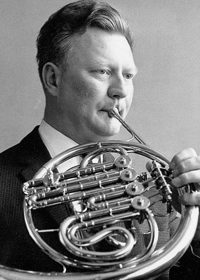
Alan Civil was born in 1929 and died in 1989. Alan started to play the French horn as a young boy, and joined an army band as a teenager. He studied the horn with Aubrey Brain, the father of Dennis Brain, and played second horn to Dennis Brain in the Royal Philharmonic Orchestra, taking over as principal horn when Dennis Brain left. In 1955 Alan joined the Philharmonia as principal horn, and in 1966 he became the principal horn of the BBC Symphony Orchestra, where he remained until he retired in 1988. He also performed as a soloist and recordings include Mozart's 'Four Horn Concertos' and Benjamin Britten's 'Serenade for Tenor, Horn and Strings' with Robert Tear. He was also a member of the Alan Civil Horn Trio, taught at the Royal College of Music and was awarded an OBE in 1985. Alan was also a prolific composer and arranger, writing many pieces for the horn as well as for an array of unusual instrument combinations.
Horn Quartet with Double Bass or Tuba
Stanley Woods – Alexander Takes A Swing (Horn Quartet & Double Bass or Tuba with optional Drums)
Written for the Royal Philharmonic Orchestra's horn section to play at Glyndebourne parties in the early 1960's. In the early 1960's almost all English hornists played on Alexander horns, hence the title. It was composed when Beethoven's Fidelio was being performed at Glyndebourne. One famous aria in this opera features the horns, and near the end they play individual scale run ups in canon, and so for fun the composer has incorporated this in the piece.
Good music for beginners, these six miniatures, entitled Horns on Parade, Promenade, The Sunday Walk, Tick-Tock March, Pastorale, Song and The Wild Goose Chase, provide the student with plenty of dynamics and a playing range from G below middle C to D, the ninth above middle C. There is a good variety of meters, tempos, rhythmic and melodic content. Students are introduced to note values and their importance in the first movement, while the fourth movement gives the opportunity for the student to experience the classical/natural horn part. Finishing with a wild goose chase in 6/8 time, the beginner also encounters a 'D.S. al Coda' - a good example of musical geography.
A Christmas favourite from the pen of the late and celebrated hornist Alan Civil.
These fine miniatures for horn quartet are the first of two sets intended as a way of providing the young horn student with the opportunity to familiarise themselves with the quartet sound and experience. Traditional harmony prevails, providing the musicians with the opportunity to hear and work at sectional balance and part discipline. These quartets are a lighter addition to the Fripperies. For the intermediate student.
Horn Quartet with Double Bass or Tuba
Written for the Royal Philharmonic Orchestra's horn section to play at Glyndebourne parties in the early 1960's. In the early 1960's almost all English hornists played on Alexander horns, hence the title. It was composed when Beethoven's Fidelio was being performed at Glyndebourne. One famous aria in this opera features the horns, and near the end they play individual scale run ups in canon, and so for fun the composer has incorporated this in the piece.
Horn Quartet with Double Bass or Tuba
Traditional arr. Woods – John Peel (Horn Quartet & Double Bass or Tuba with optional Drums)
Written for the Royal Philharmonic Orchestra's horn section to play at Glyndebourne parties in the early 1960's, this is an arrangement in various guises of the famous folk song De Ye Ken John Peel. Woods has added his own second subject.