

£14.95
An arrangement for wind quintet by Alan Civil of this excellently crafted piece of music.
Piece Description
An arrangement for wind quintet by Alan Civil of this excellently crafted piece of music.
Review: “A delightful arrangement for recitals or weddings. For colleges and professionals.” – Special Flute New Issue, July 1997
Additional information
| Media | |
|---|---|
| Composer | |
| Arranger | |
| Instrumentation | |
| Difficulty | |
| Series |
Biography
Biography
Civil, Alan
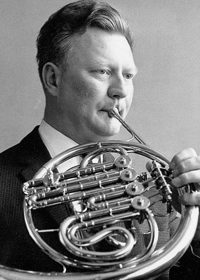
Alan Civil was born in 1929 and died in 1989. Alan started to play the French horn as a young boy, and joined an army band as a teenager. He studied the horn with Aubrey Brain, the father of Dennis Brain, and played second horn to Dennis Brain in the Royal Philharmonic Orchestra, taking over as principal horn when Dennis Brain left. In 1955 Alan joined the Philharmonia as principal horn, and in 1966 he became the principal horn of the BBC Symphony Orchestra, where he remained until he retired in 1988. He also performed as a soloist and recordings include Mozart's 'Four Horn Concertos' and Benjamin Britten's 'Serenade for Tenor, Horn and Strings' with Robert Tear. He was also a member of the Alan Civil Horn Trio, taught at the Royal College of Music and was awarded an OBE in 1985. Alan was also a prolific composer and arranger, writing many pieces for the horn as well as for an array of unusual instrument combinations.
Related products

Children in particular will enjoy listening to this rousing piece, arranged by Roy Thackray, which has also proved very suitable for audience participation. For schools, colleges and professionals.
Horn & Piano
A fine arrangement to add to Alan Civil's music for French Horn. The second movement of this work (Allegro) was an Associated Board of the Royal Schools of Music (ABRSM) Grade 6 Exam Piece between 2013 and 2022.

In this melodic and appealing music the five instruments enjoy opportunities to caress the ears of audiences who may have been fearing heavier and more uncompromising fare.
Another clever arrangement from the pen of the late and celebrated hornist Alan Civil.

This is an arrangement for wind quintet of a late piano work by Brahms. There is not enough music, that communicates the deepest of human emotions, available for wind quintet at present, either as original compositions or in arrangements. By making this arrangement David has contributed to remedying this shortage, as well as bringing a powerful piece to the attention of musicians and audiences who might not otherwise come across it. The arrangement seeks to preserve the textural clarity and sensuous melodic lines of the original. Much of the richness and late romantic warmth of the arrangement comes from Brahms' flexibility of rhythm and tonality. This piece can be played by an ensemble where nobody is beyond the standard of Grade 8 Associated Board, which would include most adult amateur wind quintets. For secondary schools, community performing groups, teaching studios, colleges, conservatories, amateurs, libraries and professionals.
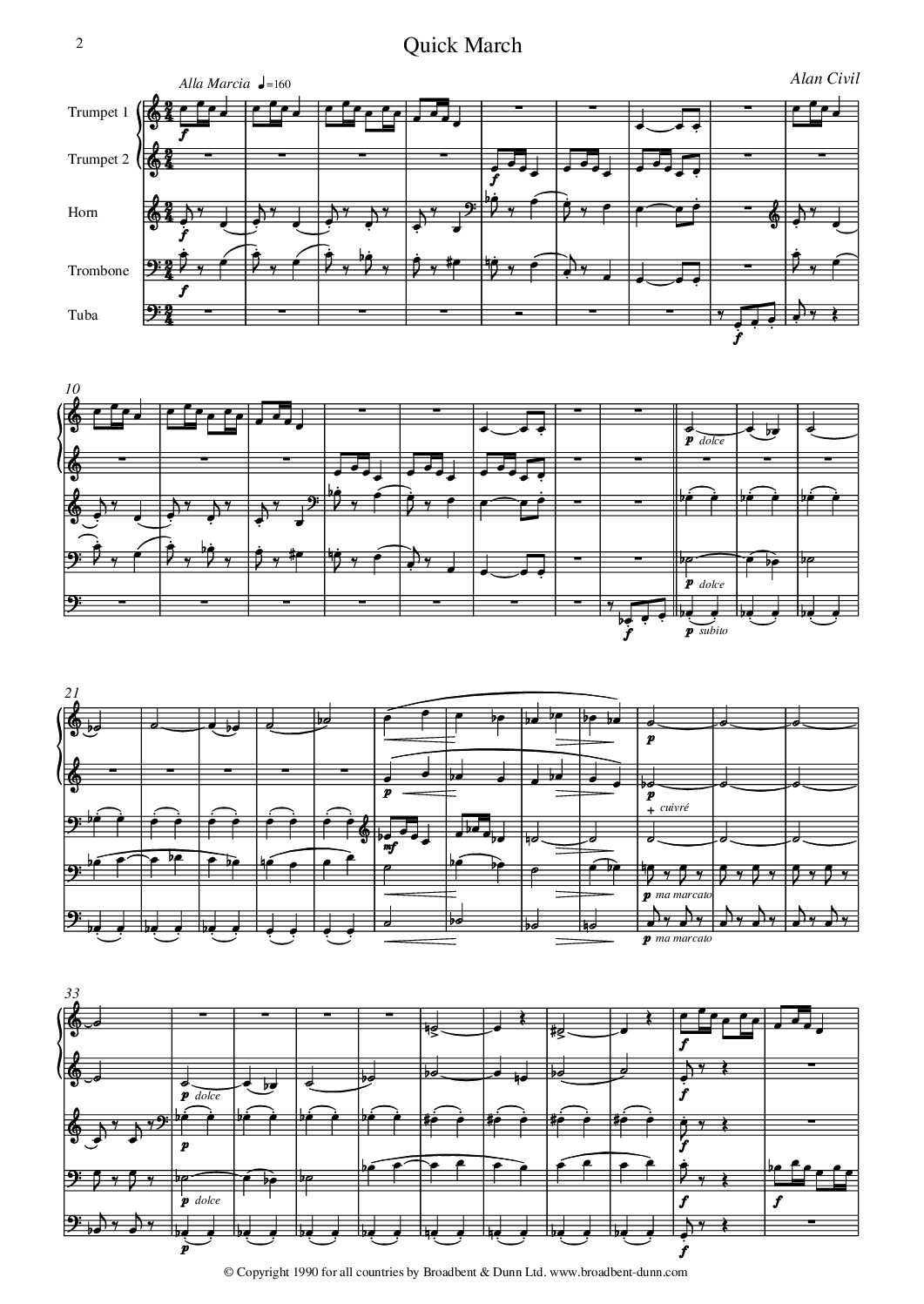
Six movements, starting with Quick March which requires some fast and neat tonguing from all members of the quintet. The Polka which follows is full of colour and requires dexterous trumpet playing. The third movement Blues is a long way from a traditional New Orleans blues - with its melancholy mood and Debussy like harmony it is more like a small impressionist tone poem. Merry Waltz is followed by Preamble, a gentle, atmospheric piece at a leisurely walking tempo. The final movement of this suite Tarandtango (Tarantango) cleverly combines two dances, the energetic tarantella and the elegant tango, resulting in an exciting and virtuoso finale.