

£15.95
In this melodic and appealing music the five instruments enjoy opportunities to caress the ears of audiences who may have been fearing heavier and more uncompromising fare.
Piece Description
In this melodic and appealing music the five instruments enjoy opportunities to caress the ears of audiences who may have been fearing heavier and more uncompromising fare.
Additional information
| Media | |
|---|---|
| Composer | |
| Instrumentation | |
| Difficulty | |
| Series |
Biography
Biography
Marson, John
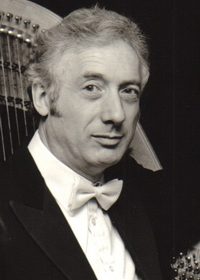
John Marson was born in 1932 and died in 2007. He studied the harp with Marie Goossens at the Royal College of Music in London, and in 1958, while still a student, began his professional career with the Carl Rosa Opera Company. A week after leaving college he joined the London Symphony Orchestra for two years before embarking on two decades of freelance work, during which he played solos, chamber music and concerti, worked with all the London orchestras and spent much time in recording studios. He played in many outstanding feature films including the original 'Star Wars'. In 1982 he was appointed principal harp of the BBC Symphony Orchestra, and subsequently resumed his freelance career while increasingly engaging in composition, both for the harp and for other instruments and voice. He played for many West End and National Theatre productions including over three years as harpist in Lloyd Webber's 'Aspects of Love'.
The roll call of artists with whom John has worked include the Beatles, Richard Rodney Bennett, Leonard Bernstein, Pierre Boulez, Benjamin Britten, Charlie Chaplin, Bing Crosby, John Dankworth, Duke Ellington, Benny Goodman, Liberace, Martha Graham, Hans Werner Henze, Herbert von Karajan, Otto Klemperer, Zoltan Kodaly, Lorin Maazel, Neville Marriner, Pierre Monteux, Jessye Norman, Laurence Olivier, Luciano Pavarotti, Gennadi Rozhdestvenski, Frank Sinatra, George Solti, Leopold Stokowski, Igor Stravinsky, George Szell, William Walton, John Williams, Stevie Wonder and countless others.
In 1964 John was one of the two founders of the United Kingdom Harp Association, edited its magazines for many years and became President of the Association in January 2005. His book 'The Complete Guide to Harp Glissandi', is published by Lyra Music of New York, while his other major work 'The Book of the Harp - techniques, history and lore of a unique musical instrument', was published by Kevin Mayhew Ltd. in 2005.
Related products

String Quartet
Written above all to be enjoyed by the players, audiences have shown that they too share that same delight. Both of Mason's string quartets are in four movements which exploit the instruments on equal terms, and both are in a musical language that enables the strings to sing as they should. These two quartets will happily share any programme with music from Haydn to Debussy and beyond.

Another clever arrangement from the pen of the late and celebrated hornist Alan Civil.

Handeloroma is a panoramic tour of Handelian favourites. Arranged for an ensemble capable of flexibility and expressiveness, this selection explores the wide range of Handel’s techniques and moods.
Another clever arrangement from the pen of the late and celebrated hornist Alan Civil.
Excellent for young audiences, the arrangement, by Roy Thackray, is helpful in learning to recognise the sound of the instruments, both together and separately. For colleges, conservatories and professionals.
Rhapsody in Several Colors is a Trinity College London Diploma Level ATCL Exam Piece until further notice
Written in response to a request for a piece utilising jazz influences, it is however a concert work suitable for a wide range of recital formats. Rhapsody in Several Colors has been a Trinity College London Diploma Level ATCL Exam Piece since January 2022.