

£10.95
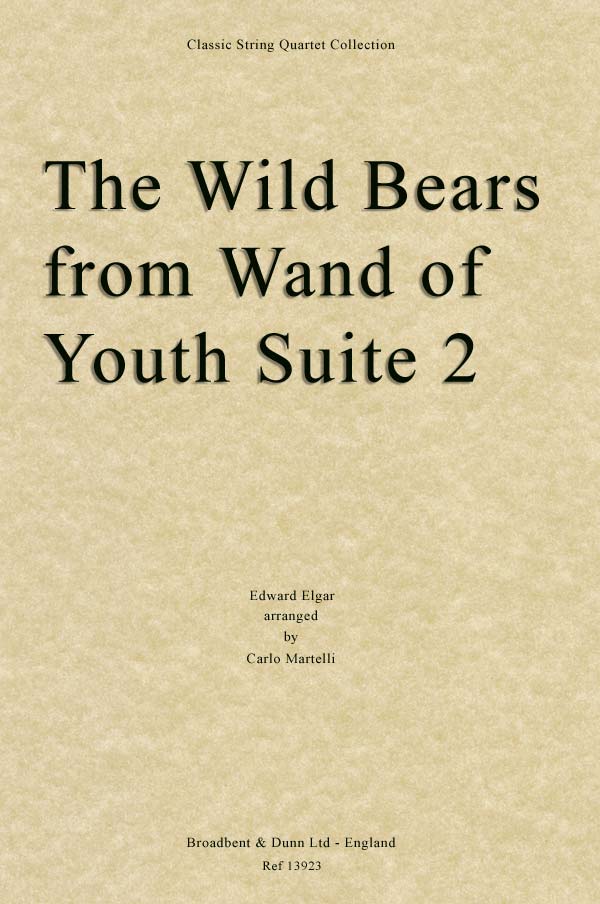
The Wild Bears, here arranged by Carlo Martelli for String Quartet, is the last movement from Elgar’s second Wand of Youth Suite and has become a favourite concert encore.
Piece Description
The Wild Bears, here arranged by Carlo Martelli for String Quartet, is the last movement from Elgar’s second Wand of Youth Suite and has become a favourite concert encore.
Additional information
| Media | |
|---|---|
| Composer | |
| Arranger | |
| Instrumentation | |
| Difficulty | |
| Series |
Biography
Biography
Martelli, Carlo
Carlo Martelli was born on the 12th December 1935 in London to an Italian father and an English mother. By the age of eleven Carlo had developed a passion for the symphony orchestra. Just before his twelfth birthday he started taking regular violin lessons and very soon began writing elaborate orchestral scores achieving a mastery in this field by the age of sixteen, by which time he had obtained a County Scholarship to attend the Royal College of Music in London, studying composition and viola. By the time he was 21 he had written a string quartet and had already had a great deal of success with several large scale serious symphonic compositions, notably his Second Symphony, which had many performances and broadcasts by several major orchestras in the few years after its completion. In the 1960's he turned to film music to make a living, and also worked steadily as a freelance viola player. His arrangements for string quartet, trio and other combinations number well over 250 and are played by hundreds of groups all over the world.

Related products
At the height of his maturity as a composer Elgar composed two suites for orchestra by expanding and developing some incidental music he had composed at the age of twelve for some private theatricals. This arrangement by Carlo Martelli is from the first suite.
The central movement Nimrod of Elgar's most popular symphonic orchestral work, has in this arrangement by Carlo Martelli had its original key (E flat) transposed to C for the sake of the greater sonority thus attained.

Elgar, Edward
At the height of his maturity as a composer, Elgar made two suites for orchestra by expanding and developing some incidental music he had composed at the age of twelve for some private theatricals. This arrangement by Carlo Martelli is the penultimate number from the second suite and is ideal for colleges.
In a lovely arrangement by Bill Thorp, this ever popular piece forms part of a group of Edward Elgar's much-loved salon pieces, that are as fresh and exquisite as when first conceived over a century ago. The wistful Salut d'Amour nostalgically evokes the (appropriately) Edwardian golden age, and will be ever-popular because it is so beautifully written.
Elgar, Edward
Elgar arr. Martelli – The Little Bells from Wand of Youth Suite No. 2 (String Quartet)
The Little Bells is the second movement of Elgar's Wand of Youth Suite No. 2 - it was first performed in Worcester on the 9th September 1908 as part of the Three Choirs Festival, and was conducted by the composer. Now arranged for String Quartet by Carlo Martelli.

In a lovely arrangement by Bill Thorp, this ever popular piece forms part of a group of Edward Elgar's much-loved salon pieces, that are as fresh and exquisite as when first conceived over a century ago. The wistful Salut d'Amour nostalgically evokes the (appropriately) Edwardian golden age, and will be ever-popular because it is so beautifully written.