

£12.95
A flashy arrangement by Stephen Morland, delightful as an encore. For colleges and professionals.
Piece Description
A flashy arrangement by Stephen Morland, delightful as an encore. For colleges and professionals.
Additional information
| Media | |
|---|---|
| Composer | |
| Arranger | |
| Instrumentation | |
| Difficulty | |
| Series |
Biography
Biography
Morland, Stephen
Stephen Pierce (aka Morland) studied clarinet with Wilfred Kealey, Colin Bradbury and John McCaw, and studied bass clarinet with Stephen Trier. Since leaving the Royal College of Music in 1975 he has been in demand over a wide range of musical styles. He was for many years principal clarinet with the Orchestra de Camera, and has played for many of the British orchestras on both clarinet and saxophone. He has worked for the Royal Philharmonic Orchestra, the BBC Concert Orchestra, the City of Birmingham Symphony Orchestra, the Royal Scottish National Orchestra and the Royal Ballet Sinfonia. With the National Symphony Orchestra he has recorded something in the region of 65 complete musicals for TER records. Stephen has always been a keen chamber musician, and as a soloist made his debut at the Wigmore Hall in 1980. For many years his principal occupation was as a recitalist and lecture recitalist. He was a member of the Marlborough Wind Quintet and the clarinet sextet Capital Clarinet. His wind Octet Harmoniemusik of London made its debut recording with Virgin Classics as well as its Wigmore Hall debut in 1997. At present Stephen plays bass clarinet with Saxpac, a saxophone septet, as well as clarinet in the Reineke Ensemble. Stephen has made numerous recordings, including the original cast recording of 'Phantom of the Opera'. He has worked for the Royal Shakespeare Company at the Barbican Theatre, London and the Royal Shakespeare Theatre, Stratford, and has also worked for the New Shakespeare's Globe as well as in many West End productions. Stephen is a former professor of clarinet and saxophone at the London College of Music.

Related products
Clarinet Quartet
C. P. E. Bach arr. Morland – Solfeggietto (Clarinet Quartet)
A flashy arrangement by Stephen Morland, delightful as an encore. For colleges and professionals.
Bach, Johann Sebastian
Bach arr. Martelli – Toccata and Fugue in D Minor (String Quartet)
This arrangement by Carlo Martelli of perhaps the mightiest and most popular of all organ works is at the other end of the scale from the many that have been made for huge orchestras, although nonetheless effective despite its mere four string players. Suitable for colleges, conservatories and professionals.

The second and last movements Burlesque I and Burlesque II are Associated Board of the Royal Schools of Music (ABRSM) Grade 7 Exam Pieces from 2022 until the end of 2029
A welcome addition to the repertoire for solo saxophone. The whole work was a Licentiate of the Royal Schools of Music (LRSM) Performance Diploma Exam Piece between 2000 and 2023. The third and last movements were Associated Board of the Royal Schools of Music (ABRSM) Grade 7 exam pieces between 2002 and 2013, while the first and last movements were Trinity College London exam pieces between 2001 and 2022. This work was also a Trinity College London Performance Certificate exam piece between 2003 and 2006.
Review: "A contemporary suite in four movements, two slow and two fast, making it ideal for recital or contest. For studios, schools, colleges, conservatories and professionals." - New Issues September 1995
Flute Quartet
In his Three by series Stephen Morland has compiled and edited favourite themes in an interesting and challenging way. These flute quartets, in this case Bach's Sleepers Wake, Jesu' Joy and Sheep May Safely Graze, have been delightfully arranged in such a manner that students of varying ability can have a rewarding and enjoyable musical experience. For schools, studios and professionals.
Saxophone Solo
There is not much repertoire for the tenor saxophone, and so this commissioned piece will form a useful addition to an impoverished market.
Flute Quartet
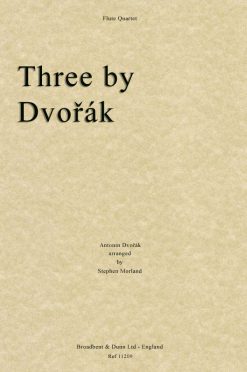
In his Three by series Stephen Morland has compiled and edited favourite themes in an interesting and challenging way. These flute quartets, in this case Dvořák’s Humoreske Opus 101 No. 7, themes from the New World Symphony and Slavonic Dance, have been delightfully arranged in such a manner that students of varying ability can have a rewarding and enjoyable musical experience. For studios, schools, colleges, conservatories and professionals.