

£10.95
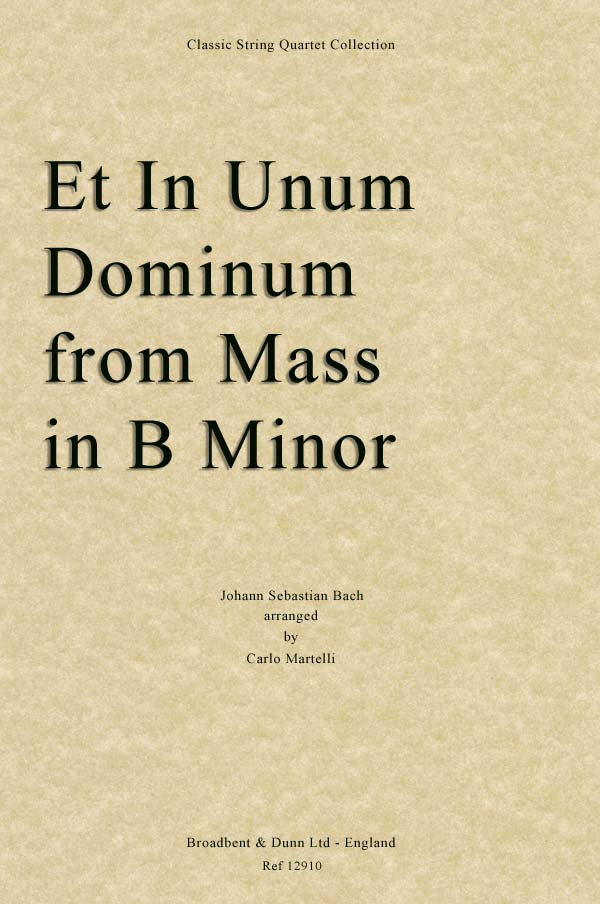
Bach’s vocal style has been accused, quite justly, of being entirely instrumental in origin – therefore this excerpt from the Mass in B Minor is particularly well suited to this arrangement for string quartet by Carlo Martelli.
Piece Description
Bach’s vocal style has been accused, quite justly, of being entirely instrumental in origin – therefore this excerpt from the Mass in B Minor is particularly well suited to this arrangement for string quartet by Carlo Martelli.
Additional information
| Media | |
|---|---|
| Composer | |
| Arranger | |
| Instrumentation | |
| Difficulty | |
| Series |
Biography
Biography
Martelli, Carlo
Carlo Martelli was born on the 12th December 1935 in London to an Italian father and an English mother. By the age of eleven Carlo had developed a passion for the symphony orchestra. Just before his twelfth birthday he started taking regular violin lessons and very soon began writing elaborate orchestral scores achieving a mastery in this field by the age of sixteen, by which time he had obtained a County Scholarship to attend the Royal College of Music in London, studying composition and viola. By the time he was 21 he had written a string quartet and had already had a great deal of success with several large scale serious symphonic compositions, notably his Second Symphony, which had many performances and broadcasts by several major orchestras in the few years after its completion. In the 1960's he turned to film music to make a living, and also worked steadily as a freelance viola player. His arrangements for string quartet, trio and other combinations number well over 250 and are played by hundreds of groups all over the world.

Related products
Grieg, Edvard Hagerup
Grieg arr. Martelli – Norwegian Dance Opus 35 No. 2 (String Quartet)
Grieg was essentially a miniaturist and therefore he tended to excel at this kind of piece, which evokes with a few characterized turns and intervals a deep love for his homeland. Arranged by Carlo Martelli.
Grieg, Edvard Hagerup
Grieg arr. Martelli – Norwegian Dance Opus 35 No. 1 (String Quartet)
This charming and characteristic dance is one of Grieg's many pieces for piano with a distinct national flavour, here expertly transcribed for string quartet by Carlo Martelli. For conservatories and professionals.
Bach, Johann Sebastian
Bach arr. Martelli – Toccata and Fugue in D Minor (String Quartet)
This arrangement by Carlo Martelli of perhaps the mightiest and most popular of all organ works is at the other end of the scale from the many that have been made for huge orchestras, although nonetheless effective despite its mere four string players. Suitable for colleges, conservatories and professionals.
Bach, Johann Sebastian
Bach arr. Martelli – Jesu’ Joy, Cantata No. 147 (String Quartet)
During his 27 years as cantor at St. Thomas's in Leipzig, Bach wrote over 160 cantatas for the various festivals of the church year. This arrangement by Carlo Martelli is of one of the best known numbers of these works.
Mendelssohn, Felix & Wagner, Richard
Mendelssohn & Wagner arr. Martelli – Wedding March (String Quartet)
In this arrangement by Carlo Martelli the middle section of Mendelssohn's famous wedding march has been replaced by Wagner's equally famous bridal march from Lohergrin. Two for the price of one, so to speak!
Bach, Johann Sebastian
Bach arr. Martelli – Et In Unum Dominum from Mass in B Minor (String Quartet) – Digital Download
Bach's vocal style has been accused, quite justly, of being entirely instrumental in origin - therefore this excerpt from the Mass in B Minor is particularly well suited to this arrangement for string quartet by Carlo Martelli.