An arrangement by Martin Yates for horn quartet of this popular song.
Horn Quartet
An arrangement by Martin Yates for horn quartet of this popular song.
Horn Quartet
An arrangement by Martin Yates for horn quartet of this popular song.
Gershwin, George
Gershwin arr. Thorp – They Can’t Take That Away From Me (String Quartet) – Digital Download
This bittersweet song, here arranged by Bill Thorp for string quartet, was famously sung by Fred Astaire in the 1937 film Shall We Dance? Lines from Ira Gershwin's lyric seem to have suggested the dreamy middle section "The way your smile just beams, The way you sing off key, The way you haunt my dreams". **** Not for sale in the USA ****
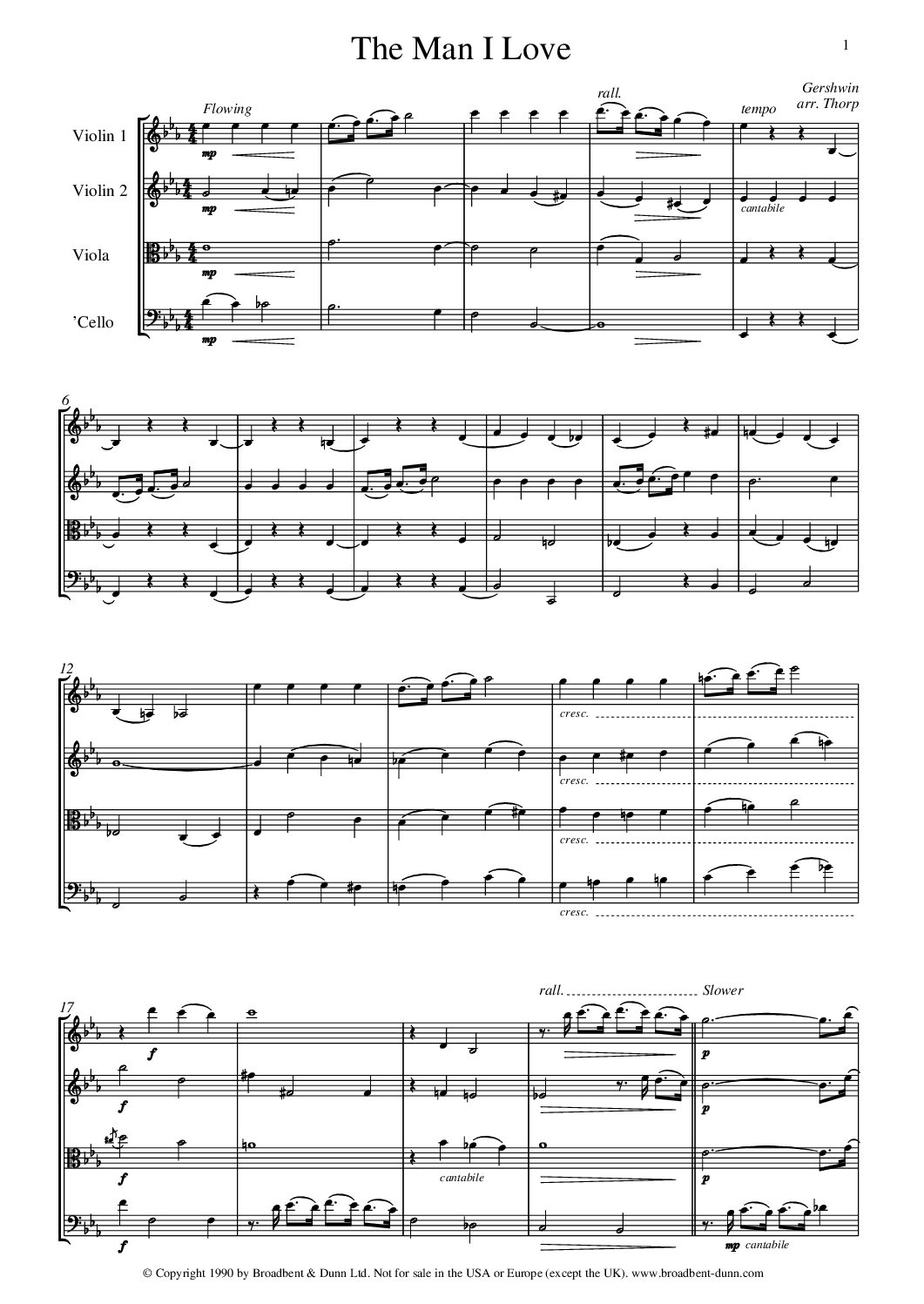
Since described as the best popular song ever written, this gem was inexplicably dropped from Lady Be Good, the Gershwins' first complete Broadway score, before it reached New York. However, it had an unlikely champion in the then Lady Mountbatten who brought her autographed copy back to London where soon nearly every band was playing it by ear, and from where its popularity spread to Paris and beyond. In this version, originally marked "not necessarily narcissistically", the arranger Bill Thorp subtly suggests the identity of the eponymous 'man'.
Gershwin, George
Since described as the best popular song ever written, this gem was inexplicably dropped from Lady Be Good, the Gershwins' first complete Broadway score, before it reached New York. However, it had an unlikely champion in the then Lady Mountbatten who brought her autographed copy back to London where soon nearly every band was playing it by ear, and from where its popularity spread to Paris and beyond. In this version, originally marked "not necessarily narcissistically", the arranger Bill Thorp subtly suggests the identity of the eponymous 'man'.
Gershwin, George
Gershwin arr. Thorp – Swanee (String Quartet) – Digital Download
Little is known of Irving Caesar's alternative lyric (and title Swansea) for this, George Gershwin's first big success (1919). Prompted by an unexpected and entirely spurious visit to Wales the following year, the new version is suffused with Celtic overtones and contains the legendary lines "I'd give the world to be, Among the folks in D-Y-F-E-D". The next port of call on the companions' short European tour (reflected in this arrangement by Bill Thorp) was Prague (aha!) where they eagerly imbued the Bohemian spirit and lifestyle of the artistic community centred on Novy Svet (literally 'New World'), the old poor quarter.
Gershwin, George
Little is known of Irving Caesar's alternative lyric (and title Swansea) for this, George Gershwin's first big success (1919). Prompted by an unexpected and entirely spurious visit to Wales the following year, the new version is suffused with Celtic overtones and contains the legendary lines "I'd give the world to be, Among the folks in D-Y-F-E-D". The next port of call on the companions' short European tour (reflected in this arrangement by Bill Thorp) was Prague (aha!) where they eagerly imbued the Bohemian spirit and lifestyle of the artistic community centred on Novy Svet (literally 'New World'), the old poor quarter.
This wistful song first appeared in George White's Scandals of 1924 and has been deservedly popular ever since. The chorus begins with the query "Somebody loves me, I wonder who?", which prompted the arranger Bill Thorp to mark this, one of his pet arrangements, "with an enquiring mind", and to musically explore possible solutions, considering Maria, Liza and Susie along the way before settling on his faithful boyhood friend (and dedicatee) 'my old dog', whose name you are invited to discover.
Gershwin, George
This wistful song first appeared in George White's Scandals of 1924 and has been deservedly popular ever since. The chorus begins with the query "Somebody loves me, I wonder who?", which prompted the arranger Bill Thorp to mark this, one of his pet arrangements, "with an enquiring mind", and to musically explore possible solutions, considering Maria, Liza and Susie along the way before settling on his faithful boyhood friend (and dedicatee) 'my old dog', whose name you are invited to discover.
Gershwin, George
Gershwin arr. Thorp – Nice Work If You Can Get It (String Quartet) – Digital Download
This song featured in the 1937 film A Damsel in Distress starring Fred Astaire and Joan Fontaine. 50 years later the arranger Bill Thorp dedicated his version to 'Mrs T' which, taken with the song's title and original marking "with gainful employment", has been considered by some to be a wry political comment. However, things are not always as they seem, a more commercial example of which we find in the songs initial couplet "The man who only lives for making money, Lives a life that isnt necessarily sunny", the penultimate word of which clearly gave the arranger some employment. **** Not for sale in the USA ****
Gershwin, George
Gershwin arr. Thorp – Nice Work If You Can Get It (String Quartet)
This song featured in the 1937 film A Damsel in Distress starring Fred Astaire and Joan Fontaine. 50 years later the arranger Bill Thorp dedicated his version to 'Mrs T' which, taken with the song's title and original marking "with gainful employment", has been considered by some to be a wry political comment. However, things are not always as they seem, a more commercial example of which we find in the songs initial couplet "The man who only lives for making money, Lives a life that isnt necessarily sunny", the penultimate word of which clearly gave the arranger some employment. **** Not for sale in the USA ****
This beautiful song was one of Gershwin's last, featuring in the 1938 film the Goldwyn Follies. It has been marked to be played entrancingly, apparently prompted by lines from Ira Gershwin's lyric "there came a knock-knock-knocking at the door - Love walked right in" which seemingly caused the arranger Bill Thorp's mind to make an imaginative leap to a mid-19th century Parisian garret, a celebrated knock at an operatic door, and the entrance of Puccini's Mimi. Ideal for weddings. **** Not for sale in the USA ****
Gershwin, George
This beautiful song was one of Gershwin's last, featuring in the 1938 film the Goldwyn Follies. It has been marked to be played entrancingly, apparently prompted by lines from Ira Gershwin's lyric "there came a knock-knock-knocking at the door - Love walked right in" which seemingly caused the arranger Bill Thorp's mind to make an imaginative leap to a mid-19th century Parisian garret, a celebrated knock at an operatic door, and the entrance of Puccini's Mimi. Ideal for weddings. **** Not for sale in the USA ****
According to his brother (and lyricist) Ira, this was the last song that George Gershwin worked on before his untimely death at the age of 38; it became even more popular after being featured in the 1951 film An American in Paris. It is marked 'Solid Rock Feel' by the arranger Bill Thorp, apparently due to the culminating lines of Ira's apocalyptic lyric "In time the Rockies may crumble, Gibraltar may tumble, They're only made of clay, But our love is here to stay". **** Not for sale in the USA ****
Gershwin, George
According to his brother (and lyricist) Ira, this was the last song that George Gershwin worked on before his untimely death at the age of 38; it became even more popular after being featured in the 1951 film An American in Paris. It is marked 'Solid Rock Feel' by the arranger Bill Thorp, apparently due to the culminating lines of Ira's apocalyptic lyric "In time the Rockies may crumble, Gibraltar may tumble, They're only made of clay, But our love is here to stay". **** Not for sale in the USA ****
Gershwin, George
Gershwin arr. Thorp – I’ll Build A Stairway To Paradise (String Quartet) – Digital Download
Here with an introduction that looks like a (slightly rickety) staircase, this song was included in George White's Scandals of 1922 at the Globe Theatre, New York, conducted by Paul Whiteman, for whom Gershwin was two years later to write Rhapsody in Blue. The song's dancing theme prompted the arranger Bill Thorp to dedicate his version to Fred Astaire; he also originally marked it to be played "horticulturally", an exotic instruction whose only justification seems to be a line from the song's second verse, wherein appears the exhortation "Get busy .... Lizzy", though it has been suggested that the chorus lyric "I've got the blues" originally read "I've got the pinks". The "fair" mentioned in the following line is thought to be the celebrated one held at the Paradise Gardens, Berghald, Switzerland.
Gershwin, George
Gershwin arr. Thorp – A Foggy Day In London Town (String Quartet) – Digital Download
This song, sung by Fred Astaire in A Damsel in Distress (1937) was originally marked "with a scholarly air" by the arranger Bill Thorp, prompted by the celebrated couplet from Ira Gershwin's lyric "I viewed the morning with alarm, The British Museum had lost its charm". There is also a reference to 'Summertime' at the point in the song with the words "and through foggy London Town the sun was shining everywhere". **** Not for sale in the USA ****
Gershwin, George
Gershwin arr. Thorp – A Foggy Day In London Town (String Quartet)
This song, sung by Fred Astaire in A Damsel in Distress (1937) was originally marked "with a scholarly air" by the arranger Bill Thorp, prompted by the celebrated couplet from Ira Gershwin's lyric "I viewed the morning with alarm, The British Museum had lost its charm". There is also a reference to 'Summertime' at the point in the song with the words "and through foggy London Town the sun was shining everywhere". **** Not for sale in the USA ****
The irresistible 'S Wonderful' featured in the 1927 Broadway show Funny Face, starring Fred Astaire and his sister Adele. (Astonishingly, Fred also starred in the Paramount film of Funny Face, made 30 years later, though this time with a young Audrey Hepburn). The arranger Bill Thorp originally marked his version "natalitially", a piece of whimsy suggested by the song's opening line "Life has just begun", which seems to have induced in him a somewhat Messianic train of thought.
Gershwin, George
The irresistible 'S Wonderful' featured in the 1927 Broadway show Funny Face, starring Fred Astaire and his sister Adele. (Astonishingly, Fred also starred in the Paramount film of Funny Face, made 30 years later, though this time with a young Audrey Hepburn). The arranger Bill Thorp originally marked his version "natalitially", a piece of whimsy suggested by the song's opening line "Life has just begun", which seems to have induced in him a somewhat Messianic train of thought.
This arrangement by Carlo Martelli, of one of Gershwin's early songs, perfectly captures the spirit of mid 1920's America and the atmosphere of the then popular speakeasies. The skilful use of the string quartet medium achieves a richness and complexity unequalled by other arrangers in this genre.
Gershwin, George
This arrangement by Carlo Martelli, of one of Gershwin's early songs, perfectly captures the spirit of mid 1920's America and the atmosphere of the then popular speakeasies. The skilful use of the string quartet medium achieves a richness and complexity unequalled by other arrangers in this genre.
Gershwin, George
Gershwin arr. Martelli – Walking The Dog, Promenade (String Quartet) – Digital Download
This Promenade was originally improvised by its composer on the film set to provide music for a scene not previously thought by its director to need it. Gershwin subsequently wrote it down and this arrangement by Carlo Martelli elaborates on what was originally a simpler piece. For conservatories and professionals. **** Not for sale in the USA ****
Gershwin, George
Gershwin arr. Martelli – Walking The Dog, Promenade (String Quartet)
This Promenade was originally improvised by its composer on the film set to provide music for a scene not previously thought by its director to need it. Gershwin subsequently wrote it down and this arrangement by Carlo Martelli elaborates on what was originally a simpler piece. For conservatories and professionals. **** Not for sale in the USA ****
This is one of the most elaborate and complex of Carlo Martelli's string quartet arrangements. Martelli's approach is to use the original material of the song as the basis for a quasi symphonic musical discourse. The skilful use of the string quartet medium achieves a richness and complexity unequalled by other arrangers in this genre. The Pavão Quartet recorded this piece on the CD Someone To Watch Over Me, released in 2006 by Landor Records LAN 277. On the same CD are four more of Martelli’s Gershwin arrangements also published by Broadbent & Dunn. **** Not for sale in the USA ****
Gershwin, George
This is one of the most elaborate and complex of Carlo Martelli's string quartet arrangements. Martelli's approach is to use the original material of the song as the basis for a quasi symphonic musical discourse. The skilful use of the string quartet medium achieves a richness and complexity unequalled by other arrangers in this genre. The Pavão Quartet recorded this piece on the CD Someone To Watch Over Me, released in 2006 by Landor Records LAN 277. On the same CD are four more of Martelli’s Gershwin arrangements also published by Broadbent & Dunn. **** Not for sale in the USA ****