

This piece is all about the fun side of country music. Don't Ask is the simple answer to the question asking what happens next. Freedom is a spiritual from the rural state of Tennessee, starting with a lone plaintive cry that becomes a statement of optimism as more people join in. In Pam! Bam! Zonk! the drinking gets a little too much for some, so this movement is a glorious fight.
String Quartet
This piece is all about the fun side of country music. Don't Ask is the simple answer to the question asking what happens next. Freedom is a spiritual from the rural state of Tennessee, starting with a lone plaintive cry that becomes a statement of optimism as more people join in. In Pam! Bam! Zonk! the drinking gets a little too much for some, so this movement is a glorious fight.
String Orchestra
Martin Yates – L.A. Beach Music for String Orchestra (Set of Parts)
Your purchase will consist of the following set of Parts:
5 x First Violin 4 x Second Violin 3 x Viola 2 x 'Cello 1 x Double Bass Extra parts available on request A musical representation of the city or area of the titles as experienced by the composer. The music is drawn from pop, rock, jazz and jazz funk.
String Orchestra
Martin Yates – L.A. Beach Music for String Orchestra (Full Score)
A musical representation of the city or area of the titles as experienced by the composer. The music is drawn from pop, rock, jazz and jazz funk.

A musical representation of the city or area of the titles as experienced by the composer Martin Yates. The music is drawn from pop, rock, jazz and jazz funk.

A musical representation of the city or area of the titles as experienced by the composer Martin Yates. The music is drawn from pop, rock, jazz and jazz funk.

String Orchestra
Martin Yates – L.A. Beach Music for String Orchestra – Double Bass Digital Download
A musical representation of the city or area of the titles as experienced by the composer Martin Yates. The music is drawn from pop, rock, jazz and jazz funk.

A musical representation of the city or area of the titles as experienced by the composer Martin Yates. The music is drawn from pop, rock, jazz and jazz funk.

String Orchestra
Martin Yates – L.A. Beach Music for String Orchestra – 2nd Violins Digital Download
A musical representation of the city or area of the titles as experienced by the composer Martin Yates. The music is drawn from pop, rock, jazz and jazz funk.

String Orchestra
Martin Yates – L.A. Beach Music for String Orchestra – 1st Violins Digital Download
A musical representation of the city or area of the titles as experienced by the composer Martin Yates. The music is drawn from pop, rock, jazz and jazz funk.

A musical representation of the city or area of the titles as experienced by the composer. The music is drawn from pop, rock, jazz and jazz funk.
String Quartet
A musical representation of the city or area of the titles as experienced by the composer. The music is drawn from pop, rock, jazz and jazz funk.

Oboe, Bassoon & Double Bass
Martin Yates – Divertimento (Oboe, Bassoon & Double Bass) – Digital Download
Oboe and bassoon are joined by a lively string bass in this charming English chamber work. For colleges, conservatories and professionals.
Oboe, Bassoon & Double Bass
Oboe and bassoon are joined by a lively string bass in this charming English chamber work. For colleges, conservatories and professionals.

Violin, 'Cello & Piano
Martin Yates – Café Music (Violin, ‘Cello & Piano) – Digital Download
The first movement First Waltz is a delicate waltz, very English in spirit. The Lopsided Polka is just that (imagine three old ladies playing in the Pump Room in Bath, with none of them able to agree on the time signatures or the rhythms in this polka). Valse d'Amour is a beautiful melody played on the 'cello, whose intention it is to remind the listener of the love theme from a turn of the century operetta, and Midsummer Waltz is a happy forward looking dance, simple and straightforward with a charm all of its own. For colleges, conservatories and professionals.
Violin, 'Cello & Piano
The first movement First Waltz is a delicate waltz, very English in spirit. The Lopsided Polka is just that (imagine three old ladies playing in the Pump Room in Bath, with none of them able to agree on the time signatures or the rhythms in this polka). Valse d'Amour is a beautiful melody played on the 'cello, whose intention it is to remind the listener of the love theme from a turn of the century operetta, and Midsummer Waltz is a happy forward looking dance, simple and straightforward with a charm all of its own. For colleges, conservatories and professionals.

Flute, 'Cello & Piano
Martin Yates – Café Music (Flute, ‘Cello & Piano) – Digital Download
The first movement First Waltz is a delicate waltz, very English in spirit. The Lopsided Polka is just that (imagine three old ladies playing in the Pump Room in Bath, with none of them able to agree on the time signatures or the rhythms in this polka. Valse d'Amour is a beautiful melody played on the 'cello, whose intention it is to remind the listener of the love theme from a turn of the century operetta, and Midsummer Waltz is a happy forward looking dance, simple and straightforward with a charm all of its own. For colleges, conservatories and professionals.
Flute, 'Cello & Piano
The first movement First Waltz is a delicate waltz, very English in spirit. The Lopsided Polka is just that (imagine three old ladies playing in the Pump Room in Bath, with none of them able to agree on the time signatures or the rhythms in this polka. Valse d'Amour is a beautiful melody played on the 'cello, whose intention it is to remind the listener of the love theme from a turn of the century operetta, and Midsummer Waltz is a happy forward looking dance, simple and straightforward with a charm all of its own. For colleges, conservatories and professionals.

'Frisco by those in the know is a jewel of a city. The titles of the four movements tell it all - Keeping Ahead of yourself is what you have to do in a city with a glorious past but an uncertain and uneasy present. Light Reflecting from the Bridge seems to warm the whole city, bathing it in a gently reddish hue. Alongside the pathway in one of the city parks is a sand track for horses, and every now and then you see Footprints in the Sand, some are in couples, others alone. The thoughts of those people who are alone touches you, but it is the Time to Be Certain and you regain your beliefs and confidence.
String Quartet
'Frisco by those in the know is a jewel of a city. The titles of the four movements tell it all - Keeping Ahead of yourself is what you have to do in a city with a glorious past but an uncertain and uneasy present. Light Reflecting from the Bridge seems to warm the whole city, bathing it in a gently reddish hue. Alongside the pathway in one of the city parks is a sand track for horses, and every now and then you see Footprints in the Sand, some are in couples, others alone. The thoughts of those people who are alone touches you, but it is the Time to Be Certain and you regain your beliefs and confidence.

Violin & Harpsichord
This 2014 publication might well have been composed 300 years earlier, being a truly baroque sonata in four movements (slow-fast-slow-fast). The composer has adhered not only to the harmonic and structural idioms of the time, but also to many of the other "unwritten" conventions. The work invites a great deal of freedom, and even leaves room for some improvisation. In the third movement the violin enters on a long, held note - this pattern recurs throughout, and in some ways appears to echo similar long notes in Bach's B Minor Sonata. The last movement is a set of variations, though neither chaconne nor passacaglia - these are melodic, in the Italian manner, and clearly sound less baroque. The thematic material derives from the opening of Papageno's aria Ein Mädchen oder Weibchen from Mozart's Magic Flute, but transposed from F Major to D Minor. This sonata was premiered at the Lincoln Center by Bobby Portney and has subsequently been recorded by Sarah Darling and can be heard on YouTube: https://www.youtube.com/watch?v=UigLnCPNYSw
Violin & Harpsichord
Lenny Cavallaro – Sonata No. 1 in D Minor for Violin and Piano (or Harpsichord) Opus 4
This 2014 publication might well have been composed 300 years earlier, being a truly baroque sonata in four movements (slow-fast-slow-fast). The composer has adhered not only to the harmonic and structural idioms of the time, but also to many of the other "unwritten" conventions. The work invites a great deal of freedom, and even leaves room for some improvisation. In the third movement the violin enters on a long, held note - this pattern recurs throughout, and in some ways appears to echo similar long notes in Bach's B Minor Sonata. The last movement is a set of variations, though neither chaconne nor passacaglia - these are melodic, in the Italian manner, and clearly sound less baroque. The thematic material derives from the opening of Papageno's aria Ein Mädchen oder Weibchen from Mozart's Magic Flute, but transposed from F Major to D Minor. This sonata was premiered at the Lincoln Center by Bobby Portney and has subsequently been recorded by Sarah Darling and can be heard on YouTube: https://www.youtube.com/watch?v=UigLnCPNYSw

Violin & Piano
Lenny Cavallaro – ‘Raindrops’ Fantasia for Violin and Piano, Opus 5 – Digital Download
"Raindrops" Fantasia, Opus 5, is essentially a set of free variations in early Romantic style. The work develops a simple three-note motif (E-D#-E) in both the minor and major modes. Each variation is quite different, with one taking the form of the Classical minuet and trio. This composition was hailed by a critic as "a throwback to Schubert", which is certainly somewhat unusual for a 21st Century publication, although Cavallaro audaciously adheres to 18th and 19th century forms, harmonic language, and structure. In this sense Lenny is a 'cultural missionary' who hopes that his compositions will encourage other composers to return to our common heritage. "Raindrops Fantasia" can be heard on YouTube with Bobby Portney on violin and Lenny Cavallaro on piano at https://www.youtube.com/watch?v=QQ8PRH9n2AM
"Raindrops" Fantasia, Opus 5, is essentially a set of free variations in early Romantic style. The work develops a simple three-note motif (E-D#-E) in both the minor and major modes. Each variation is quite different, with one taking the form of the Classical minuet and trio. This composition was hailed by a critic as "a throwback to Schubert", which is certainly somewhat unusual for a 21st Century publication, although Cavallaro audaciously adheres to 18th and 19th century forms, harmonic language, and structure. In this sense Lenny is a 'cultural missionary' who hopes that his compositions will encourage other composers to return to our common heritage. "Raindrops Fantasia" can be heard on YouTube with Bobby Portney on violin and Lenny Cavallaro on piano at https://www.youtube.com/watch?v=QQ8PRH9n2AM

This Sonata for Violin and Piano reflects the essence of John Simpson's music. It belongs to one of the most fulfilled periods of the composers life when he was experiencing both the excitement of travelling the world as a music examiner as well as the intense happiness of being a grandparent. As such this is possibly the composers most radiant work, with a slow movement that he would most like to be remember by.
The opening movement of this work, the most extended of the four, contrasts a wistful almost elegiac section with one that is fast and dance-like. There is an extended slow passage at the end that seems to be searching for resolutions not provided until later. The second movement, a scherzo, is passionate rather than playful: it is the most joyous of the four, indicative perhaps of the elation that it is possible to feel when finding the means of being able to express ideas in a way that the composer hardly thought possible. The slow third movement, a lyrical cantilena with the violin always to the fore, is the emotional core of the work, and leads without a break into the quick dance-like finale. After modulating through a variety of keys this reaches a climax in an ecstatic waltz-time transformation of the opening of the work in the home key of D major. However, rather than ending loudly, the music drifts ever more quietly into the distance without ever slowing down, like a procession fading into memory.
Violin & Piano
This Sonata for Violin and Piano reflects the essence of John Simpson's music. It belongs to one of the most fulfilled periods of the composers life when he was experiencing both the excitement of travelling the world as a music examiner as well as the intense happiness of being a grandparent. As such this is possibly the composers most radiant work, with a slow movement that he would most like to be remember by.
The opening movement of this work, the most extended of the four, contrasts a wistful almost elegiac section with one that is fast and dance-like. There is an extended slow passage at the end that seems to be searching for resolutions not provided until later. The second movement, a scherzo, is passionate rather than playful: it is the most joyous of the four, indicative perhaps of the elation that it is possible to feel when finding the means of being able to express ideas in a way that the composer hardly thought possible. The slow third movement, a lyrical cantilena with the violin always to the fore, is the emotional core of the work, and leads without a break into the quick dance-like finale. After modulating through a variety of keys this reaches a climax in an ecstatic waltz-time transformation of the opening of the work in the home key of D major. However, rather than ending loudly, the music drifts ever more quietly into the distance without ever slowing down, like a procession fading into memory.
Violin & Piano
John Marson – Two Idylls (Violin & Piano) – Digital Download
Short modern violin and piano pieces are rare, but these can take their place amongst examples from Elgar and the like. Unpretentious and good at making friends Two Idylls attempts to capture the sense of delight in the contemplation of pastoral landscapes, and the perceived serenity of the countryside. For the city dweller passing through such vistas speak of more relaxed times and freedom from constant pressures. There is, however, an underlying sense of not belonging, and in these pieces the tranquil settings are shot through with tensions that will not go away. No specific times or places are depicted, but the composers own recall of a period spent living in the country and his feeling of loss as he looks back to those years, perhaps account for the mixed moods of these pieces.
Violin & Piano
Short modern violin and piano pieces are rare, but these can take their place amongst examples from Elgar and the like. Unpretentious and good at making friends Two Idylls attempts to capture the sense of delight in the contemplation of pastoral landscapes, and the perceived serenity of the countryside. For the city dweller passing through such vistas speak of more relaxed times and freedom from constant pressures. There is, however, an underlying sense of not belonging, and in these pieces the tranquil settings are shot through with tensions that will not go away. No specific times or places are depicted, but the composers own recall of a period spent living in the country and his feeling of loss as he looks back to those years, perhaps account for the mixed moods of these pieces.

These lyrical pieces are essentially nostalgic, although never sad. They appeal to all audiences.
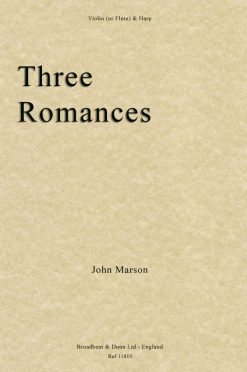
These lyrical pieces are essentially nostalgic, although never sad. They appeal to all audiences.