

£18.95
In five movements, each with an engaging title, this is a substantial concert work which can serve as a principal item when programme building. Always tuneful and with a great variety of moods, it is a valuable addition to the flute and harp repertoire.
Piece Description
In five movements, each with an engaging title, this is a substantial concert work which can serve as a principal item when programme building. Always tuneful and with a great variety of moods, it is a valuable addition to the flute and harp repertoire.
Review: “This Suite of 5 contrasting movements is a charming work for flute and harp, making it a great piece to add to a concert programme being light and accessible for the audience, tuneful and fun to play. The harp part is fairly straight-forward and it is fairly easy to get together with the flute. Played in full it is quite a substantial work and a great addition to the standard repertoire, and a piece which could work in many situations, including background. Well-written for both the flute and harp, I have performed it in concert and there are chances for both instruments to shine.” – Dr. Rachel Smith DMA, MA, BMus (Hons), FTCL – January 2013
Review: “This Suite for Flute and Harp is a delightfully light and accessible tonal work. Five movements in length, all but the last movement rondo are tripartite in construction. Had Marson not been so clever in his melodic invention, and just decidedly good at writing idiomatically for both instruments, this repetitious format could have become very tedious. Marson has thought it all out however: his sectional transitions are smooth and the modulations are well planned events. Except for the repetitious formal structure, Marson does nothing in excess: even in its most spirited and syncopated third movement, Can’t Stop to Talk, the music rarely loses its polite, graceful manner. The wavelike arpeggiated harp figures and flowing flute melody in Almond Lake are reminiscent of Debussy’s En Bateau and the Strawberries and Cream finale is replete with a Debussian whole-tone downward glissando. Marsons love and understanding of his own instrument is particularly apparent in the well written solo sections of the third and fourth (Like Blossoms on a Tree) movements. Let there be no misunderstanding – Marson has not intended this suite as a ‘serious’ work for flute and harp. Nonetheless, it is a fine example of a light hearted, idiomatically written composition.” – Mary Natvig of Bowling Green State University in Notes, March 2000
Additional information
| Media | |
|---|---|
| Composer | |
| Instrumentation | |
| Difficulty | |
| Series | |
| Movement Titles | Spring Blooms, Almond Lake, Can't Stop to Talk, Like Blossom on a Tree and Strawberries and Cream |
Biography
Biography
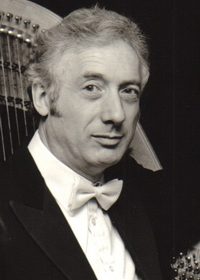
Marson, John
John Marson was born in 1932 and died in 2007. He studied the harp with Marie Goossens at the Royal College of Music in London, and in 1958, while still a student, began his professional career with the Carl Rosa Opera Company. A week after leaving college he joined the London Symphony Orchestra for two years before embarking on two decades of freelance work, during which he played solos, chamber music and concerti, worked with all the London orchestras and spent much time in recording studios. He played in many outstanding feature films including the original 'Star Wars'. In 1982 he was appointed principal harp of the BBC Symphony Orchestra, and subsequently resumed his freelance career while increasingly engaging in composition, both for the harp and for other instruments and voice. He played for many West End and National Theatre productions including over three years as harpist in Lloyd Webber's 'Aspects of Love'.
The roll call of artists with whom John has worked include the Beatles, Richard Rodney Bennett, Leonard Bernstein, Pierre Boulez, Benjamin Britten, Charlie Chaplin, Bing Crosby, John Dankworth, Duke Ellington, Benny Goodman, Liberace, Martha Graham, Hans Werner Henze, Herbert von Karajan, Otto Klemperer, Zoltan Kodaly, Lorin Maazel, Neville Marriner, Pierre Monteux, Jessye Norman, Laurence Olivier, Luciano Pavarotti, Gennadi Rozhdestvenski, Frank Sinatra, George Solti, Leopold Stokowski, Igor Stravinsky, George Szell, William Walton, John Williams, Stevie Wonder and countless others.
In 1964 John was one of the two founders of the United Kingdom Harp Association, edited its magazines for many years and became President of the Association in January 2005. His book 'The Complete Guide to Harp Glissandi', is published by Lyra Music of New York, while his other major work 'The Book of the Harp - techniques, history and lore of a unique musical instrument', was published by Kevin Mayhew Ltd. in 2005.
Related products
Flute & Harp
The musical equivalent of important extracts taken from a diary. For colleges and professionals.
Flute & Harp
A lightweight kaleidoscopic view of a country outing, in which the last of the three movements portrays playfully the pleasures, and perhaps fatigue, of a bicycle ride.

These lyrical pieces are essentially nostalgic, although never sad. They appeal to all audiences.
String Quartet
Written above all to be enjoyed by the players, audiences have shown that they too share that same delight. Both of Mason's string quartets are in four movements which exploit the instruments on equal terms, and both are in a musical language that enables the strings to sing as they should. These two quartets will happily share any programme with music from Haydn to Debussy and beyond.
Flute & Harp
In five movements, each with an engaging title, this is a substantial concert work which can serve as a principal item when programme building. Always tuneful and with a great variety of moods, it is a valuable addition to the flute and harp repertoire.

Bassoon & Piano
Too little good music exists for this combination, and so its accessibility commends it to bassoonists. John Marson has given the personalities of the different registers plentiful scope to display their individualities in music with strong melodic content.