



£13.95
An expertly contrived arrangement by Carlo Martelli of the most famous movement from Holst’s ever popular suite, which contains the well known tune I Vow to Thee my Country.
Piece Description
An expertly contrived arrangement by Carlo Martelli of the most famous movement from Holst’s ever popular suite, which contains the well known tune I Vow to Thee my Country.
Additional information
| Media | |
|---|---|
| Composer | |
| Arranger | |
| Instrumentation | |
| Difficulty | |
| Series |
Biography
Biography
Martelli, Carlo
Carlo Martelli was born on the 12th December 1935 in London to an Italian father and an English mother. By the age of eleven Carlo had developed a passion for the symphony orchestra. Just before his twelfth birthday he started taking regular violin lessons and very soon began writing elaborate orchestral scores achieving a mastery in this field by the age of sixteen, by which time he had obtained a County Scholarship to attend the Royal College of Music in London, studying composition and viola. By the time he was 21 he had written a string quartet and had already had a great deal of success with several large scale serious symphonic compositions, notably his Second Symphony, which had many performances and broadcasts by several major orchestras in the few years after its completion. In the 1960's he turned to film music to make a living, and also worked steadily as a freelance viola player. His arrangements for string quartet, trio and other combinations number well over 250 and are played by hundreds of groups all over the world.
Related products
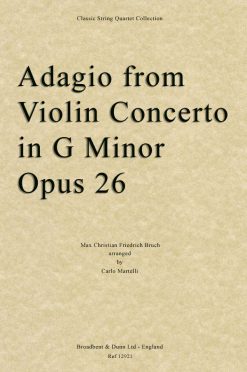
Bruch, Max Christian Friedrich
Bruch arr. Martelli – Adagio from Violin Concerto in G Minor (String Quartet)
In this arrangement by Carlo Martelli of the beautiful slow movement of Bruch's Violin Concerto the solo part is unchanged and the orchestral part arranged for the other three players.
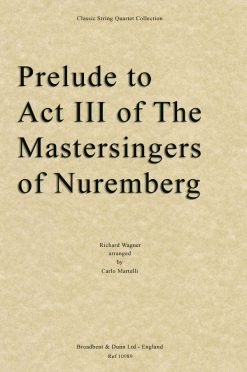
Wagner, Richard
Wagner arr. Martelli – Prelude to Act III of The Mastersingers of Nuremberg (String Quartet)
This solemn and pensive prelude from Wagner's only comic masterpiece expresses the poet-cobbler Hans Sach's ruminations on the folly and vanity of man. Arranged by Carlo Martelli.
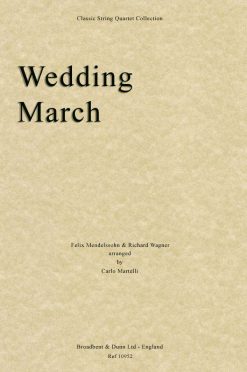
Mendelssohn, Felix & Wagner, Richard
Mendelssohn & Wagner arr. Martelli – Wedding March (String Quartet)
In this arrangement by Carlo Martelli the middle section of Mendelssohn's famous wedding march has been replaced by Wagner's equally famous bridal march from Lohergrin. Two for the price of one, so to speak!

Beethoven, Ludwig Van
Beethoven arr. Martelli – Symphony No. 6 Movement 1 (String Quartet) – Digital Download
This opening movement, of perhaps Beethoven's most lyrical and contemplative symphony, lends itself particularly well to transference to the string quartet. Beethoven meant this movement to evoke the awakening of cheerful feelings on arrival in the country. This skilful arrangement by Carlo Martelli captures the mood intended just as well as the original.
Grieg, Edvard Hagerup
Grieg arr. Martelli – Norwegian Dance Opus 35 No. 2 (String Quartet)
Grieg was essentially a miniaturist and therefore he tended to excel at this kind of piece, which evokes with a few characterized turns and intervals a deep love for his homeland. Arranged by Carlo Martelli.
Davies, Henry Walford
This rousing march, arranged by Carlo Martelli, was written by the then 'Master of the King's Music' to celebrate the R.A.F. victory over Hitler's Luftwaffe in September 1940. For secondary schools, colleges, conservatories and professionals.