

£10.95
This, the last and liveliest of the set of Norwegian Dances, is characterised by the composers conspicuous gift for melody, nourished by the folk tunes of his native Norway. Arranged by Carlo Martelli. For colleges, conservatories and professionals.
Piece Description
This, the last and liveliest of the set of Norwegian Dances, is characterised by the composers conspicuous gift for melody, nourished by the folk tunes of his native Norway. Arranged by Carlo Martelli. For colleges, conservatories and professionals.
Additional information
| Media | |
|---|---|
| Composer | |
| Arranger | |
| Instrumentation | |
| Difficulty | |
| Series |
Biography
Biography
Martelli, Carlo
Carlo Martelli was born on the 12th December 1935 in London to an Italian father and an English mother. By the age of eleven Carlo had developed a passion for the symphony orchestra. Just before his twelfth birthday he started taking regular violin lessons and very soon began writing elaborate orchestral scores achieving a mastery in this field by the age of sixteen, by which time he had obtained a County Scholarship to attend the Royal College of Music in London, studying composition and viola. By the time he was 21 he had written a string quartet and had already had a great deal of success with several large scale serious symphonic compositions, notably his Second Symphony, which had many performances and broadcasts by several major orchestras in the few years after its completion. In the 1960's he turned to film music to make a living, and also worked steadily as a freelance viola player. His arrangements for string quartet, trio and other combinations number well over 250 and are played by hundreds of groups all over the world.
Related products
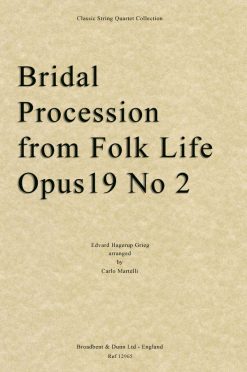
Grieg, Edvard Hagerup
Grieg arr. Martelli – Bridal Procession from Folk Life, Opus 19 No. 2 (String Quartet)
This opus cleverly conjures up the vision of an approaching procession, the wild merrymaking as it passes by and its subsequent fading away into the distance. In the closing bars of this characteristically masterly arrangement Carlo Martelli has introduced sly references to both Mendelssohn's and Wagner's wedding marches. For colleges, conservatories and professionals.

Grieg, Edvard Hagerup
Grieg arr. Martelli – Norwegian Dance Opus 35 No. 1 (String Quartet) – Digital Download
This charming and characteristic dance is one of Grieg's many pieces for piano with a distinct national flavour, here expertly transcribed for string quartet by Carlo Martelli. For conservatories and professionals.
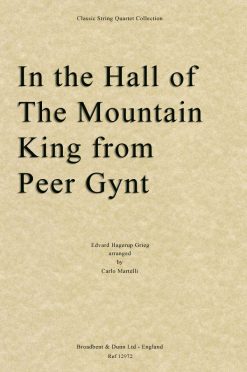
Grieg, Edvard Hagerup
Grieg arr. Martelli – In the Hall of the Mountain King from Peer Gynt (String Quartet)
One of the most difficult problems for an arranger with only a string quartet to deal with is to reproduce and translate into chamber music terms the cumulative effect of a lengthy orchestral crescendo. Carlo Martelli in this case has solved the problem to brilliant effect. For conservatories and professionals.

Grieg, Edvard Hagerup
Grieg arr. Martelli – Norwegian March from Lyric Pieces (String Quartet) – Digital Download
This arrangement by Carlo Martelli is one of six characteristic pieces originally composed for pianoforte. The composer later orchestrated four of them to comprise his Lyric Pieces of which this is the second movement. For colleges, conservatories and professionals.

Grieg, Edvard Hagerup
One of the most difficult problems for an arranger with only a string quartet to deal with is to reproduce and translate into chamber music terms the cumulative effect of a lengthy orchestral crescendo. Carlo Martelli in this case has solved the problem to brilliant effect. For conservatories and professionals.
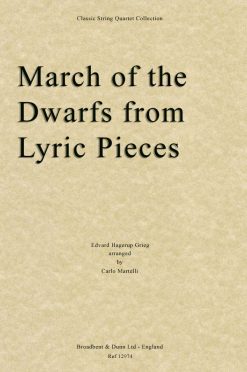
Grieg, Edvard Hagerup
Grieg arr. Martelli – March of the Dwarfs from Lyric Pieces (String Quartet)
One of six Lyric Pieces, originally for piano, which have been expertly transcribed for the four strings by Carlo Martelli. Better known in its orchestrated version this quiet march has a wistful middle section.