

Lemare, Edwin Henry
Lemare arr. Thorp – Moonlight and Roses (String Quartet) – Digital Download
The haunting melody, that forms the chorus of this song, started life in 1892 as an Andantino for organ by Edwin Henry Lemare. Its opening phrase had an even earlier birth, however, bearing as it does an uncanny resemblance to that of the Adagio of Mozart's Hunt quartet. This may explain the arranger Bill Thorp's musical treatment, his original marking "in hot pursuit", and the dedication to the celebrated Pizza Express quartet at Dean Street, Soho, London; for in medieval times this area was farming and hunting land, its name deriving from the old hunting cry of "So-ho!"
Lemare, Edwin Henry
The haunting melody, that forms the chorus of this song, started life in 1892 as an Andantino for organ by Edwin Henry Lemare. Its opening phrase had an even earlier birth, however, bearing as it does an uncanny resemblance to that of the Adagio of Mozart's Hunt quartet. This may explain the arranger Bill Thorp's musical treatment, his original marking "in hot pursuit", and the dedication to the celebrated Pizza Express quartet at Dean Street, Soho, London; for in medieval times this area was farming and hunting land, its name deriving from the old hunting cry of "So-ho!"

Scott Joplin was born into a poor black family in Texas in 1868, just three years after the abolition of slavery. As a teenager he left home to work as a saloon pianist in St Louis, a cosmopolitan Mississippi port and the birthplace of Ragtime, the lively piano style which had developed from syncopated minstrel songs and dances. Among many talented black pianists Joplin was the first with the ability to set down in musical notation this new art form. Besides rags Joplin wrote other sorts of piano music, such as the lovely Solace (featured in the hit film The Sting, and arranged here for string quartet by Bill Thorp), whose gentle melancholy and emotionally-charged pauses are overlaid on the rhythms of a Mexican Serenade.

Scott Joplin was born into a poor black family in Texas in 1868, just three years after the abolition of slavery. As a teenager he left home to work as a saloon pianist in St Louis, a cosmopolitan Mississippi port and the birthplace of Ragtime, the lively piano style which had developed from syncopated minstrel songs and dances. Among many talented black pianists Joplin was the first with the ability to set down in musical notation this new art form. Besides rags Joplin wrote other sorts of piano music, such as the lovely Solace (featured in the hit film The Sting, and arranged here for string quartet by Bill Thorp), whose gentle melancholy and emotionally-charged pauses are overlaid on the rhythms of a Mexican Serenade.

Scott Joplin was born into a poor black family in Texas in 1868, just three years after the abolition of slavery. As a teenager he left home to work as a saloon pianist in St Louis, a cosmopolitan Mississippi port and the birthplace of Ragtime, the lively piano style which had developed from syncopated minstrel songs and dances. Among many talented black pianists Joplin was the first with the ability to set down in musical notation this new art form, and his second published rag, Maple Leaf (to which Roseleaf Rag, arranged here for string quartet by Bill Thorp, makes a worthy counterpart), was a nationwide hit in 1899.
Joplin, Scott
Scott Joplin was born into a poor black family in Texas in 1868, just three years after the abolition of slavery. As a teenager he left home to work as a saloon pianist in St Louis, a cosmopolitan Mississippi port and the birthplace of Ragtime, the lively piano style which had developed from syncopated minstrel songs and dances. Among many talented black pianists Joplin was the first with the ability to set down in musical notation this new art form, and his second published rag, Maple Leaf (to which Roseleaf Rag, arranged here for string quartet by Bill Thorp, makes a worthy counterpart), was a nationwide hit in 1899.

Scott Joplin was born into a poor black family in Texas in 1868, just three years after the abolition of slavery. As a teenager he left home to work as a saloon pianist in St Louis, a cosmopolitan Mississippi port and the birthplace of Ragtime, the lively piano style which had developed from syncopated minstrel songs and dances. Among many talented black pianists Joplin was the first with the ability to set down in musical notation this new art form. Besides rags Joplin wrote other sorts of piano music such as the graceful Bethena, which he called a concert waltz, arranged here for string quartet by Bill Thorp.

Scott Joplin was born into a poor black family in Texas in 1868, just three years after the abolition of slavery. As a teenager he left home to work as a saloon pianist in St Louis, a cosmopolitan Mississippi port and the birthplace of Ragtime, the lively piano style which had developed from syncopated minstrel songs and dances. Among many talented black pianists Joplin was the first with the ability to set down in musical notation this new art form. Besides rags Joplin wrote other sorts of piano music such as the graceful Bethena, which he called a concert waltz, arranged here for string quartet by Bill Thorp.

Glover-Kind, John
Glover-Kind arr. Thorp – I Do Like To Be Beside The Seaside (String Quartet) – Digital Download
Oh for the joys of the British seaside, perfectly captured in what is widely considered a glorious gem of a song. Glover-Kind penned, besides the classic chorus, three verses with quite a cast of characters, including a certain 'William Sykes the burglar' who seems to have led the arranger Bill Thorp into a somewhat Dickensian train of thought.
Oh for the joys of the British seaside, perfectly captured in what is widely considered a glorious gem of a song. Glover-Kind penned, besides the classic chorus, three verses with quite a cast of characters, including a certain 'William Sykes the burglar' who seems to have led the arranger Bill Thorp into a somewhat Dickensian train of thought.
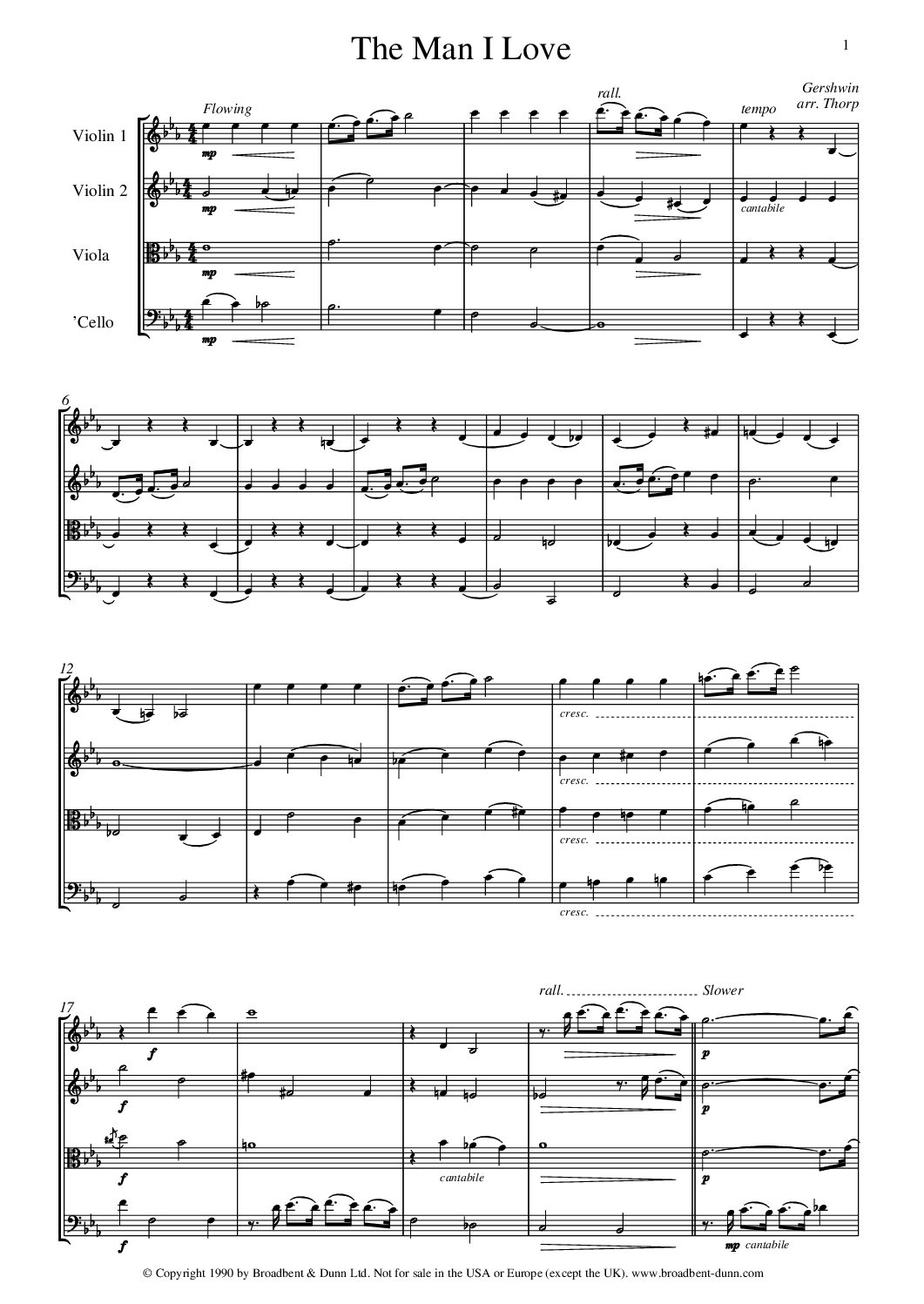
Since described as the best popular song ever written, this gem was inexplicably dropped from Lady Be Good, the Gershwins' first complete Broadway score, before it reached New York. However, it had an unlikely champion in the then Lady Mountbatten who brought her autographed copy back to London where soon nearly every band was playing it by ear, and from where its popularity spread to Paris and beyond. In this version, originally marked "not necessarily narcissistically", the arranger Bill Thorp subtly suggests the identity of the eponymous 'man'.
Gershwin, George
Since described as the best popular song ever written, this gem was inexplicably dropped from Lady Be Good, the Gershwins' first complete Broadway score, before it reached New York. However, it had an unlikely champion in the then Lady Mountbatten who brought her autographed copy back to London where soon nearly every band was playing it by ear, and from where its popularity spread to Paris and beyond. In this version, originally marked "not necessarily narcissistically", the arranger Bill Thorp subtly suggests the identity of the eponymous 'man'.

Gershwin, George
Gershwin arr. Thorp – Swanee (String Quartet) – Digital Download
Little is known of Irving Caesar's alternative lyric (and title Swansea) for this, George Gershwin's first big success (1919). Prompted by an unexpected and entirely spurious visit to Wales the following year, the new version is suffused with Celtic overtones and contains the legendary lines "I'd give the world to be, Among the folks in D-Y-F-E-D". The next port of call on the companions' short European tour (reflected in this arrangement by Bill Thorp) was Prague (aha!) where they eagerly imbued the Bohemian spirit and lifestyle of the artistic community centred on Novy Svet (literally 'New World'), the old poor quarter.
Gershwin, George
Little is known of Irving Caesar's alternative lyric (and title Swansea) for this, George Gershwin's first big success (1919). Prompted by an unexpected and entirely spurious visit to Wales the following year, the new version is suffused with Celtic overtones and contains the legendary lines "I'd give the world to be, Among the folks in D-Y-F-E-D". The next port of call on the companions' short European tour (reflected in this arrangement by Bill Thorp) was Prague (aha!) where they eagerly imbued the Bohemian spirit and lifestyle of the artistic community centred on Novy Svet (literally 'New World'), the old poor quarter.

This wistful song first appeared in George White's Scandals of 1924 and has been deservedly popular ever since. The chorus begins with the query "Somebody loves me, I wonder who?", which prompted the arranger Bill Thorp to mark this, one of his pet arrangements, "with an enquiring mind", and to musically explore possible solutions, considering Maria, Liza and Susie along the way before settling on his faithful boyhood friend (and dedicatee) 'my old dog', whose name you are invited to discover.
Gershwin, George
This wistful song first appeared in George White's Scandals of 1924 and has been deservedly popular ever since. The chorus begins with the query "Somebody loves me, I wonder who?", which prompted the arranger Bill Thorp to mark this, one of his pet arrangements, "with an enquiring mind", and to musically explore possible solutions, considering Maria, Liza and Susie along the way before settling on his faithful boyhood friend (and dedicatee) 'my old dog', whose name you are invited to discover.

Gershwin, George
Gershwin arr. Thorp – I’ll Build A Stairway To Paradise (String Quartet) – Digital Download
Here with an introduction that looks like a (slightly rickety) staircase, this song was included in George White's Scandals of 1922 at the Globe Theatre, New York, conducted by Paul Whiteman, for whom Gershwin was two years later to write Rhapsody in Blue. The song's dancing theme prompted the arranger Bill Thorp to dedicate his version to Fred Astaire; he also originally marked it to be played "horticulturally", an exotic instruction whose only justification seems to be a line from the song's second verse, wherein appears the exhortation "Get busy .... Lizzy", though it has been suggested that the chorus lyric "I've got the blues" originally read "I've got the pinks". The "fair" mentioned in the following line is thought to be the celebrated one held at the Paradise Gardens, Berghald, Switzerland.
Here with an introduction that looks like a (slightly rickety) staircase, this song was included in George White's Scandals of 1922 at the Globe Theatre, New York, conducted by Paul Whiteman, for whom Gershwin was two years later to write Rhapsody in Blue. The song's dancing theme prompted the arranger Bill Thorp to dedicate his version to Fred Astaire; he also originally marked it to be played "horticulturally", an exotic instruction whose only justification seems to be a line from the song's second verse, wherein appears the exhortation "Get busy .... Lizzy", though it has been suggested that the chorus lyric "I've got the blues" originally read "I've got the pinks". The "fair" mentioned in the following line is thought to be the celebrated one held at the Paradise Gardens, Berghald, Switzerland.

The irresistible 'S Wonderful' featured in the 1927 Broadway show Funny Face, starring Fred Astaire and his sister Adele. (Astonishingly, Fred also starred in the Paramount film of Funny Face, made 30 years later, though this time with a young Audrey Hepburn). The arranger Bill Thorp originally marked his version "natalitially", a piece of whimsy suggested by the song's opening line "Life has just begun", which seems to have induced in him a somewhat Messianic train of thought.
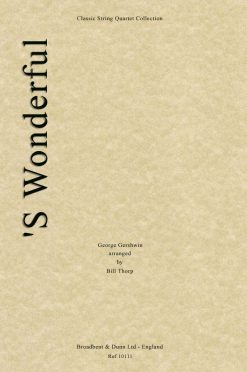
Gershwin, George
The irresistible 'S Wonderful' featured in the 1927 Broadway show Funny Face, starring Fred Astaire and his sister Adele. (Astonishingly, Fred also starred in the Paramount film of Funny Face, made 30 years later, though this time with a young Audrey Hepburn). The arranger Bill Thorp originally marked his version "natalitially", a piece of whimsy suggested by the song's opening line "Life has just begun", which seems to have induced in him a somewhat Messianic train of thought.