


£12.95
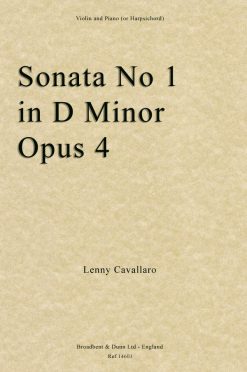
This 2014 publication might well have been composed 300 years earlier, being a truly baroque sonata in four movements (slow-fast-slow-fast). The composer has adhered not only to the harmonic and structural idioms of the time, but also to many of the other “unwritten” conventions. The work invites a great deal of freedom, and even leaves room for some improvisation. In the third movement the violin enters on a long, held note – this pattern recurs throughout, and in some ways appears to echo similar long notes in Bach’s B Minor Sonata. The last movement is a set of variations, though neither chaconne nor passacaglia – these are melodic, in the Italian manner, and clearly sound less baroque. The thematic material derives from the opening of Papageno’s aria Ein Mädchen oder Weibchen from Mozart’s Magic Flute, but transposed from F Major to D Minor. This sonata was premiered at the Lincoln Center by Bobby Portney and has subsequently been recorded by Sarah Darling and can be heard on YouTube:
https://www.youtube.com/watch?v=UigLnCPNYSw
Piece Description
This 2014 publication might well have been composed 300 years earlier, being a truly baroque sonata in four movements (slow-fast-slow-fast). The composer has adhered not only to the harmonic and structural idioms of the time, but also to many of the other “unwritten” conventions. The work invites a great deal of freedom, and even leaves room for some improvisation. In the third movement the violin enters on a long, held note – this pattern recurs throughout, and in some ways appears to echo similar long notes in Bach’s B Minor Sonata. The last movement is a set of variations, though neither chaconne nor passacaglia – these are melodic, in the Italian manner, and clearly sound less baroque. The thematic material derives from the opening of Papageno’s aria Ein Mädchen oder Weibchen from Mozart’s Magic Flute, but transposed from F Major to D Minor. This sonata was premiered at the Lincoln Center by Bobby Portney and has subsequently been recorded by Sarah Darling and can be heard on YouTube:
https://www.youtube.com/watch?v=UigLnCPNYSw
Review: “This is an absolutely outstanding composition. A truly baroque sonata written by a contemporary …. what a relief and pleasure it is to hear some ‘real’ music composed by a modern-day composer. It’s a wonderful and sincere Sonata that deserves great exposure and attention from music lovers around the world.” – Alexander Makov (Paganini Competition prize winner), New York, January 2014
Review: “It was truly an honor to present the world premier of this ‘new’ baroque sonata at Lincoln Center. It felt almost as though we were debuting the newly-found work of an 18th century composer.” – Dr. Robert Portney, January 2014
Additional information
| Media | |
|---|---|
| Composer | |
| Instrumentation | |
| Difficulty | |
| Series |
Biography
Biography
Cavallaro, Lenny
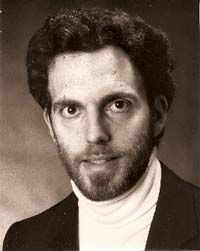
Lenny Cavallaro (born 1947) notes with some wry amusement that the top four names on Anthony Tommasini’s list of 'Top 10 Composers were Bach, Beethoven, Mozart, and Schubert. These men, he asserts, are his gods, and the geniuses whose works he seeks to emulate. The result, not surprisingly, is that most of Cavallaro’s music sounds as though it was written between 1720 and 1830. Lenny has been called "the reactionary neoclassicist", and one critic went so far as to call him "a throwback to Schubert".
Cavallaro has written two sonatas in the baroque style (for violin and piano or harpsichord, and oboe and clavier), a keyboard partita, an organ fugue, and some contrapuntal chamber music. He has written two piano sonatas in the classical style, Songs Without Words loosely modeled after Mendelssohn, and a number of more Romantic works closer to Schubert in spirit.
Cavallaro, an accomplished pianist, was a top prizewinner in the J.S. Bach International Competition for Pianists and subsequently played that composer's Six Partitas to the highest critical acclaim in Carnegie Recital Hall. He earned a Doctor of Musical Arts degree from West Virginia University. Additionally a man of letters, he served for nine years as music critic for the New Haven Register and is author or co-author of six books. He edited and revised Paganini's Fire, a novel based on the life of that legendary violinist by Ann Abelson, released in November 2011 by Stay Thirsty Press. He teaches English at Northern Essex Community College. Finally, Cavallaro is also a therapist practicing hypnosis, hyperempiria, and other healing arts. See http://www.lennycavallaromusic.com
Related products
Arrangements of Somerset folk songs to give them a new lease of life and introduce them to audiences who might never otherwise hear them. Very popular with audiences, its individual movements are useful as fillers or encores. Martock Jig and Langport March are also playable on Piccolo. It is a very direct and enjoyable work and is also versatile, with versions for flute, violin or harmonica with piano accompaniment. The original harmonica version is very idiomatically written by the composer, who was long associated with the late great virtuoso Tommy Reilly. It is folk material very well suited to the instrument. For teaching studios, conservatories, libraries, amateurs and professionals. The last movement of this work Langport March was a Trinity College London Grade 5 Exam Piece for Flute between 2007 and 2022.
Alfonso Cavallaro's Serenade, like its sister composition Tango (also published by Broadbent & Dunn), is essentially a very tonal concert piece, loosely modelled after those of Fritz Kreisler. The composition assumes the familiar 'three-part song form' and is usually performed with Tango.

Violin & Piano
Alfonso Cavallaro – Tango for Violin and Piano Opus Posth. 2 No. 2 – Digital Download
Alfonso Cavallaro's Tango, like its sister composition Serenade (also published by Broadbent & Dunn), is essentially a very tonal concert piece, loosely modelled after those of Fritz Kreisler. The composition assumes the familiar 'three-part song form' and is usually performed with Serenade.
Violin & Piano
Short modern violin and piano pieces are rare, but these can take their place amongst examples from Elgar and the like. Unpretentious and good at making friends Two Idylls attempts to capture the sense of delight in the contemplation of pastoral landscapes, and the perceived serenity of the countryside. For the city dweller passing through such vistas speak of more relaxed times and freedom from constant pressures. There is, however, an underlying sense of not belonging, and in these pieces the tranquil settings are shot through with tensions that will not go away. No specific times or places are depicted, but the composers own recall of a period spent living in the country and his feeling of loss as he looks back to those years, perhaps account for the mixed moods of these pieces.
Violin & Piano
These lyrical pieces are essentially nostalgic, although never sad. They appeal to all audiences.
"Raindrops" Fantasia, Opus 5, is essentially a set of free variations in early Romantic style. The work develops a simple three-note motif (E-D#-E) in both the minor and major modes. Each variation is quite different, with one taking the form of the Classical minuet and trio. This composition was hailed by a critic as "a throwback to Schubert", which is certainly somewhat unusual for a 21st Century publication, although Cavallaro audaciously adheres to 18th and 19th century forms, harmonic language, and structure. In this sense Lenny is a 'cultural missionary' who hopes that his compositions will encourage other composers to return to our common heritage. "Raindrops Fantasia" can be heard on YouTube with Bobby Portney on violin and Lenny Cavallaro on piano at https://www.youtube.com/watch?v=QQ8PRH9n2AM