

£18.95
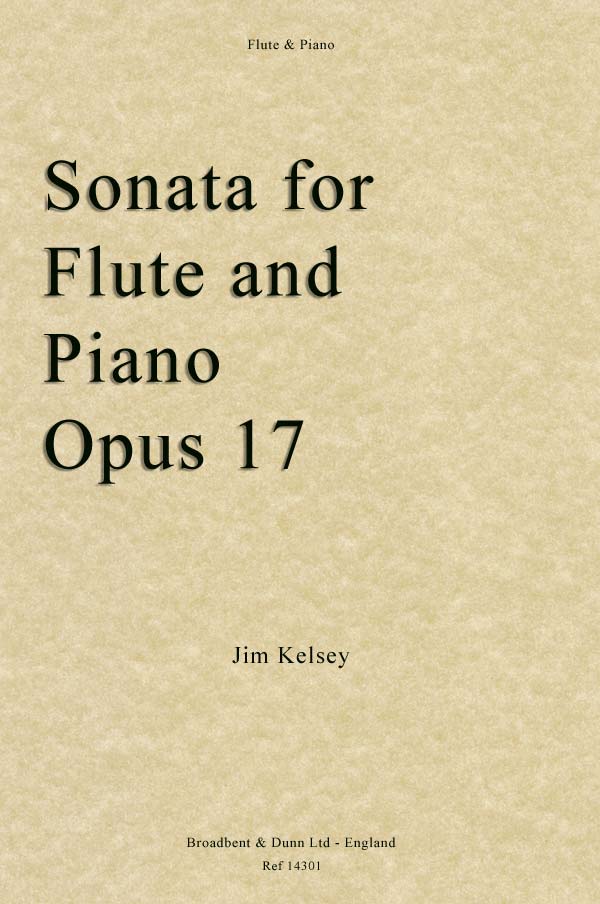
Sonata for Flute and Piano, Opus 17 is written in a late Romantic style. The first movement is constructed essentially in traditional sonata-allegro form, with an extensive coda augmenting the new material heard in the development. The passionate second movement opens with a lyrical theme that culminates into a free cadenza at the end. The third movement is written in theme and variation form. Of importance, the fifth variation is written as a four-part fugue and the final variation culminates by joining the theme of the third movement with that of the first. This work not only adds to the existing repertoire of intermediate-advanced flute music, but also teaches young people about traditional classical forms such as the rondo, theme and variations and the fugue. For the history of the composition please see Jim Kelsey’s biography. Suitable for teaching studios, secondary schools, colleges and conservatories.
Piece Description
Sonata for Flute and Piano, Opus 17 is written in a late Romantic style. The first movement is constructed essentially in traditional sonata-allegro form, with an extensive coda augmenting the new material heard in the development. The passionate second movement opens with a lyrical theme that culminates into a free cadenza at the end. The third movement is written in theme and variation form. Of importance, the fifth variation is written as a four-part fugue and the final variation culminates by joining the theme of the third movement with that of the first. This work not only adds to the existing repertoire of intermediate-advanced flute music, but also teaches young people about traditional classical forms such as the rondo, theme and variations and the fugue. For the history of the composition please see Jim Kelsey’s biography. Suitable for teaching studios, secondary schools, colleges and conservatories.
Review: “A three contrasting movement sonata with an accompaniment which is not too demanding for the pianist and fits together with the flute fairly easily. It sits well under the fingers and is nicely melodic. The second movement includes a short virtuosic cadenza and provides a balance between two faster movements. It ends with a theme and variations, always a nice addition to a concert programme I find. A very worthwhile addition to the repertoire and probably suit post grade 8 students upwards to professional looking for different music to perform in a recital.” – Dr. Rachel Smith DMA, MA, BMus (Hons), FTCL – October 2013
Review: “This sonata is very much a duo work, with the themes being shared equally between both instruments. Suitable for advanced players it begins with an exciting first movement, followed by a melancholy second movement containing technical challenges for both the pianist and the flautist. The final movement is a set of variations in a variety of tempos and styles with an impressive finish. This work would compliment a program of new music, or alternatively as a pleasing contrast to more standard flute and piano repertoire.” – Sarah Waycott & Hannah Mitchell of Tranquillo Duo, April 2013
Review: “If you are preparing a recital and have free choice of repertoire, you might like to consider this sonata which might impress examiners or a general audience. It is in the usual three movements, the first being marked Allegro with a key signature of 3 flats. The second movement moves into 5 flats and is marked Adagio. It’s slow, broad and lyrical. The third movement goes back to the original key and is slightly unusual as it is a theme and set of variations with a fugue thrown in for good measure. The composer is an American High School teacher and apparently it took six years to write this Sonata!” – Liz Goodwin of Flute Wise, December 2012
Additional information
| Media | |
|---|---|
| Composer | |
| Instrumentation | |
| Difficulty | |
| Series |
Biography
Biography
Kelsey, Jim
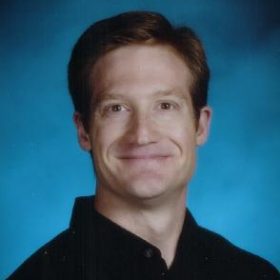
Jim Kelsey is the Director of Music at Columbia Junior High for the Fife School District in the state of Washington in the U.S.A. His junior high ensembles have achieved an impressive record of competitive and festival performances. He established a band and choral program in the Fife School District that is one of the finest and most active in the Northwest of the country. Concert, marching and jazz groups regularly perform for local events, as well as touring annually throughout Washington and Oregon. He was piano adjudicator for the Chinook Region Solo/Ensemble Contest from 2003-2007, and has been the adjudicator for the Arrow Lumber Piano Competitions since 2009, and is also an adjudicator for the Washington State Homeschool Band Festival. In 2000, 2002, and 2004 Kelsey was nominated into the ‘Who's Who Among America’s Teachers’. In 2005 he was selected as Fife School District's ‘Teacher of the Year’. Outside of Columbia Junior High he conducts ‘The Jazz Disciples’, a Christian jazz band based out of Life Center in Tacoma. He has also taught adult piano through Pierce College's extended learning program. His hobbies include spending time with his family, Star Wars, antique automobiles, model aircraft building and design, kite flying and camping. An interesting fact about Jim is that he can trace his piano instructor lineage back to Chopin, Liszt, Czerny, Beethoven, Haydn, Hummel, Mozart and J.S. Bach. Kelsey holds a Bachelor's of Music Education degree from Eastern Washington University and a Masters in Music Composition from Central Washington University. His teachers include Dr. David Rostkoski (professor of piano, Eastern Washington University), Dr. Wendal Jones (composition, Eastern Washington University), Vijay Singh (composition, Central Washington University) and Gregory Youtz (composition, Pacific Lutheran University).
Kelsey's 'Sonata for Flute and Piano, Opus 17' was composed between 1989 and 1995 and published by Broadbent & Dunn in August 2012. Jim began writing the first movement in the fall of 1988 while doing undergraduate work in music education at Eastern Washington University. The development of the first movement was inspired from listening to the introduction of Richard Wagner's Der Ring des Nibelungen and was completed in May 1989. The sonata was temporarily put on hold while Jim revised his second nocturne for trombone, which debuted in March 1990. The second movement of the flute sonata was completed in May 1990, the same month that Jim performed Beethoven's 'Emperor Concerto' with the Eastern Washington University Orchestra. The sonata was again put on hold the following year while Jim finished his Bachelor's Degree in Education. In the fall of 1991 Jim began teaching, and so it wasn't until December 1995 that he resumed work again on the sonata and finally completed it, dedicating the work to his first piano instructor Elizabeth "Betty" Mittelstaedt. The sonata received its debut performance on the 12th June 2011 at Bethany Baptist Church in Puyallup, Washington with flutist Heather Carpenter and Kelsey on the piano.
Related products
The title Seren Y Nos is Welsh for Star of the Night. This atmospheric piece by Rebecca Faith is based on a simple bass line made up of three chords but the overall result is quite complex. There are two main themes, the first heard on the piano, the second introduced by the flute - these two themes are then layered, inverted and heard in different ranges, timbres and textures to create a sound that goes far beyond two simple themes. The result is a magical sound that has a distinct enchanting impression of a vast open space, hence the title Star of the Night.
This beautiful melody arranged by Rebecca Faith is refreshed with nonchalant jazzy harmonies. The main melody is heard but then takes a different turn with a short interlude in an improvisatory style. The main melody is heard in three different keys descending each time, however the opposite effect occurs as the rich sound of the key change lifts the ambience of the music.
Flute & Piano
Penderyn is a tiny village at the edge of the Brecon Beacons and is the birthplace of the compose's grandmother. The old church of Penderyn is enclosed by trees that are home to scores of birds from which the village takes its name - 'Hill of Birds' is the English translation. The flute evokes the bird song and in the central section plays a folk style melody, while the piano takes a harp like role with an old Welsh hymn (Llef) hidden in the harmony and following the bird song.
Deliberately fun and slightly tongue in cheek, this arrangement by Rebecca Faith is challenging but highly enjoyable. The new composed melodies become as much loved as the original tune, seamlessly layered and intertwined. The descending bass line, punchy accents and shifting time signatures give this piece a sense of a 'swing' style. Definitely a piece that requires strong drive and attitude.
Arrangements of Somerset folk songs to give them a new lease of life and introduce them to audiences who might never otherwise hear them. Very popular with audiences, its individual movements are useful as fillers or encores. Martock Jig and Langport March are also playable on Piccolo. It is a very direct and enjoyable work and is also versatile, with versions for flute, violin or harmonica with piano accompaniment. The original harmonica version is very idiomatically written by the composer, who was long associated with the late great virtuoso Tommy Reilly. It is folk material very well suited to the instrument. For teaching studios, conservatories, libraries, amateurs and professionals. The last movement of this work Langport March was a Trinity College London Grade 5 Exam Piece for Flute between 2007 and 2022.
Flute & Piano
As a change from show-off bravura items this piece simply asks to be loved, and will return that feeling. Written in a very approachable style, it is well mannered enough to be taken anywhere. For colleges, conservatories and professionals.